Smart Object Localization in Smart Homes: Enhancing Elderly Care through RFID and Machine Learning
Published in Healthcare & Nursing, Bioengineering & Biotechnology, and Computational Sciences

Introduction
The global population is aging rapidly, and with this demographic shift comes a pressing need to develop sustainable, efficient, and cost-effective solutions for elderly care. One of the most promising directions in this space is the concept of aging in place, which refers to the ability of older adults to live independently and safely in their own homes for as long as possible. Achieving this vision not only preserves the dignity and autonomy of the elderly but also reduces the burden on healthcare systems and long-term care facilities. Central to making aging in place a reality is the development of smart home technologies that can monitor, assist, and adapt to the needs of aging individuals.
At the heart of many smart home systems is the ability to recognize and interpret Activities of Daily Living (ADLs). These include essential tasks such as eating, bathing, dressing, and mobility, among others. ADL recognition allows a system to assess the well-being of an individual, detect deviations from normal routines, and alert caregivers in case of emergencies. However, to monitor these activities effectively, smart systems must go beyond simple motion detection or environmental sensing—they must also understand how and when household objects are used. This leads us to a specific and vital challenge: object localization within the smart home environment.
Object localization refers to the ability of a system to determine the location of physical items within a space. For elderly care, this capability can provide fine-grained insights into daily routines. For example, if a person retrieves a kettle from the kitchen and uses it at a specific time each day, a system can infer tea-making as part of a routine. If the kettle is not moved on a certain day, the system might detect a disruption in routine, potentially signaling a problem. By localizing objects such as medication boxes, utensils, mobility aids, or appliances, caregivers and monitoring systems gain a deeper understanding of the elder's behavior and health status.
In our recent research, we explored this very challenge and proposed a practical, machine learning-based approach to object localization within smart homes using Radio Frequency IDentification (RFID) technology. RFID has long been recognized for its potential in tracking and inventory applications, but its role in smart homes—especially in support of eldercare—is still an emerging area of innovation.
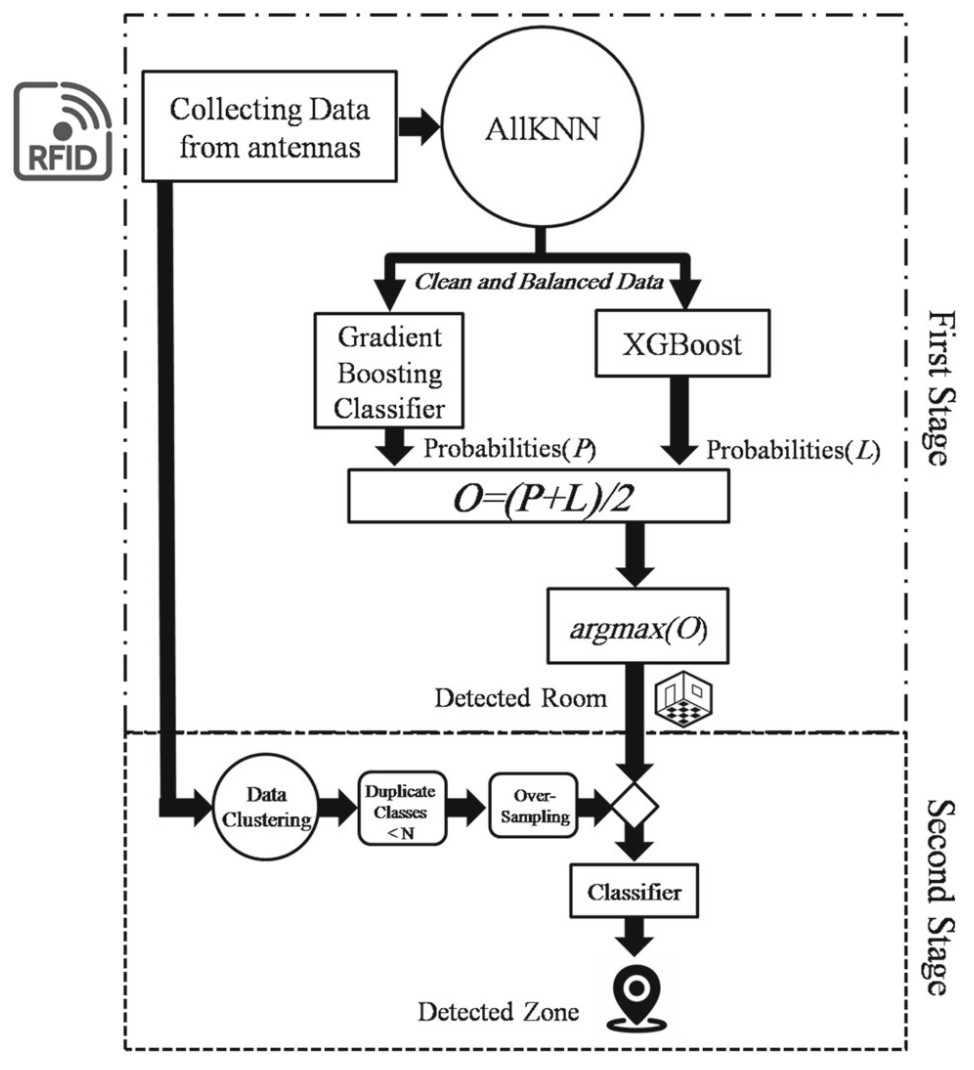
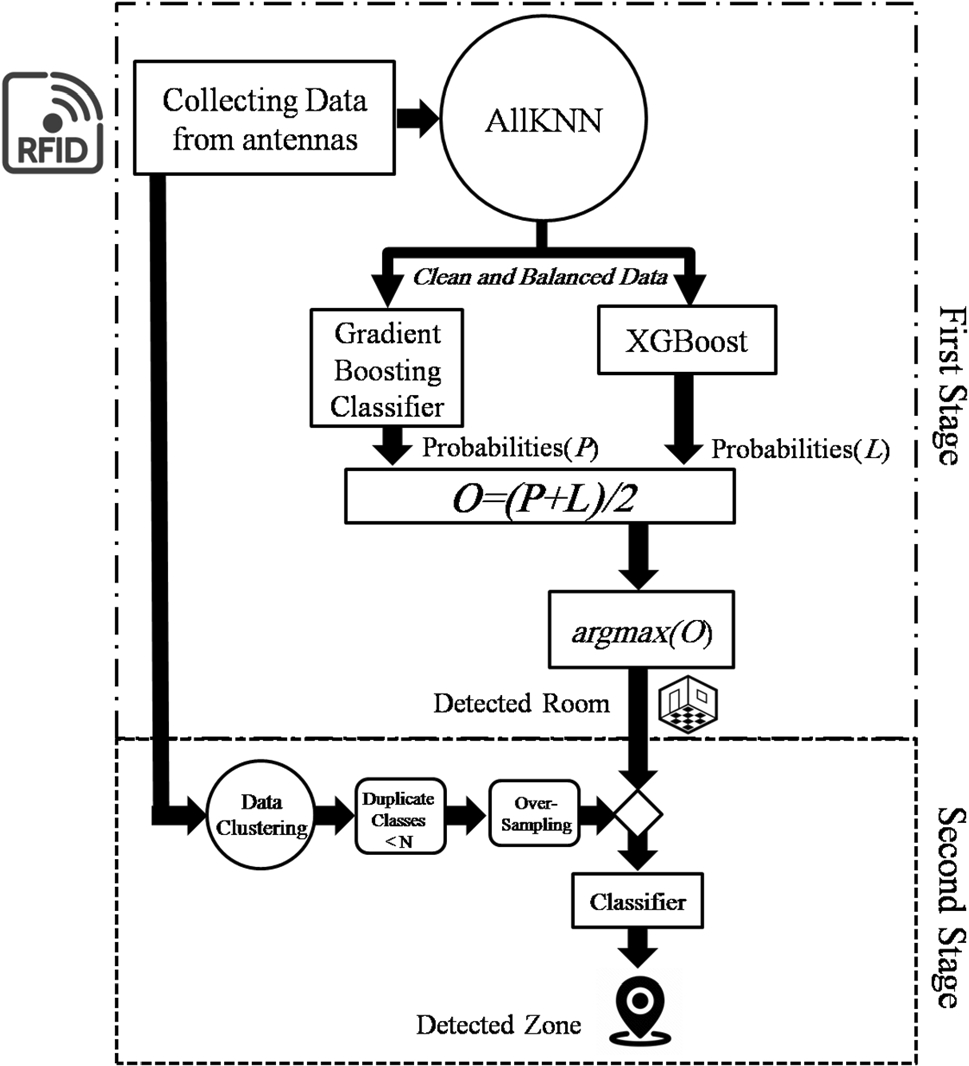
Our approach focuses on cost-effectiveness and reliability, making it particularly suitable for real-world deployment in residential environments. The proposed solution comprises two main stages:
Stage 1: Room-Level Localization
The first phase of our system is dedicated to determining the room in which a particular object is located. This high-level classification is essential as it provides contextual awareness to the system. For example, knowing that a medication box is in the bathroom as opposed to the kitchen or bedroom gives important clues about the likely activity being performed.
To achieve this, RFID tags attached to commonly used household objects. RFID readers, strategically placed throughout the home, collect signal strength and other data from these tags. This raw data is then processed using machine learning algorithms trained to recognize patterns corresponding to different rooms. Various environmental factors such as interference, furniture placement, and tag orientation are considered in the model, ensuring the classification remains robust and accurate.
Stage 2: Fine-Grained Positioning within the Room
Once the room containing the object has been identified, the next step involves pinpointing the exact location of the object within that room. This level of detail is crucial for understanding the elder's interaction with the item. For instance, distinguishing between a medication box being on a shelf versus being carried around can indicate whether medication has likely been taken.
In this second stage, we again rely on RFID tag data and apply more fine-tuned machine learning models that can handle the subtle variations in signal behavior caused by proximity, orientation, and obstacles within the room. The goal is to translate signal characteristics into a precise spatial location, effectively mapping the object's position with high accuracy.
Machine Learning Techniques
To process and analyze the RFID data effectively, we employed Gradient Boosted Decision Trees (GBDT)—a powerful and popular machine learning technique known for its performance and flexibility. GBDT models work by building an ensemble of decision trees, where each tree corrects the errors of its predecessors, leading to a strong overall predictor. In our experiments, GBDT consistently outperformed simpler models, offering both accuracy and generalizability across different home layouts and configurations.
Addressing Data Imbalance
A common challenge in machine learning, especially in real-world data, is class imbalance. Some objects or locations may naturally generate more training data than others, which can bias the model. To counter this, we employed a combination of over-sampling and under-sampling strategies. Over-sampling involves duplicating or synthetically generating samples from underrepresented classes, while under-sampling reduces the number of samples in overrepresented classes. Additionally, clustering techniques were applied to group similar data points, helping to smooth out variability and enhance model training.
These preprocessing steps played a vital role in ensuring that the model could learn effectively from the data without being skewed by inconsistencies or imbalances. They also improved the model's ability to generalize across new, unseen data—an important factor for real-world deployment.
Experimental Evaluation in Real Smart Homes
To validate our approach, we conducted extensive experiments using data collected from an actual smart home environment. The setup included multiple RFID-tagged objects, readers in different rooms, and varied object interactions over a period of time. Our evaluation criteria included accuracy and F1-score for both room-level and fine-grained localization tasks.
The results were highly promising. Our system demonstrated high localization accuracy, with the GBDT-based models consistently outperforming baseline methods. The two-stage approach—first identifying the room and then refining the object's location—proved both effective and scalable. Moreover, the use of data balancing techniques significantly improved the robustness of the models under diverse conditions.
Implications for Elderly Care and Smart Home Design
The potential applications of this work extend far beyond technical achievement. By enabling accurate object localization, smart home systems can offer more meaningful assistance to elderly individuals. For example:
-
Routine Monitoring: Systems can track daily activities and detect anomalies, such as skipped meals or missed medications.
-
Safety Alerts: If a critical item (e.g., a walking aid) is misplaced or not used for an extended period, the system can alert caregivers or family members.
-
Context-Aware Assistance: Smart assistants can offer reminders or guidance based on object usage patterns, enhancing autonomy.
-
Data-Driven Healthcare: Detailed behavior logs can support healthcare professionals in making better-informed decisions about treatment and care.
Moreover, the cost-effective nature of RFID and the scalability of machine learning models make this solution suitable for broad deployment, including low-income households or shared living facilities.
Future Directions
While our current system demonstrates strong performance, there are opportunities for further enhancement. Future work may involve:
-
Integrating additional sensor modalities (e.g., motion sensors, cameras, or pressure mats) to improve localization and activity recognition.
-
Expanding the system to support multiple occupants in a home and differentiate between users.
-
Real-time processing and alerting mechanisms that can respond dynamically to ongoing activities.

Shadi Abudalfa received his BSc and MSc degrees in Computer Engineering from the Islamic University of Gaza (IUG), Palestine, in 2003 and 2010, respectively. He earned his PhD in Computer Science and Engineering from King Fahd University of Petroleum & Minerals (KFUPM), Saudi Arabia, in 2018 on a full-student scholarship. Abudalfa has extensive teaching experience, having worked as an assistant professor at the University College of Applied Sciences, Palestine. He is currently a research scientist at KFUPM. From July 2003 to August 2004, he served as a research assistant at the Projects and Research Lab at IUG and simultaneously worked as a teaching assistant in the Faculty of Engineering. He has reviewed for numerous international conferences and journals and has served as a guest editor for Frontiers in Artificial Intelligence. His contributions include several research publications and a patent. Additionally, he has been a PI and Co-I in some funded projects. His research interests focus on data mining, human activity recognition, and Arabic natural language processing.
Follow the Topic
-
Journal of Reliable Intelligent Environments
This journal focuses on theoretical developments and lessons learnt on the deployment of Intelligent Environments (IE).

Related Collections
With Collections, you can get published faster and increase your visibility.
Engineering Reliable Intelligent Environments: Quality, Technical Debt and Trustworthy AI
Aims and Scope
Intelligent Environments are rapidly evolving through the integration of Artificial Intelligence, Foundation Models, Generative AI, edge intelligence, digital twins, robotics, pervasive sensing, and autonomous decision-making. These technologies have significantly expanded the capabilities of Intelligent Environments while simultaneously introducing new challenges regarding performance, reliability, availability, maintainability, resilience, trustworthiness, security, explainability, sustainability, and long-term evolution.
As Intelligent Environments become increasingly AI-driven, software quality can no longer be viewed as a collection of isolated non-functional properties. Performance and dependability now depend on complex interactions between traditional software engineering concerns and emerging AI-specific characteristics such as model uncertainty, data quality, explainability, fairness, robustness, continuous learning, and governance. Decisions that improve one quality attribute often introduce trade-offs with others, making the engineering of dependable Intelligent Environments considerably more challenging. For example, reliability vs. performance, accuracy vs. explainability, privacy vs. utility.
This Special Issue aims to bring together researchers and practitioners working on the engineering, validation, deployment, and evolution of Intelligent Environments that balance multiple quality objectives while embracing the opportunities and challenges introduced by modern AI technologies. We particularly encourage contributions that move beyond proof-of-concept systems and provide evidence from realistic deployments, empirical studies, industrial case studies, benchmark datasets, and reproducible evaluation methodologies.
The Special Issue welcomes, but is not limited to, the following topics:
AI Engineering and Dependability
- Reliable Generative AI for Intelligent Environments
- Large Language Models in Intelligent Environments
- Foundation Models for Smart Systems
- AI Engineering methodologies
- AI lifecycle management
- Technical debt in AI-enabled systems
- Continuous validation and monitoring of AI systems
- Sustainable/resource-efficient AI
- Agentic AI and multi-agent systems
- AI observability and LLMOps
- Reliability of GenAI systems (e.g., hallucinations, uncertainty, RAG)
- AI security, and technical debt related to data, models, and prompts.
Trustworthy AI
- Explainable AI
- Responsible AI
- Fairness and bias mitigation
- Human oversight
- Transparency and accountability
- AI governance
- Safety-critical Intelligent Environments
Software Quality
- Reliability, availability, maintainability, safety, and resilience engineering
- Software architecture for AI systems
- Quality models for Intelligent Environments
- Software evolution and maintenance
- Self-adaptive systems
- Runtime verification
- Resilience and fault tolerance
Performance and Dependability Modeling and Assessment
- AI- and LLM-assisted generation, evolution, parameterization, and validation of performance and dependability models
- Stochastic and probabilistic modeling, including Petri nets, Markov chains, queueing networks, and stochastic workflows
- Hierarchical and multimodel approaches
- Digital twins for performance and dependability assessment
- Performance and dependability assessment of IoT, cloud–fog–edge, and cyber-physical systems, including reliability, availability, maintainability, safety, and resilience
Verification and Validation
- Testing AI-enabled systems
- Verification of autonomous systems
- Model validation
- Benchmarking methodologies
- Reproducibility and replicability
- Digital twins for validation
- Formal methods
Data and Learning
- Data quality assessment
- Synthetic data generation
- Continual learning
- Federated learning
- Edge AI
- Privacy-preserving AI
- Secure machine learning
Human-Centred Intelligent Environments
- Human-AI collaboration
- User trust
- User experience
- Accessibility
- Inclusive Intelligent Environments
- Adaptive interfaces
Applications
- Healthcare
- Smart cities
- Ambient Assisted Living
- Robotics
- Industry 5.0
- Smart transportation
- Education
- Agriculture
- Energy systems
Empirical Research
- Industrial experience reports
- Longitudinal studies
- Deployment experiences
- Lessons learned
- Replication studies
- Systematic literature reviews
- Mapping studies
- Benchmark datasets
If you are unsure whether your work would fit the scope of this special issue, please contact the guest editors, by sending an email to a.santokhee@mdx.ac.mu, carlosrodriguez@ugr.es, and/or
Peer-review process:
All submitted papers, provided they are original and somehow related to the theme of this Special Issue, will undergo a rigorous peer-review process with at least three reviewers. Please also note that only unpublished articles, which are not under consideration for publication elsewhere will be considered for publication in this special issue.
Submission procedure:
Manuscripts should be prepared according to the instructions for authors of the Journal of Reliable Intelligent Environments and submitted through Snapp, which can be accessed via the "submit your manuscript" option on the journal homepage: https://link.springer.com/journal/40860. Authors should register and upload their manuscript text, tables, and figures, as well as subsequent revisions, through this website. When submitting a paper for this Special Issue (S.I.), please be sure to select the corresponding option from the Collection drop-down list on the Details page. Thus, the submission will be managed in the review process for this S.I. instead of being considered as a regular paper submission to the journal.
Publishing Model: Hybrid
Deadline: Nov 15, 2026