Stability Analysis of p-GaN Gate AlGaN/GaN HEMTs Under High Voltage Stress
Published in Electrical & Electronic Engineering and Materials

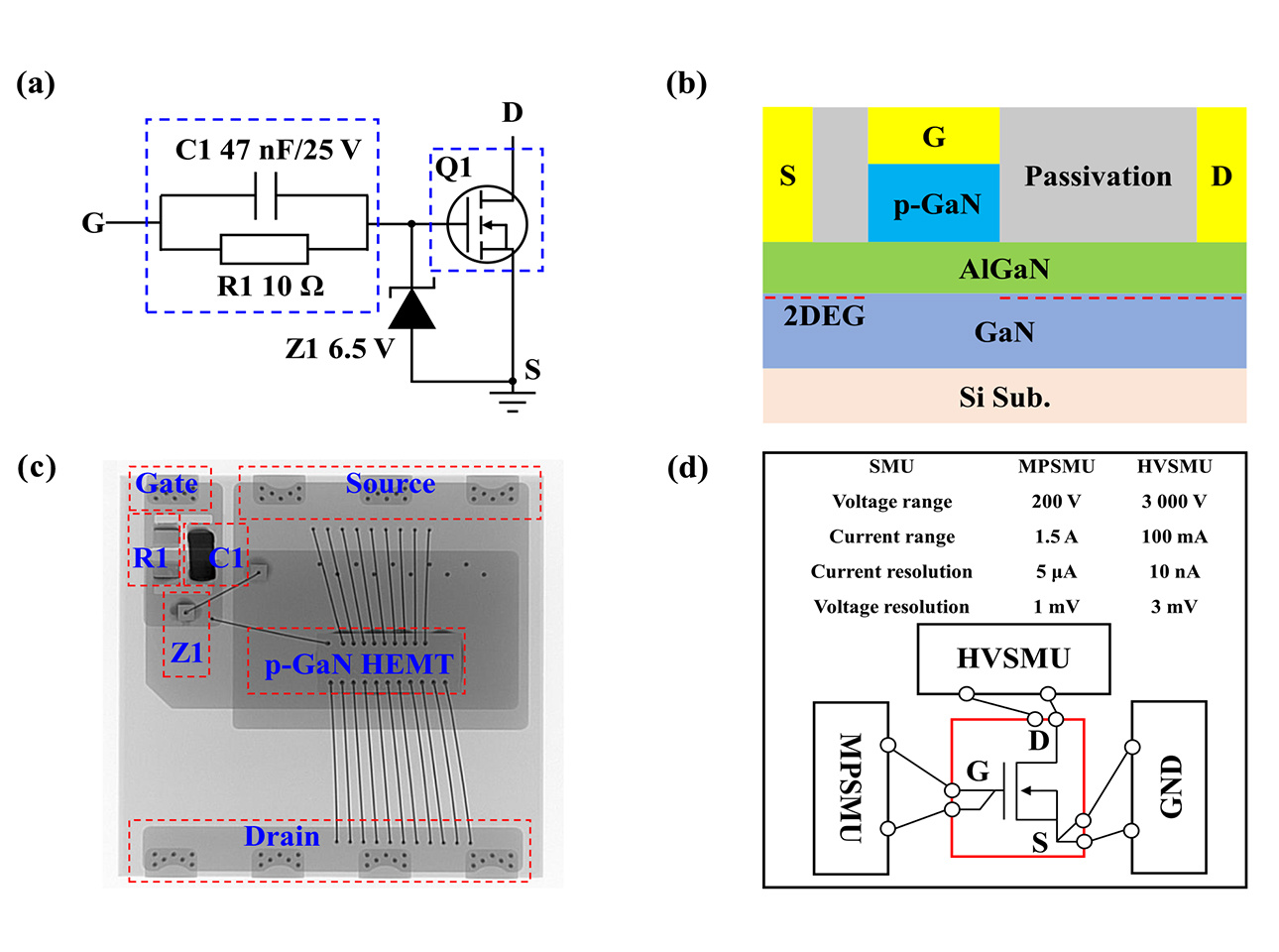





The reliability of gallium nitride (GaN)-based high-electron-mobility transistors (HEMTs) is critical for their adoption in high-power applications such as electric vehicles, 5G infrastructure, and renewable energy systems. Among these devices, p-GaN gate HEMTs have emerged as promising candidates for enhancement-mode operation. However, their long-term stability under extreme electrical stress remains a key concern. This study systematically investigates the threshold voltage (VTH) instability of p-GaN gate AlGaN/GaN HEMTs under static and dynamic drain stress, providing actionable insights for device optimization.
Key Experimental Findings
- VTH Shift Under Drain Stress
- Pulsed I-V measurements revealed a significant positive VTH shift (ΔVTH ) as drain voltage increased from 0 V to 650 V, with a maximum ΔVTH of 0.7 V observed.
- At 200 V drain bias, ΔVTH reached 0.4 V but saturated under prolonged stress, indicating a self-limiting degradation mechanism.
- Recovery Dynamics
- Post-stress recovery analysis demonstrated that ΔVTH gradually diminished after stress removal. At 300 V, an initial rapid recovery was followed by a negative ΔVTH shift, attributed to electron injection via gate-drain capacitance (CGD).
- Temperature-dependent studies (25–150℃) showed accelerated ΔVTH recovery at elevated temperatures, with 150℃ conditions reducing recovery time by over 60% compared to room temperature.
- Mechanistic Insights
- The instability originated from hole depletion in the p-GaN layer under high electric fields. Stress removal allowed hole replenishment through capacitor discharge, mitigating VTH shifts.
- No permanent degradation was observed, confirming the robustness of p-GaN gate structures under transient stress conditions.
Technological Implications
The findings directly address a critical barrier to GaN power device commercialization. By elucidating the interplay between electrical stress, temperature, and recovery kinetics, this work enables:
- Circuit-Level Solutions: Integration of passive components with p-GaN HEMTs to stabilize VTH in high-voltage environments.
- Thermal Management Strategies: Leveraging temperature-accelerated recovery for system design optimization.
- Reliability Prediction Models: Data-driven frameworks to forecast device lifetimes under real-world operating conditions.
Challenges and Future Directions
While the study establishes foundational knowledge, several challenges remain:
- Material-Level Optimization:Further reduction of interface trap densities in p-GaN/AlGaN heterostructures.
- System Integration:Development of compact models incorporating stress-dependent parameters for circuit simulation.
- Standardized Testing Protocols: Establishment of industry benchmarks for dynamic stress characterization.
Future research should prioritize hybrid approaches combining device physics insights with advanced characterization techniques (e.g., in-situ TEM, deep-level transient spectroscopy) to unlock the full potential of GaN-based power electronics.
Toward a p-GaN gate HEMTs Future
This work demonstrates that p-GaN gate HEMTs exhibit recoverable VTH instability under high drain stress, with performance metrics surpassing traditional silicon-based devices. The proposed integration strategies and mechanistic understanding provide a clear pathway for deploying GaN technology in next-generation power systems, aligning with global sustainability goals through improved energy efficiency and reduced material waste.
Follow the Topic
-
Moore and More
This is the first top-tier journal dedicated to Beyond Moore technology in the field of integrated circuit.