Surrogacy in Singapore - Should the Current Ban be Lifted?
Published in Healthcare & Nursing, Social Sciences, and General & Internal Medicine
Please read the following articles:
The Case for Legalizing And Regulating Surrogacy in Singapore
Should Singapore Rethink Its Surrogacy Ban?
Should Singapore legalize surrogacy to better protect all parties involved?
Proposed ethical guidelines and legislative framework for permitting gestational surrogacy in Singapore
Should Singapore Rethink Its Surrogacy Ban?
Singapore is facing two big demographic pressures at the same time: people are having fewer children, and the population is getting older.
Against that backdrop, one difficult question is returning to public debate: should surrogacy remain completely banned, or should it be allowed under strict rules?
The second option is strongly advocated, but not for a free-for-all. Its preferred starting point is a narrow, tightly supervised system based on altruism rather than profit, with access initially limited to married heterosexual couples who have genuine medical need.
The proposal is controversial. Surrogacy may offer some people a route to parenthood, but it also raises difficult questions about consent, money, pregnancy risks, parenthood, and the child’s rights.
The issue is therefore not simply whether to legalise surrogacy, but whether clear domestic rules would be safer and preferable to cross-border arrangements in legal grey areas.
What Does Surrogacy Mean?
In gestational surrogacy, an embryo created through assisted reproductive treatment is transferred to another woman, who carries the pregnancy and gives birth.
The woman who carries the pregnancy is commonly called the surrogate. The people who intend to raise the child are the intended parents.
The process can involve medical treatment, counselling, contracts and decisions about who is legally recognised as a parent. That is why surrogacy is not only a fertility issue; it is also a legal, ethical and child-welfare issue.
Where Singapore Currently Stands With Regard To Surrogacy
Singapore’s current healthcare rules effectively prohibit gestational surrogacy. Assisted reproduction access is currently being limited to women legally married to men, excluding single women and same-sex couples.
The main concern is that an outright ban may push people to seek arrangements overseas. That can leave uncertainty about legal parenthood, the child’s immigration status, surrogate protections, clinical oversight, and what happens when adults disagree.
Ambiguity could arise from:
- Who the child’s legal parents are?
- Whether the child can enter Singapore and secure residency or citizenship status?
- What protections the surrogate has?
- Whether clinics or agencies are properly supervised?
- What happens if the intended parents and surrogate disagree?
A domestic framework could resolve these questions in a transparent system with defined responsibilities for doctors, lawyers, social workers, and regulators.
The question is therefore not only whether Singapore should permit surrogacy locally. It is also whether the present gap — domestic medical prohibition combined with possible, but uncertain, post-birth immigration, and parentage routes — protects children and adults as well as a clear regulatory system would.
For intended parents, the practical lesson is straightforward: overseas surrogacy should not be treated as a guaranteed workaround for Singapore’s domestic ban.
Before entering an arrangement, they would need advice on the law of the country where the procedure will occur, Singapore family law, immigration requirements, citizenship, adoption, and the child’s long-term welfare. The same uncertainty is precisely why a transparent domestic framework is advocated.
Surrogacy is thus a legal grey area in Singapore. The overseas medical procedure may take place under the law of another country, while the child’s arrival, parentage, adoption, residency rights, and citizenship are later considered under Singapore law.
The overseas contract may be valid where it was made, but that does not necessarily determine who Singapore recognises as the legal parent or whether an adoption order will be granted.
Singapore’s current framework regulates what licensed assisted-reproduction providers may do inside Singapore.
The Health Sciences Authority’s current guidance requires a licence for services such as handling or transferring reproductive cells or embryos, while the Singapore Medical Association has described domestic surrogacy as prohibited, but noted that there is no law specifically regulating Singaporeans’ participation in surrogacy procedures abroad.
How The Offspring Of Surrogacy Are Impacted By Legal Ambiguity
Singapore’s Immigration and Checkpoints Authority (ICA) citizenship and permanent residency regulations list an unmarried child below 21 who was born within a legal marriage to, or legally adopted by, a Singapore citizen as eligible to apply.
The ICA also states it considers factors such as family ties, the applicant’s circumstances and the person’s integration into Singapore.
Its fee schedule separately identifies some overseas-born children where the gestational mother is a Singapore citizen, or where the father is a Singapore citizen and married to the gestational mother.
Other overseas-born children fall under a different application category. These distinctions show why a surrogacy case cannot be assessed from the intended parent’s nationality alone.
Hence, the legal parent-child relationship and any adoption or court order may therefore be central to citizenship and permanent residency applications for children born from surrogacy.
According to ICA regulations, Singapore does not register births that occurred overseas. Parents must first obtain the overseas birth certificate and then submit a Singapore citizenship application for the child through ICA.
This wording matters: an application is required; returning to Singapore is not the same thing as automatic citizenship.
Hence, there is no simple rule that says, “If Singapore citizens arrange surrogacy overseas, the child automatically becomes a Singapore citizen or permanent resident.” The practical pathway may still exist, but it is fact-sensitive and involves separate decisions.
Bringing The Child Home Does Not Automatically Create Singapore Status
The High Court’s decision in the landmark court case UKM v Attorney-General illustrates the tension. The case involved a Singaporean gay man whose son was conceived through IVF and born to a paid surrogate in the United States.
The child was brought to Singapore, and the applicant sought an adoption order. The Court ultimately considered adoption to be in the child’s welfare interests, because it could strengthen the prospects of regularising the child’s citizenship or residency.
At the same time, the judgement recorded that under Singapore law, based on the facts before it, the child was treated as a non-citizen and as born out of wedlock.
The decision was about the child’s welfare and the adoption application; it was not a general approval of overseas commercial surrogacy or a promise that every similar case would receive the same result.
A useful way to understand this is as a gap between “possible in practice” and “guaranteed in law.”
Why Supporters Say Regulation Could Help
It could create a path to parenthood for some infertile couples: For some people, ordinary IVF may not be medically possible — for example, when a woman cannot safely carry a pregnancy.
Surrogacy could provide a route to parenthood and, depending on the arrangement, a genetic link to at least one intended parent.
It could reduce risky cross-border arrangements: Cross-border arrangements can create conflicting legal assumptions about parenthood, paperwork and the child’s status. Domestic rules could clarify expectations before treatment and after birth.
It could protect the surrogate from pressure and exploitation: Regulation could require independent counselling, medical screening, informed consent and legal advice. It could also prevent clinics from recruiting surrogates or controlling payments.
It could put the child’s interests at the centre: A child should not be left in legal limbo because adults disagree or because a cross-border arrangement was poorly documented. Clear rules could address parenthood, financial responsibility, medical care and disputes.
The Major Caution: Regulation Is Not The Same As Permission Without Limits
Legalisation would not remove risk. Pregnancy can be medically dangerous, money can create pressure, and contracts cannot predict every emotional or medical event.
The proposed model therefore rejects commercial surrogacy at the outset. Payments would be limited to documented reimbursement of direct expenses, with audits designed to prevent hidden or excessive payments.
The model also calls for independent oversight rather than leaving decisions entirely to private clinics or agencies.
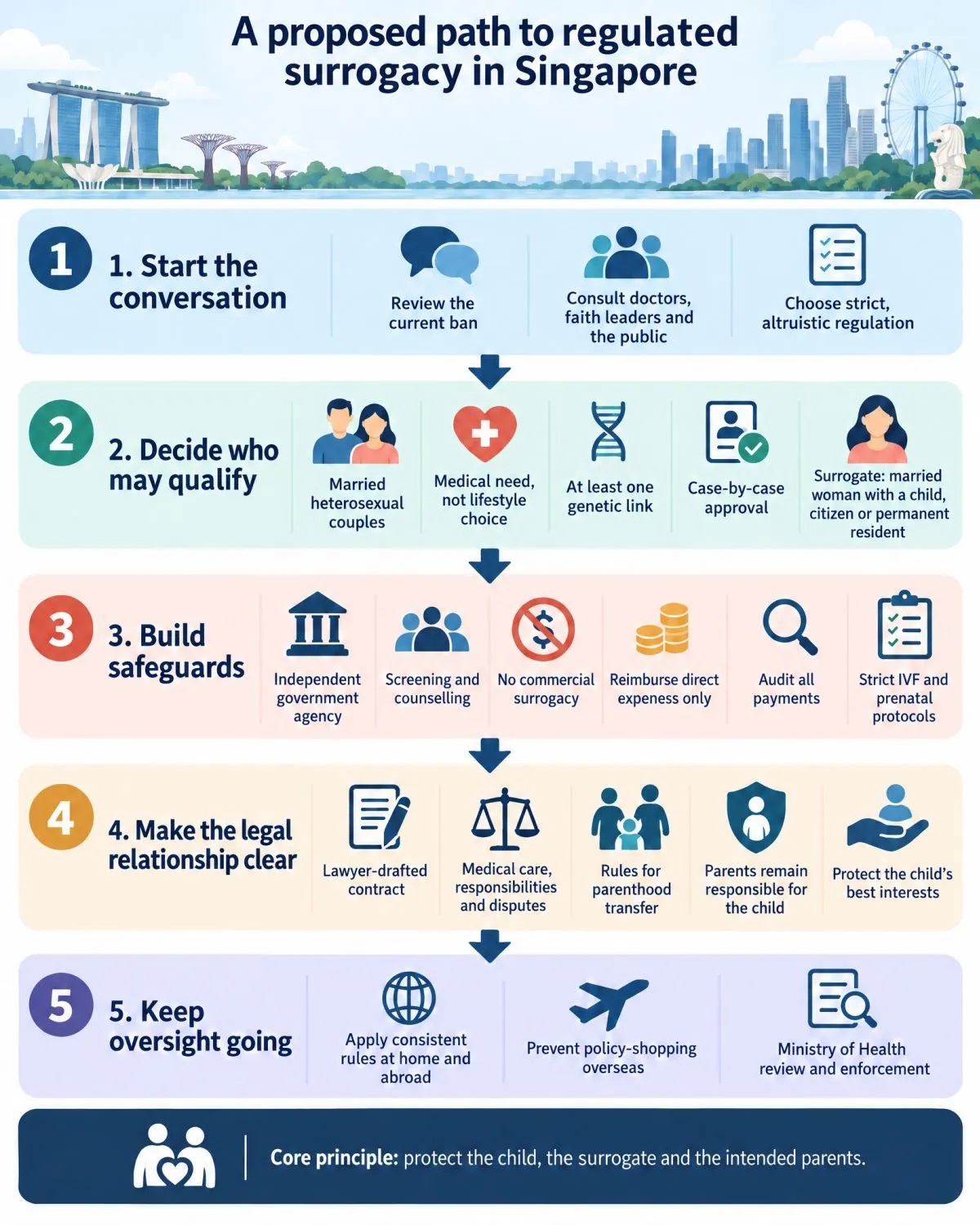
The following is a proposed five-phase pathway for legalising and regulating surrogacy in Singapore:
- Begin with public policy and consultation.
- Define who may participate.
- Build independent safeguards.
- Make parenthood and contracts legally clear.
- Keep the system under continuous review.
Phase 1: Start With Public Discussion
The government would first clarify whether it intends to lift the ban. It would then consult health care professionals, religious and community leaders, and the wider public.
It is suggested that legalized surrogacy in Singapore should begin with a narrow, less commercial model before considering whether a broader system might ever be appropriate.
Phase 2: Set Strict Eligibility Rules
The proposed starting points:
- Intended parents would be married heterosexual couples.
- Surrogacy would require a medical reason, not simply convenience or lifestyle preference.
- At least one intended parent would need a genetic link to the child.
- Each case would require official review.
- Surrogates would generally be married women who already have a child and are Singapore citizens or permanent residents.
These criteria reflect an attempt to fit reform within Singapore’s conservative family-policy environment.
They also make the proposal explicitly exclusionary: legalized surrogacy does not initially extend access to single people or de facto same-sex couples.
Phase 3: Build An Independent Safety System
The proposal calls for a government-affiliated agency under the Ministry of Health (MOH) to oversee both local and overseas cases. Its job could include:
- Checking the eligibility of intended parents and surrogates.
- Arranging independent counselling and social-work support.
- Reviewing contracts and monitoring payments.
- Keeping records and helping resolve disputes.
The proposal also includes stringent medical oversight, such as careful use of IVF, restrictions on third-party egg donation and a documented—but non-binding-agreement about possible prenatal findings (e.g. Down syndrome).
That last point is especially sensitive: it is suggested that adults should discuss possible outcomes in advance, but the agreement would not remove the need for individual medical and ethical decision-making.
Phase 4: Make Parenthood And Responsibility Clear
It must be noted that under current Singapore family law, the woman who gives birth is generally treated as the legal mother.
A future framework would therefore need a clear route for transferring legal parenthood to the intended parents, potentially through an amended adoption or parental-order process.
Contracts would need to be drafted by lawyers and approved through the proper regulatory or judicial channel. They would cover medical care, parental responsibilities, dispute resolution and fair expense reimbursement.
It is also proposed that the intended parents should remain financially responsible for raising the child, including when the child is born with serious health or developmental needs.
Phase 5: Keep Reviewing And Enforcing The Rules
Finally, the MOH would continuously review the system. It is argued that domestic and overseas arrangements should be treated consistently and that people should not be able to bypass Singapore’s policy simply by travelling abroad.
This is one of the most contentious parts of the proposal because it could affect families formed outside Singapore.
It would require careful consideration of child welfare, immigration status, parenthood, and the limits of Singapore’s legal reach.
What The Proposal May Get Right And What Remains Unresolved
The proposal could improve predictability, add independent screening and counselling, reduce hidden payments, clarify parenthood and make financial responsibility for the child explicit.
Nevertheless, the following questions still remain unresolved:
- How would the system protect a surrogate who changes her mind or experiences medical complications?
- What happens if the intended parents and surrogate dispute on whether an abnormal foetus (e.g. Down syndrome) should be aborted?
- Would restricting access to married heterosexual couples be fair and compatible with evolving views of family?
- How would the government handle children born through overseas arrangements?
These questions determine whether regulation genuinely protects people or merely gives an unequal arrangement a legal appearance.
The Bigger Policy Choice
Surrogacy is part of a wider debate about family formation in a rapidly changing Singapore. Younger people may be more open to varied family structures, while current policy favours traditional heterosexual marriage.
The proposed compromise is gradualism: begin with a narrow, altruistic framework for severe medical cases and genuine need, build oversight and trust, then review the model over time.
Whether this is acceptable depends on whether Singapore prioritizes political practicality or equal access to parenthood.
The case is not that surrogacy is simple or risk-free. It is that a local controlled system could be safer and more transparent than a ban that pushes intended parents abroad.
A workable framework would need to protect the surrogate’s informed choice, the intended parents’ responsibilities and the child’s long-term legal security, while keeping profit and coercion out.
This remains a policy proposal, not a new legal route. Reform would require legislation, detailed regulations, public consultation and ongoing scrutiny.