Sustainable farming and fire risk management using IoT and MQTT technologies for enhancing food security
Published in Electrical & Electronic Engineering and Sustainability
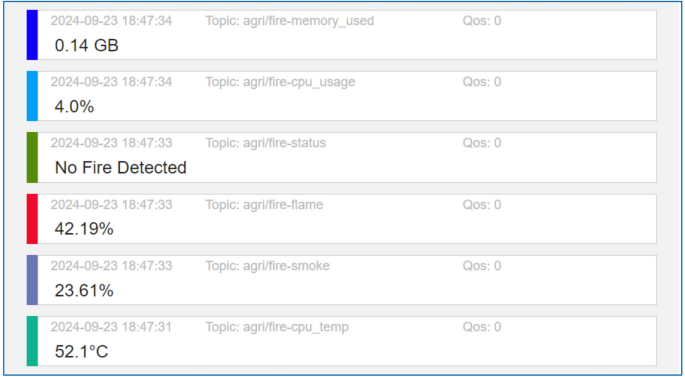

Agricultural fires can cause significant losses to crops, infrastructure, and natural resources, while directly threatening food security. Early detection is therefore essential to limit damage and enable intervention before the situation becomes critical. The paper “Sustainable Agriculture and Fire Risk Management Using IoT and MQTT Technologies to Strengthen Food Security” presents an IoT system designed to provide continuous monitoring of fire risks in agricultural environments. The solution is based on a Raspberry Pi 3 B+, paired with sensors capable of detecting the presence of flames and smoke. The proposed architecture consists of three complementary layers: a local layer dedicated to data acquisition and processing, an HiveMQ MQTT broker that transmits data using a “publish/subscribe” architecture, and an interface providing real-time access to critical information. This structure effectively links physical monitoring in the field to a communication infrastructure tailored to connected agricultural applications.
Experiments show that the system can transmit up to 5,400 messages across six MQTT topics in 30 minutes, while monitoring processor performance, memory usage, and temperature to limit resource consumption. ROC curve analysis also made it possible to determine optimized detection thresholds of 50% for smoke and 60% for flames. Further, the results show particularly encouraging performance, with an accuracy of 92.9%, a precision of 86.4%, a recall of 100%, an F1-score of 92.7%, and a specificity of 87.0%. The AUC values also reached 0.947 for smoke and 0.967 for flame, confirming the system’s strong ability to distinguish between situations with and without a fire risk.
Beyond detection, the main advantage of this approach lies in its ability to provide real-time monitoring using a relatively lightweight embedded infrastructure. The use of the IoT and the MQTT protocol thus paves the way for solutions that can improve fire prevention while contributing to crop protection, food security, and the sustainability of agricultural systems. This approach also paves the way for more advanced monitoring systems that incorporate artificial intelligence, edge computing, and automated decision-making mechanisms. Such developments could enable better anticipation of high-risk situations and the implementation of agricultural systems capable of responding more quickly to critical events. The challenge ahead will therefore be to evolve these solutions into even more autonomous, energy-efficient, and robust architectures capable of operating under real-world agricultural conditions and across vast areas. The gradual integration of the Internet of Things (IoT), artificial intelligence, and smart communication systems could thus help make the agricultural sector more resilient to climate and environmental risks.

Dr. Abdennabi Morchid holds a Master’s degree in Microelectronics, Signals, and Systems (2ME2S) and a Ph.D. in Electrical Engineering and Internet of Things (IoT) from the Faculty of Sciences Dhar El Mahraz (FSDM), Sidi Mohamed Ben Abdellah University (USMBA), Fez. He is a member of the LIMAS laboratory at FSDM, where his research focuses on designing and developing advanced embedded systems that integrate IoT, cloud computing, and blockchain for smart farming applications. His work addresses critical challenges in food security and sustainable agriculture, with particular emphasis on smart irrigation and fire detection. Dr. Morchid has authored several papers in high-quality journals and has served as a reviewer for more than 100 scientific articles in journals published by Springer, Elsevier, Taylor and Francis, MDPI, and others. Dr. Abdennabi Morchid is actively engaged in several editorial initiatives. He serves as an Editorial Board Member for Discover Sustainability (Q1, Springer Nature, 2025) and contributes to editorial development for the forthcoming book Innovative Production Methods for Sustainable Agriculture (IET, 2025, in progress). He is also involved in organizing the Special Issue on Smart Energy Management for Sustainable Agriculture (ICEF’26, 2026). In addition, he has completed comprehensive editorial training through the Springer Nature Editorial Academy (2025), strengthening his expertise in peer review, editorial decision-making, and journal management.He has also contributed to the organization of international conferences. His research interests include smart farming, agricultural innovation, food security, sustainability, water management, IoT, cloud computing, blockchain, embedded systems, sensors, fuzzy logic, MQTT, HTTP, and artificial intelligence. He can be reached at abdennabi.morchid@usmba.ac.ma.
Follow the Topic
What are SDG Topics?
An introduction to Sustainable Development Goals (SDGs) Topics and their role in highlighting sustainable development research.
Continue reading announcement
Please sign in or register for FREE
If you are a registered user on Research Communities by Springer Nature, please sign in