When Machine Learning Meets Blockchain: Toward Smart, Reliable, and Sustainable Agriculture
Published in Electrical & Electronic Engineering, Sustainability, and Mathematical & Computational Engineering Applications
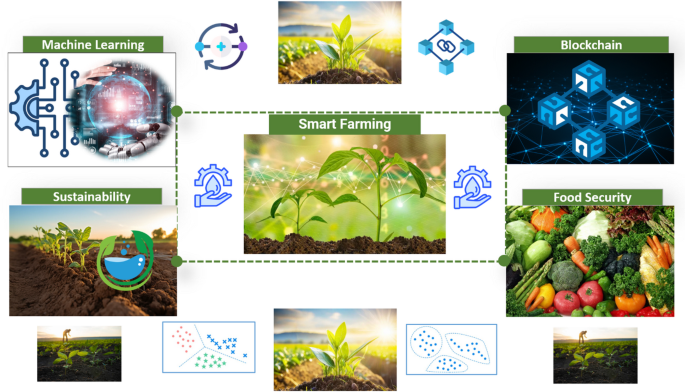

Smart farming is evolving rapidly thanks to the integration of machine learning, blockchain, and the Internet of Things (IoT) technologies. Machine learning enables the use of agricultural data to improve crop monitoring, disease detection, yield forecasting, and resource management. Blockchain adds a complementary dimension by enhancing data security, transparency, and traceability.
The article “Review of Machine Learning and Blockchain Integration for Crop Monitoring and Management in Smart Farming” provides a systematic review of this emerging field. Using a methodology based on the PRISMA principles, 127 scientific publications were analyzed to identify the main applications, technological approaches, benefits, limitations, and research prospects.
The results show that combining machine learning and blockchain technology can foster the development of smarter, more reliable, and more transparent agricultural systems. Integrating these technologies with the Internet of Things (IoT), edge computing, and cloud computing also paves the way for more connected agricultural architectures tailored to on-the-ground needs.
However, several challenges remain, particularly regarding data quality, interoperability, scalability, privacy, and energy efficiency. Future research should therefore focus on integrated and robust solutions that can be applied in real-world agricultural conditions, in order to contribute to a more sustainable, resilient, and resource-efficient agricultural sector.

Dr. Abdennabi Morchid holds a Master’s degree in Microelectronics, Signals, and Systems (2ME2S) and a Ph.D. in Electrical Engineering and Internet of Things (IoT) from the Faculty of Sciences Dhar El Mahraz (FSDM), Sidi Mohamed Ben Abdellah University (USMBA), Fez. He is a member of the LIMAS laboratory at FSDM, where his research focuses on designing and developing advanced embedded systems that integrate IoT, cloud computing, and blockchain for smart farming applications. His work addresses critical challenges in food security and sustainable agriculture, with particular emphasis on smart irrigation and fire detection. Dr. Morchid has authored several papers in high-quality journals and has served as a reviewer for more than 100 scientific articles in journals published by Springer, Elsevier, Taylor and Francis, MDPI, and others. Dr. Abdennabi Morchid is actively engaged in several editorial initiatives. He serves as an Editorial Board Member for Discover Sustainability (Q1, Springer Nature, 2025) and contributes to editorial development for the forthcoming book Innovative Production Methods for Sustainable Agriculture (IET, 2025, in progress). He is also involved in organizing the Special Issue on Smart Energy Management for Sustainable Agriculture (ICEF’26, 2026). In addition, he has completed comprehensive editorial training through the Springer Nature Editorial Academy (2025), strengthening his expertise in peer review, editorial decision-making, and journal management.He has also contributed to the organization of international conferences. His research interests include smart farming, agricultural innovation, food security, sustainability, water management, IoT, cloud computing, blockchain, embedded systems, sensors, fuzzy logic, MQTT, HTTP, and artificial intelligence. He can be reached at abdennabi.morchid@usmba.ac.ma.
Follow the Topic
What are SDG Topics?
An introduction to Sustainable Development Goals (SDGs) Topics and their role in highlighting sustainable development research.
Continue reading announcement
Please sign in or register for FREE
If you are a registered user on Research Communities by Springer Nature, please sign in