Teaching differently, eating differently: how collaborative learning transformed adolescent diet quality in Ogun State, Nigeria
Published in Healthcare & Nursing and Education


When I first started teaching nutrition to teenagers and adolescents in Ogun State, something troubled me: students could recite facts about balanced diets but weren't making healthier choices at the school canteen. They knew what to eat; that knowledge just wasn't reaching their plates. That gap between knowledge and behaviour had been nagging at me for years. When we finally designed a study to tackle it, we didn't just ask whether nutrition education worked — we asked whether the way we taught it made any difference at all.
The problem behind the problem
Nigeria's adolescents carry a dual burden: persistent micronutrient deficiencies on one hand, and rapidly rising rates of overweight, obesity, and diet-related noncommunicable diseases on the other. In Ogun State specifically, young people navigate between traditional dietary patterns and an expanding market for ultra-processed foods, sugar-sweetened beverages, and fast food. Schools represent one of the few settings where adolescents can be reached consistently and at scale — yet nutrition education in Nigerian secondary schools remains inconsistent, mostly embedded in broader health lessons, and delivered the way it has always been: a teacher at the front, a class of students passively listening. We wanted to test something different.
What we did
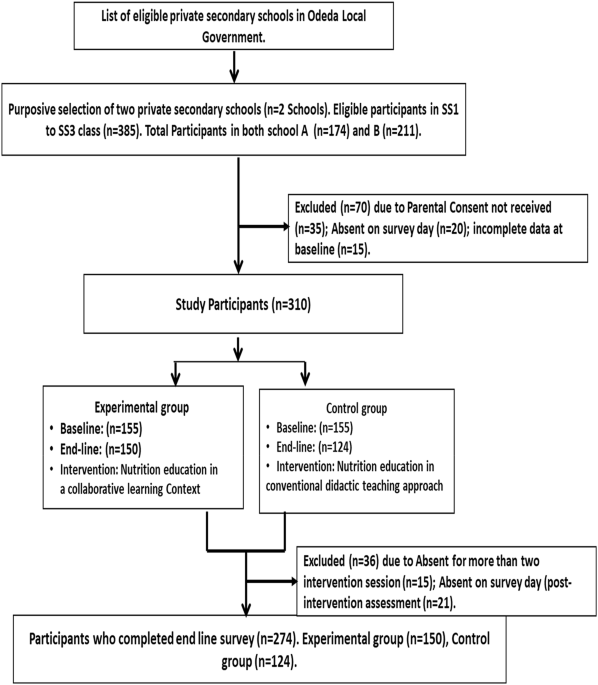
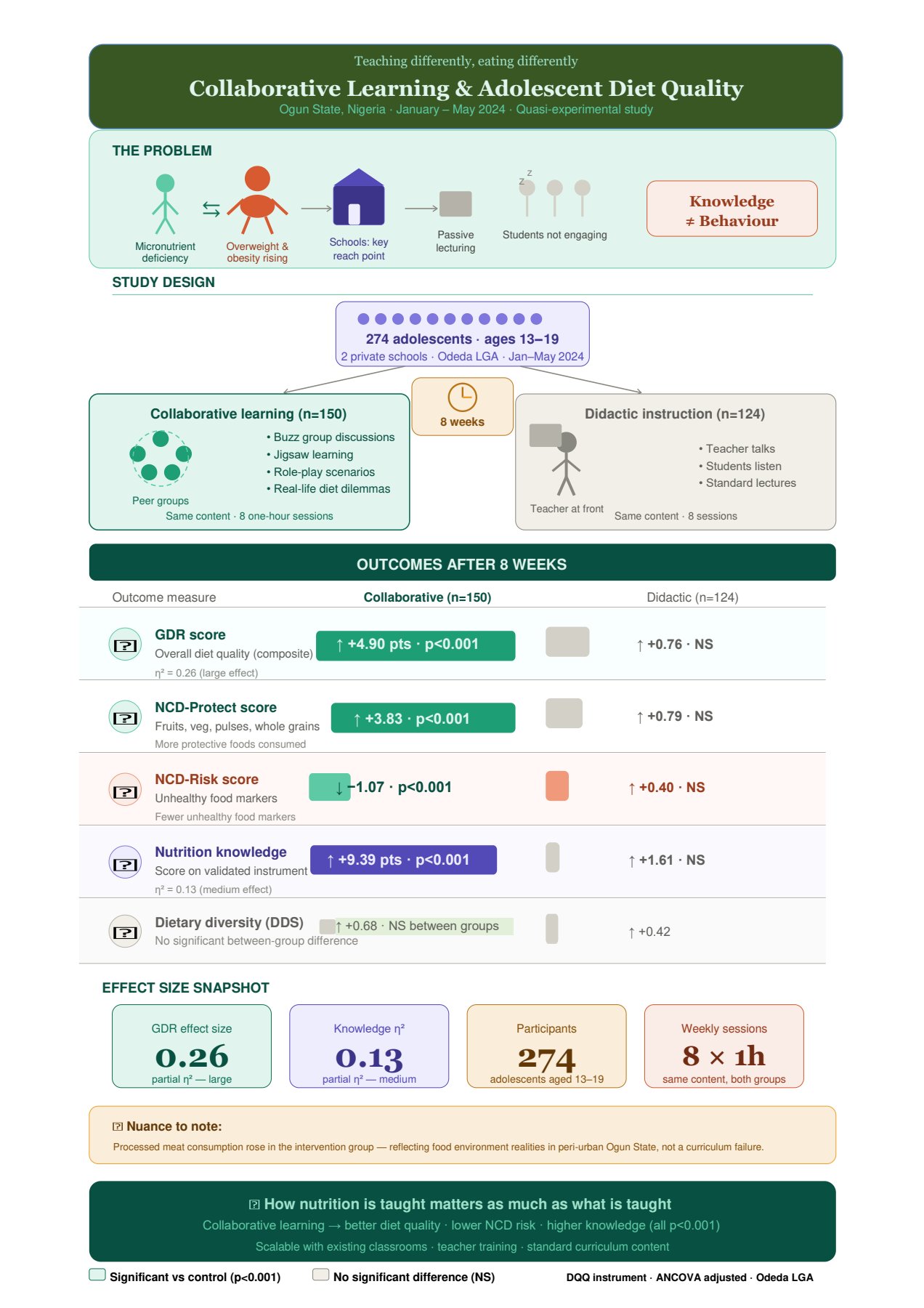
Between January and May 2024, we recruited 274 adolescents aged 13 to 19 from two private secondary schools in Odeda Local Government Area. Using a quasi-experimental design, we assigned one school to a collaborative learning–based nutrition education intervention and the other to conventional didactic teaching. Both groups received identical nutrition content — eight one-hour weekly sessions covering food groups, portion control, nutrient functions, beverage choices, and strategies for overcoming barriers to healthy eating — but the delivery differed entirely.
In the intervention group, students worked in small groups, took on rotating teaching roles, debated food choices, and solved real-life dietary dilemmas together through buzz group discussions, jigsaw learning, and role-play. In the control school, sessions looked like a standard classroom lesson: the teacher talked, the students listened. At the end of eight weeks, and again four weeks later, we assessed diet quality using the validated Diet Quality Questionnaire (DQQ) and measured nutrition knowledge with a validated instrument.
What we found
The results were striking. Across every major diet quality indicator, adolescents in the collaborative learning group outperformed their counterparts. The Global Dietary Recommendations (GDR) score — a composite measure of overall diet quality — rose by nearly five points in the intervention group compared to less than one point in controls. Their NCD-Protect score, measuring consumption of health-promoting foods like fruits, vegetables, pulses, and whole grains, jumped by nearly four points. Meanwhile, their NCD-Risk score fell by more than one point; in the control group, it barely moved. Improvements in nutrition knowledge followed the same pattern: intervention participants gained nearly 10 percentage points, while the control group scores changed by less than 2. After adjusting for baseline differences and sociodemographic factors through ANCOVA, the intervention effect remained large and statistically robust, with partial η² of 0.26 for GDR score and 0.13 for nutrition knowledge.
One finding gave us pause: processed meat consumption increased at the endline in the intervention group. This likely reflects the realities of the food environment — in peri-urban Ogun State, processed meat products are inexpensive and widely available. It is a reminder that school education alone cannot fully counteract food environment pull, and that future curricula should explicitly address processed meat risks.
Why this matters
Many school-based nutrition programmes improve knowledge without changing what adolescents actually eat. Our findings suggest that how nutrition is taught may be as important as what is taught. Collaborative learning — with its emphasis on peer interaction, shared problem-solving, and active engagement — appears to connect knowledge to behaviour in ways that passive instruction does not. The intervention is not expensive or complex. It uses existing classroom infrastructure, standard nutrition content, and facilitation skills that trained nutritionists and teachers can learn. Scaling it requires investment in teacher training and curriculum integration, not a wholesale reimagining of school health policy.
What comes next
This was a short-term study in two private schools. We do not yet know whether improvements persist over months or years, how the intervention performs in public schools or rural settings, or how effects vary across socioeconomic groups beyond what our design could capture. Cluster-randomised trials with longer follow-up, multiple schools, and mixed school types are needed. Incorporating anthropometric outcomes alongside diet quality could also provide a fuller picture of impact.
Adolescents are among the most nutritionally vulnerable populations in the world, and among the most underserved in targeted programmes. Getting nutrition education right for them — not just in content but in method — could matter enormously for chronic disease trajectories across a generation.
Follow the Topic
-
Discover Public Health
This is an open access journal publishing research from all fields relevant to public health.

Related Collections
With Collections, you can get published faster and increase your visibility.
The Economics of Longevity: Health Expenditure and Societal Implications for Public Health Systems
The relationship between health investment and life expectancy has long been a focal point in public health research and policy. As nations grapple with rising healthcare costs and varying health outcomes, understanding how financial allocations influence population health becomes increasingly critical. Numerous studies have illustrated that increased spending on health services often correlates with improvements in life expectancy; however, the complexities of this relationship are not fully understood. Factors such as socioeconomic status, healthcare accessibility, and the efficiency of health systems play significant roles in determining how investments translate into health outcomes.
At the national level, health investments primarily encompass government expenditure on healthcare systems, public health initiatives, and health infrastructure. Nations that allocate substantial resources toward healthcare often experience better health outcomes and increased life expectancy among their populations. For instance, countries with robust healthcare funding tend to provide more comprehensive services, including preventive care, chronic disease management, and health promotion programs, all of which contribute to enhanced population health. However, it is crucial to consider how these investments are distributed across different segments of the population. Inequities in health spending can exacerbate existing disparities, leading to significant differences in life expectancy among various demographic groups. Effective health investment strategies must address these disparities to ensure that improvements in life expectancy are equitable and inclusive.
The motivation for this Collection arises from the urgent need to bridge the gap between health expenditures and tangible improvements in life expectancy. Recent global health crises and ongoing disparities in health outcomes across different populations have underscored the necessity for a deeper exploration of how resource allocation affects health dynamics. This Collection seeks to provide a platform for researchers and practitioners to discuss empirical evidence, theoretical frameworks, and innovative approaches to understanding these critical interactions. By fostering dialogue around effective health investment strategies, we aim to contribute to the development of more equitable and efficient health systems worldwide.
The purpose of this Collection is to gather comprehensive research that elucidates the dynamics between health investment and life expectancy across diverse contexts. We welcome contributions that analyze historical trends, comparative studies, and policy evaluations, as well as those that explore the implications of financial investments on health equity. By highlighting interdisciplinary perspectives and fostering collaboration, this Collection aspires to advance the discourse on optimizing health investments for improved population health outcomes.
Topics of interest include, but are not limited to:
- Economic evaluations of health interventions
- Policy impacts on health spending and life expectancy
- Health equity and investment disparities
- Longitudinal studies on health expenditures and population health
This Collection supports and amplifies research related to SDG 3.
Keywords: health expenditure; healthcare economics; life expectancy; economic evaluation; population health; health investment; health policy
Publishing Model: Open Access
Deadline: Dec 31, 2026
Improving Maternal and Infant Health: The Key for Future Wellness
Optimizing health across the life course begins with ensuring equitable, high-quality care during pregnancy, childbirth, and early infancy. Evidence increasingly demonstrates that early-life exposures and experiences are critical determinants of long-term health, shaping risks for chronic disease, developmental outcomes, and overall well-being. Despite progress, disparities in maternal and infant health outcomes persist globally, underscoring the need for innovative, scalable, and evidence-based public health interventions.
This Collection aims to highlight interdisciplinary research and practice-based efforts that advance maternal and infant health from a public health perspective. We welcome contributions that examine population-level strategies, health systems strengthening, community-based interventions, and policy approaches designed to improve care during pregnancy, the birth hospitalization, and early infancy.
Submissions may include original research, implementation studies, and quality improvement initiatives that address prevention, access, equity, and health outcomes across diverse settings. By emphasizing early prevention and system-level improvements, this Collection seeks to contribute to reducing the burden of chronic disease and improving health trajectories across the lifespan.
Topics of interest include, but are not limited to:
--Public health initiatives to improve maternal and pregnancy outcomes
--Community- and population-level strategies to enhance infant health and early development
--Health system and quality improvement interventions in maternal and neonatal care
--Educational and behavioral interventions targeting pregnant individuals, families, and caregivers
--Policies and programs addressing disparities in maternal and infant health
--Preventive approaches to improve early-life health and long-term outcomes
This Collection supports and amplifies research related to SDG 3: Good health and Well-Being.
Keywords: Maternal health; Infant health; Safer motherhood; Early-life health; Health services; Healthcare system; Public health
Publishing Model: Open Access
Deadline: Mar 17, 2027