Tellurium‑Terminated MXene Synthesis via One‑Step Tellurium Etching
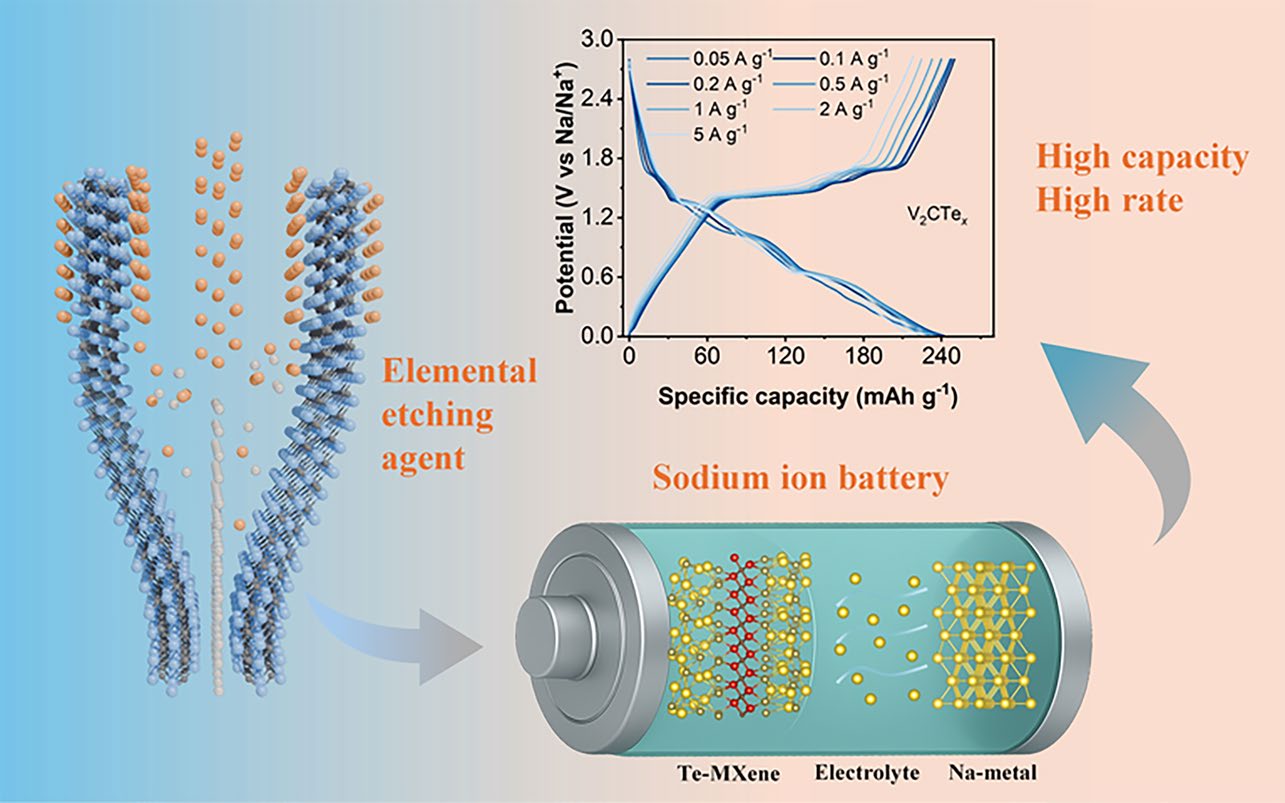
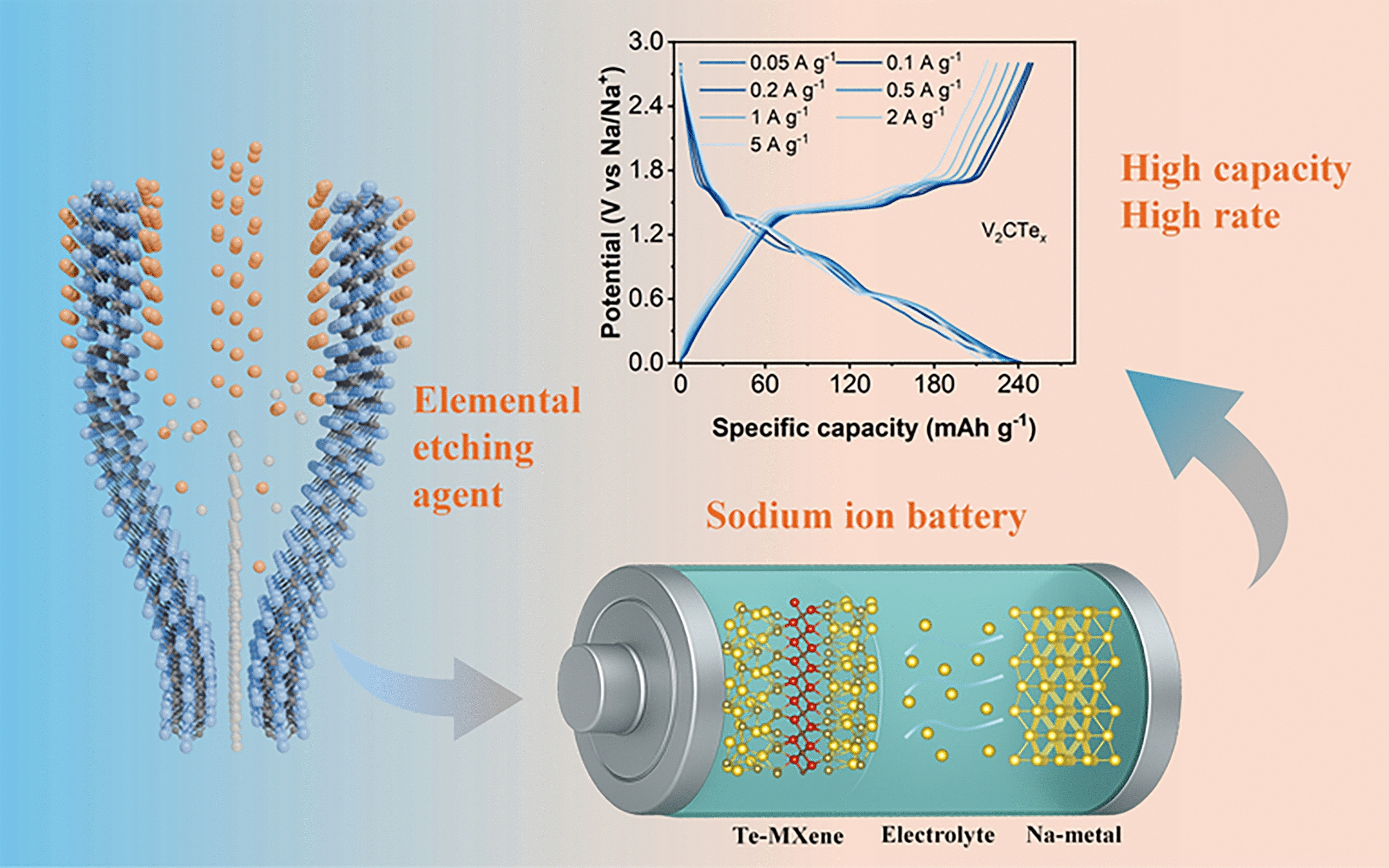

As demand grows for high-performance sodium-ion batteries, the limits of traditional electrode materials in capacity and rate capability become more evident. Now, researchers from Sichuan University, SINANO-CAS, and Université de Toulouse, led by Prof. Zifeng Lin, Prof. Hui Shao, and Prof. Patrice Simon, have unveiled a breakthrough one-step elemental-tellurium etching strategy to produce Te-terminated MXenes. This work opens a scalable, fluoride-free route to next-generation 2D materials with superior sodium-storage properties.
Why Te-Terminated MXenes Matter
- Extraordinary Capacity: V2CTex delivers 247 mAh g-1 at 0.05 A g-1 and retains 216 mAh g-1 at a 23 C rate—>50 % higher than conventional Cl-, Br-, or F-terminated MXenes.
- Long-Life Cycling: >90 % capacity retention after 1 000 cycles at 0.1 A g-1, enabled by stable Na–Te alloying confined on 2D scaffolds.
- Eco-Friendly & Scalable: Elemental Te etching eliminates toxic HF, operates at 700 °C under Ar, and is demonstrated on 20 g batches with 77 % yield and full Te recyclability.
Innovative Design and Features
- One-Step Redox Chemistry: Liquid Te selectively removes Al from MAX phases while grafting Te termini in situ, expanding interlayer spacing to 12.6 Å and preserving high electrical conductivity (45 S m-1).
- Universal MAX Compatibility: Successful etching of Ti-, V-, Nb-, Ta-, Cr-, Zr-based MAX phases (211, 312, 413 types) producing accordion-like MXenes with tunable surface chemistry.
- Mechanistic Insight: DFT shows strong Te adsorption on Al sites (−2.63 eV) driving Al2Te3 formation; Na preferentially bonds to surface Te vacancies, combining 2D ion channels with chalcogenide alloying for fast, stable storage.
Applications and Future Outlook
- Sodium-Ion Batteries: Te-MXene anodes exhibit high-rate capability (5 A g-1) and low polarization, enabling full cells with 104 mAh g-1 at 0.1 A g-1.
- Beyond Na-Ion: The elemental-etching concept (Te/Se/S/P) offers a versatile toolbox to tailor MXene terminations for Li-, K-, Zn-, and multivalent-ion systems.
- Sustainability: Te is recoverable via electrochemical reduction, positioning the process for closed-loop manufacturing.
This comprehensive study redefines MXene synthesis by merging controllable surface functionalization with green chemistry, delivering electrode materials that push sodium-ion technology toward higher energy and power densities. Stay tuned for more cutting-edge advances from Prof. Lin, Prof. Shao, and Prof. Simon’s teams!

Editor of Nano-Micro Letters, which is an Open-Access, peer-reviewed journal reported papers that have at least one dimension ranging from a few sub-nanometers to a few hundreds of micrometers. The journal is published by Springer Nature and indexed by SCI, EI, SCOPUS, Pubmed, etc. The 2024 JCR Impact Factor is 36.3. The 2024 CiteScore is 53.1.
Follow the Topic
-
Nano-Micro Letters
Nano-Micro Letters is a peer-reviewed, international, interdisciplinary and open-access journal that focus on science, experiments, engineering, technologies and applications of nano- or microscale structure and system in physics, chemistry, biology, material science, and pharmacy.




Please sign in or register for FREE
If you are a registered user on Research Communities by Springer Nature, please sign in