Terminator periodic orbits around binary asteroids: an application to the ESA Hera mission, Second-order modeling of the Cassini states of large satellites
Published in Astronomy
Explore the Research
 Cassyni
Cassyni Research Seminars
Every paper has a story. Share it as a citable video publication.
Speakers
- Dr George Voyatzis — Aristotle University of Thessaloniki
- Dr. Alexis Coyette — University of Namur
Abstract
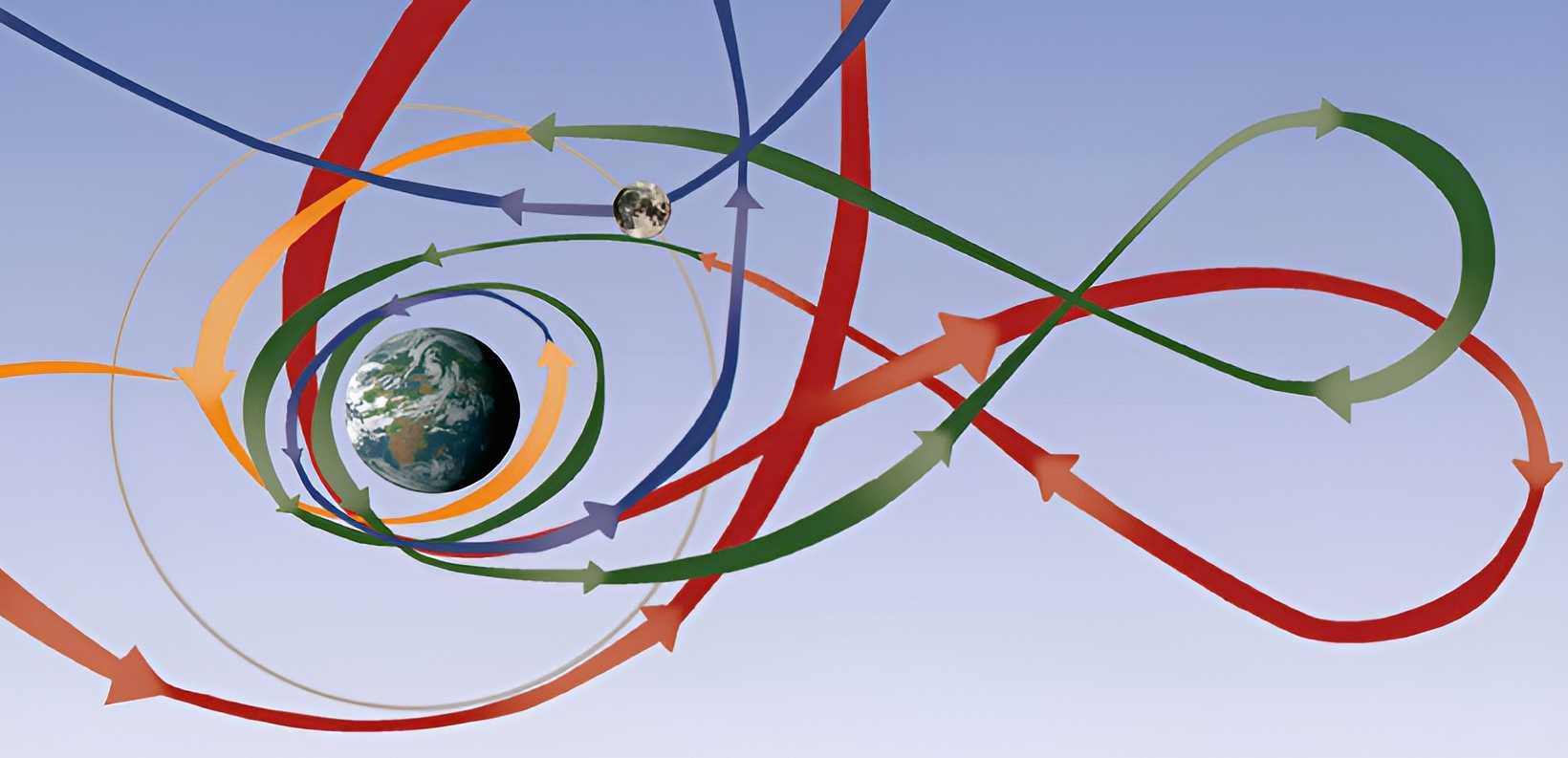
Research in celestial mechanics addresses challenges in spacecraft mission design and the dynamics of planetary bodies. One study investigated terminator periodic orbits (TPOs) for the ESA Hera mission in the Didymos–Dimorphos binary asteroid system. Using analytic continuation, eight distinct TPO families were identified in a non-rotating frame, classified into unstable (Group I, with resonant angle ϕ_R = 0) or quasi-stable/stable (Group II, with ϕ_R = π) configurations. In a rotation model, the Coriolis force caused slow orbital drift, but characteristic terminator properties (inclination ≈90°, ascending node ≈±90°) were preserved for approximately 200 days. Optimized initial conditions limited orbital deviations to below 25 m for 30 days and 40 m for two months, demonstrating suitability for Hera's parking.
A separate study developed a second-order dynamical model for Cassini states in large satellites, specifically Cassini state 1 for the Galilean moons. This model incorporated the full gravitational torque and coupled obliquity with polar motion, quantifying nutations in obliquity and longitude. Inertial obliquity exhibited primarily semidiurnal nutation, while body-frame obliquity showed predominantly diurnal nutation. For Callisto, diurnal nutations reached 400 milliarcseconds (40 m on surface), and second-order polar motion was resonantly amplified by factors up to 60. The presence of a subsurface ocean was shown to significantly influence Cassini state 1, causing resonant amplification of obliquity and polar motion for certain ocean thicknesses (e.g., 100-500 km for Ganymede), offering constraints for internal structures.
Looking for more in the field?
Explore more events from Celestial Mechanics and Dynamical Astronomy Seminar Series and Springer Nature's Astronomy.

Research Seminars by Springer Nature - giving you access to the latest research talks, direct from authors and editors.
Follow the Topic
-
Celestial Mechanics and Dynamical Astronomy
This is an international journal that is concerned with the broadest range of celestial mechanics and its applications, as well as with peripheral fields.

Related Collections
With Collections, you can get published faster and increase your visibility.
Multiple Planet Systems
This article collection is based on peer-reviewed contributions to the Multiple Planet Systems Conference held from 31 Aug – 4 Sept 2026 at the Sofia University "St. Kliment Ohridski", Sofia, Bulgaria.
All participants are invited to submit review articles and original research papers that address problems related to the dynamics of multi-planet systems and planets in binary stars, both on theoretical and observational aspects of these complex architectures. This is a multi-journal collection: Please select either Celestial Mechanics and Dynamical Astronomy (CM&DA) or Astrophysics and Space Science (Ap&SS) – depending on the scope of your work.
Publication under the subscription model is free of charge, open-access is offered for a fee or under the terms of Springer's institutional agreements.
Subjects relevant to CM&DA include: Detection and characterization of multiple-planet systems; Resonant and near-resonant configurations; Secular dynamics and chaos; Transit timing variations (TTVs); Three-dimensional architectures and Lidov–Kozai effects; Formation and stability of S-type and P-type planets in binaries; Numerical tools for fitting exoplanet data, dynamical analysis, and long-term stability; etc.
For Ap&SS, we expect papers within a broader astrophysical and planetary-science scope: related to planet formation and migration, protoplanetary disks, post-main-sequence evolution, stellar binaries, observational surveys, Gaia astrometry, etc.
Publishing Model: Hybrid
Deadline: May 31, 2027
Dynamics of Space Debris and NEO
Publishing Model: Hybrid
Deadline: Ongoing