The Equation-Free Journey: From Multiscale Computation to Neural Operators
Published in Computational Sciences, Mathematical & Computational Engineering Applications, and Mathematics



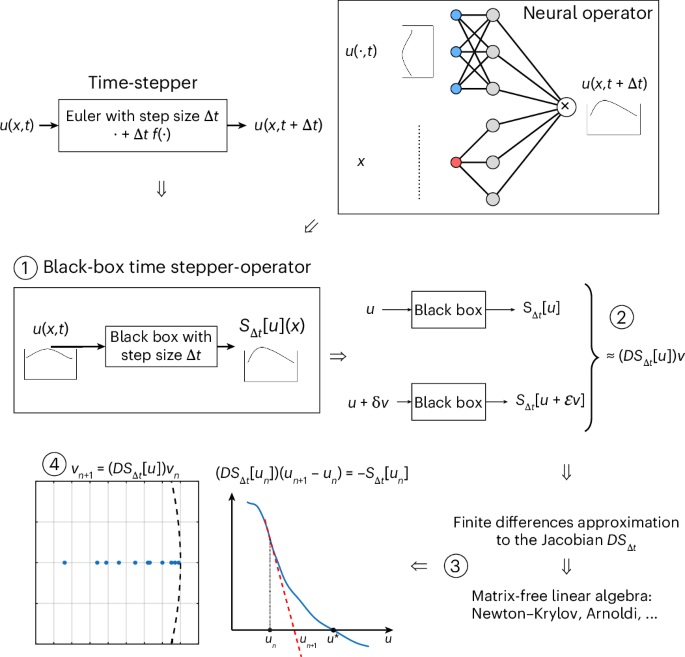

In the year 2000, a paradigm-shifting idea emerged from Kevrekidis's group at Princeton University: What if you could perform system-level analysis of complex, multiscale systems without ever deriving their governing equations in closed form? This was the birth of the "Equation-Free" approach .
The core insight was elegantly simple. For many complex systems, we have detailed microscopic simulators we trust—Lattice Boltzmann, kinetic Monte Carlo, or Molecular Dynamics—but these are too expensive to run for the long timescales we care about. Meanwhile, we believe that good, coarse-grained macroscopic equations conceptually exist, but we don't know how to derive them .
The solution? Treat the microscopic simulator as a black-box "timestepper." Design short bursts of fine-scale computation, estimate the coarse dynamics, and then embed these estimates in matrix-free iterative numerical methods like Krylov subspace solvers . The name "equation-free" was deliberate—an analogy to "matrix-free" linear algebra methods
The Toolkit Emerges
Throughout the 2000s, the equation-free framework grew into a comprehensive computational toolkit. The key developments included:
Coarse Projective Integration bypassed the need to simulate every time step by taking short bursts of fine-scale simulation, then projecting forward over large gaps in time .
Gap-Tooth and Patch Dynamics tackled spatial multiscale challenges by evolving the full process only in small spatial patches (the "teeth"), with communication between patches through appropriate boundary conditions .
Newton-Krylov solvers enabled the computation of coarse stable and unstable steady states, along with stability and bifurcation analysis—all using the microscopic simulator as the source of directional derivatives .
The phrase "closure on demand" captured the spirit: instead of deriving closures analytically, the framework obtained them computationally when and where needed
The Missing Piece
There was, however, a fundamental limitation. The equation-free framework constructed its coarse surrogates on demand—every system-level task required repeated calls to the underlying microscopic simulator. For many applications, this repeated use proved computationally prohibitive . And in some cases, the microscopic simulator simply wasn't available; all that existed were observational data.
The Neural Operator Revolution
Fast forward to the 2020s, and a new class of machine learning architectures emerged: Neural Operators (NOs). Unlike standard neural networks that learn finite-dimensional maps, NOs learn maps between infinite-dimensional function spaces—making them naturally suited for learning solution operators to partial differential equations .
Frameworks like DeepONet, Fourier Neural Operators, Graph Neural Operators, and RandONets demonstrated the ability to learn spatiotemporal dynamics directly from data, generalizing across different resolutions, boundary conditions, and bifurcation parameters .
The Natural Convergence
Our recent Nature Machine Intelligence paper by Fabiani, Vandecasteele, Goswami, Siettos, and Kevrekidis represents the logical culmination of this two-decade journey .
The key insight: replace the expensive, on-demand microscopic simulator with a learned local neural operator. Trained on spatiotemporal data, these surrogates provide efficient short-time solution operators. They can then be embedded in the same Krylov subspace methods that defined the original equation-free framework—Newton-Krylov for fixed points, Arnoldi iterations for dominant eigenvalues .
The advantages are significant:
-
Speed: Once trained, NO surrogates are far cheaper than running the underlying microscopic simulator .
-
Data-only applicability: The framework works even when the microscopic simulator is unavailable, relying solely on observational data .
-
Bridging scales: Local-in-space and local-in-time NOs accelerate system-level computations, improve conditioning of Krylov solvers, and reduce memory requirements .
-
Flexible multiscale analysis: The approach integrates naturally with established equation-free schemes like projective integration, Gap-Tooth, and Patch Dynamics .
Validation Across Benchmarks
The framework demonstrates its power across three canonical nonlinear PDE benchmarks:
-
The Allen-Cahn equation, undergoing multiple concatenated pitchfork bifurcations
-
The Liouville-Bratu-Gelfand PDE, featuring a saddle-node tipping point
-
The FitzHugh-Nagumo model, with two coupled PDEs exhibiting both Hopf and saddle-node bifurcations
Each case demonstrates the ability to perform fixed-point, stability, and bifurcation analysis without explicit knowledge of the underlying equations .
What This Means
What began as a vision to "enable microscopic simulators to perform system-level tasks" has evolved into a framework where learned operators perform those same tasks . The equation-free philosophy—bypass the derivation, compute the closure on demand—remains intact, but the "fine-scale" engine has been transformed.
The ultimate goal, as articulated in the original equation-free vision, was to enable alternative descriptions of physics to perform systems-level tasks like integration over large scales, bifurcation analysis, optimization, and control . Two decades later, the framework has not only realized that vision but expanded it—proving that the most powerful ideas are those that can be reimagined for new generations of computational tools.
Fabiani, G., Vandecasteele, H., Goswami, S., Siettos, C., & Kevrekidis, I.G. (2026). Enabling local neural operators to perform equation-free system-level analysis. Nature Machine Intelligence.
Follow the Topic
-
Nature Machine Intelligence
This journal publishes high-quality original research and reviews in a wide range of topics in machine learning, robotics and AI.