The missing sub-millisecond pulsars
Published in Astronomy

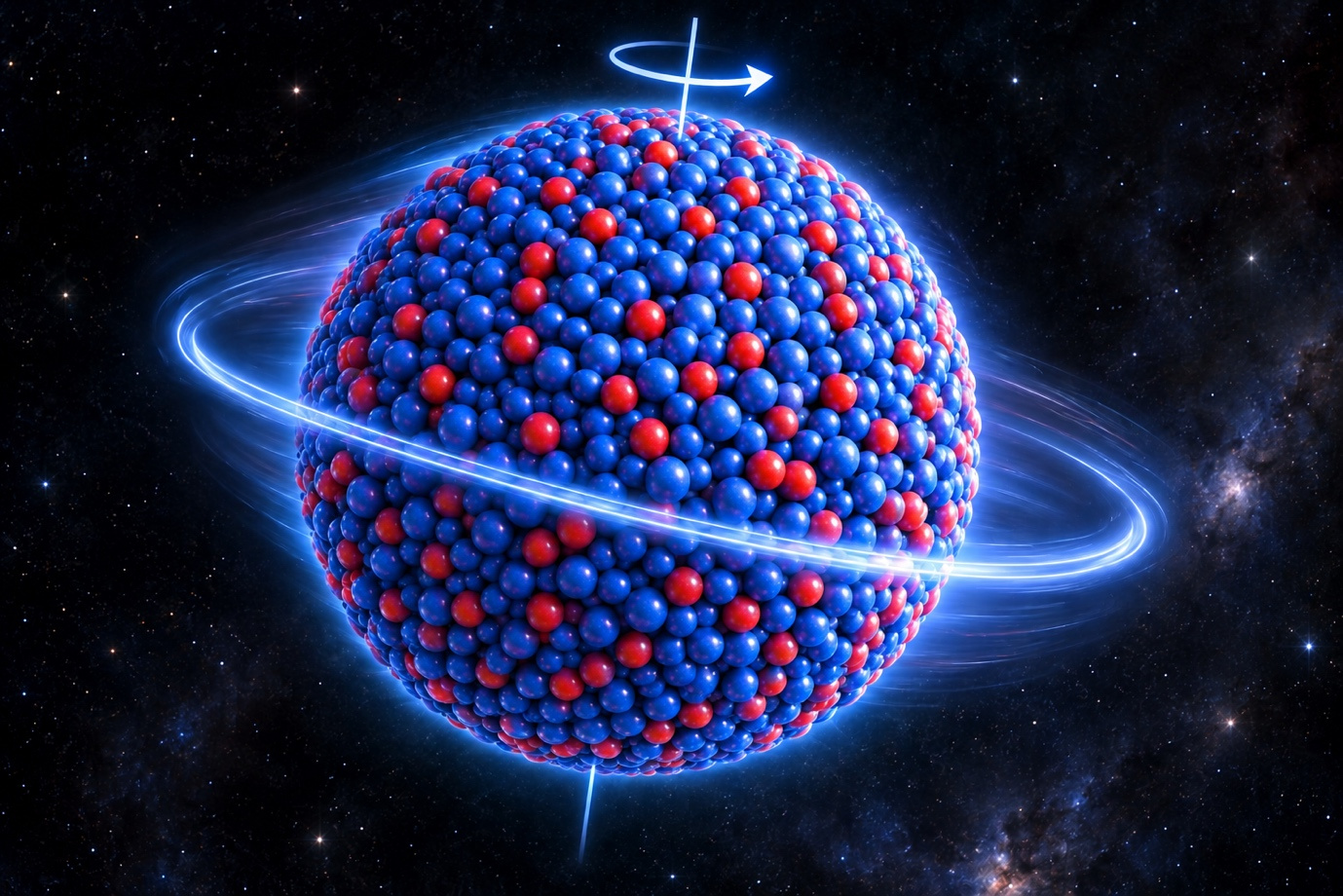
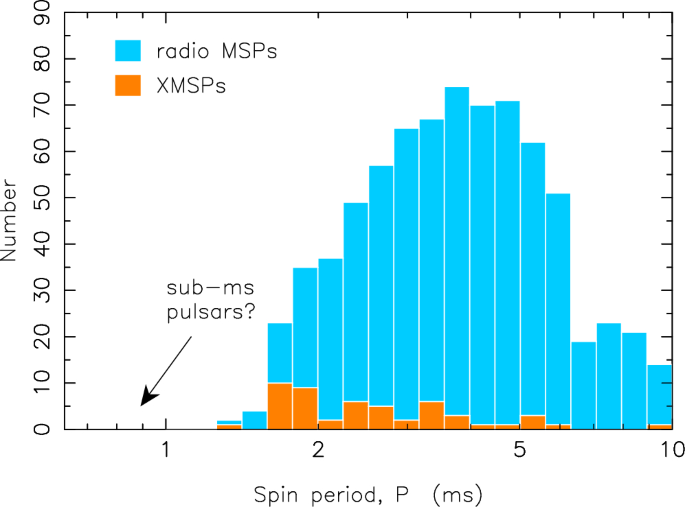

Some 4,400 radio pulsars are known today. The fastest among them, PSR J1748−2446ad, completes one rotation in just 1.40 milliseconds — more than 700 rotations per second. Remarkably, however, this record has stood since its discovery in 2006, despite major advances in pulsar surveys and searches.
Neutron stars are among the most extreme objects in the Universe. They contain more mass than the Sun compressed into a sphere only about 25 kilometres across, possess enormous magnetic fields, and can rotate with the precision of an atomic clock. The fastest-spinning examples are known as millisecond pulsars.
But even the fastest of these is surprisingly slow compared with what should theoretically be possible. Depending on their mass and the still uncertain properties of ultra-dense matter, neutron stars should be able to survive spin periods as short as about 0.6 milliseconds. At such an extraordinary rate, the stellar surface at the equator would move at more than 40% of the speed of light.
This leaves us with a long-standing puzzle. Despite more than four decades of increasingly sophisticated searches, no pulsar has ever been discovered with a spin period below one millisecond.
There are two obvious possibilities. Perhaps sub-millisecond pulsars exist but are particularly difficult to detect. Or perhaps nature simply has great difficulty making them.
The first possibility is important because the fastest-spinning pulsars are often found in compact binary systems. Their rapid orbital motion continuously changes the observed frequency of their radio pulses through the Doppler effect, making them more difficult to identify in pulsar surveys. In our work, we therefore simulated the detectability of very rapidly spinning pulsars in accelerated binary systems. Although observational selection effects certainly matter, our results indicate that they are unlikely to explain the complete absence of sub-millisecond pulsars.
This led us back to a more fundamental question: how are millisecond pulsars made?
A neutron star is not normally born spinning hundreds of times per second. Instead, an old neutron star in a binary system can be “recycled” when its companion star transfers matter to it. The transferred material carries angular momentum, gradually spinning up the neutron star — rather like pushing a playground roundabout repeatedly in the same direction.
At first sight, it therefore seems straightforward to make a sub-millisecond pulsar: simply transfer enough matter and angular momentum onto the neutron star. But when we examined the complete evolutionary process, the picture became much less efficient.
Only a fraction of the material transferred from the companion is actually accreted by the neutron star. Some of it is lost from the binary system, limiting the amount of angular momentum available for spin-up. Moreover, several physical processes can oppose continued acceleration or subsequently slow the neutron star down, including interactions between the accretion disc and the stellar magnetic field, electromagnetic radiation and potentially gravitational-wave emission.
The problem may therefore not be how fast a neutron star is allowed to rotate, but whether binary evolution can ever get it there.
Our calculations point towards a natural bottleneck in producing the fastest pulsars. Combined with the observational simulations and the measured distribution of pulsar spin periods, this offers an explanation for why the observed population appears to run out of steam before reaching the sub-millisecond regime. Nature may simply be very inefficient at producing neutron stars rotating much faster than the current record holders.
This distinction is important. The absence of sub-millisecond pulsars does not necessarily mean that neutron stars cannot rotate that fast. The fundamental physics of neutron stars appears to allow it. Instead, the evolutionary pathway required to produce such extreme rotation may be the limiting factor.
That also makes the search for sub-millisecond pulsars particularly interesting. Finding one would not merely establish a new cosmic speed record. Measurements of extremely rapid rotation can constrain the masses, radii and internal physics of neutron stars and thereby teach us about matter at densities far beyond anything we can reproduce in laboratories on Earth.
And despite the conclusions of our study, I actually hope that we are wrong. I love the idea that somewhere in the Galaxy a neutron star is rotating more than a thousand times per second, waiting to be discovered. Such a discovery would immediately give us something new to explain — and that is exactly what makes science exciting.