The R² Illusion: Why Retrospective Curve-Fitting is Failing Nanomedicine Translation (And How D-PARMO Fixes It)
Published in Chemistry, Materials, and Plant Science
Explore the Research
Just a moment...
onlinelibrary.wiley.com
The "Curve-Fitting" Trap in Drug Delivery
If you open any major biomaterials journal today, you will find hundreds of papers on chitosan-alginate (CS/ALG) polyelectrolyte complexes and nanocarriers. The methodology is almost always identical: synthesize the carrier, load the drug, run a 48-hour in vitro release assay, and then plug the resulting data points into classical semi-empirical equations.
If the Korsmeyer-Peppas or Higuchi model yields a correlation coefficient (R²) greater than 0.95, we proudly declare the release mechanism "elucidated."
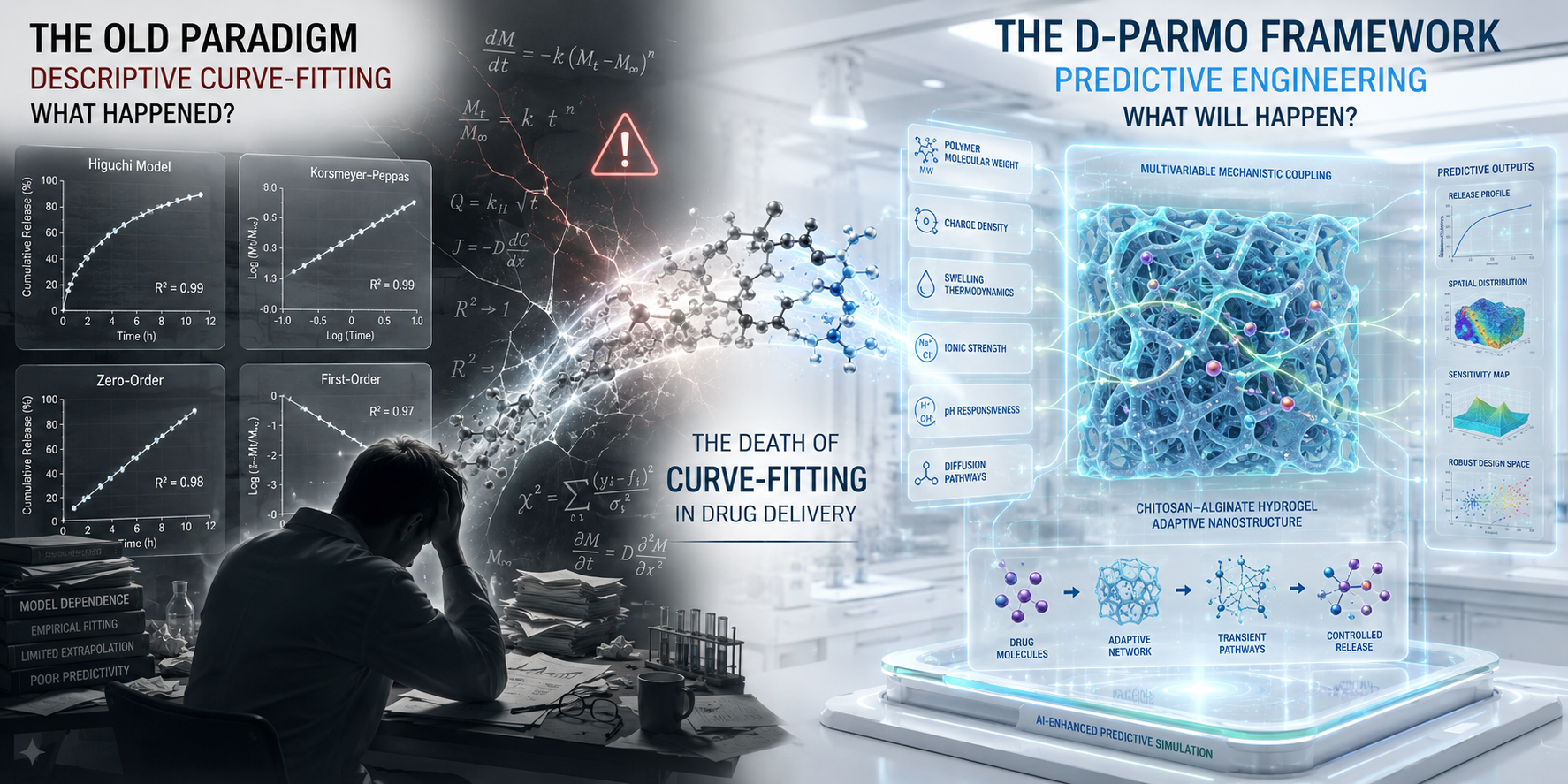
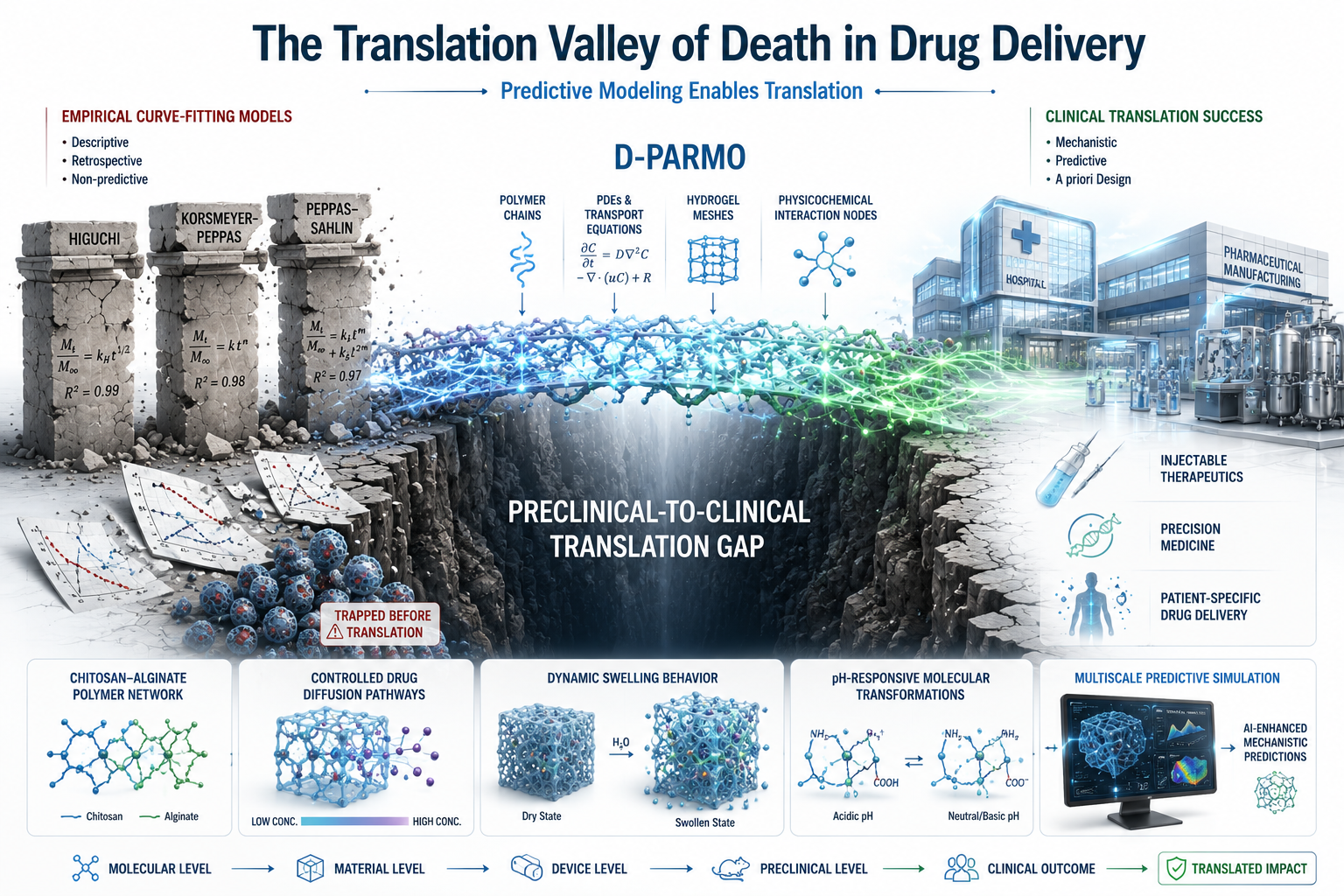
But behind the paper, my co-author (Parastoo Rekab) and I had to confront an uncomfortable truth: This is a fundamental scientific illusion. These classical models are entirely descriptive. They do not predict in vivo behavior based on formulation parameters; they merely offer a mathematical post-mortem of what already happened in a beaker. We are using 60-year-old math to describe next-generation therapeutics, and it is the primary reason our field suffers from such a massive "predictive gap" when transitioning from preclinical models to clinical trials.
Why We Built the D-PARMO Framework
The frustration of seeing thousands of beautifully synthesized nanocarriers fail in clinical translation drove the genesis of our recent review published in Macromolecular Materials and Engineering. We realized the community didn't need another review summarizing how chitosan binds to alginate. We needed a fundamental teardown of how we model that binding's effect on drug release.
We mapped the precise physicochemical foundations of CS/ALG systems and exposed the profound inadequacy of relying on descriptive curve-fitting. You cannot engineer a patient-specific, controlled-release therapeutic if your mathematical model cannot answer the question: "What will happen to the release profile if I change the polymer molecular weight by 10%?"
To bridge this gap, we introduced the D-PARMO Framework.
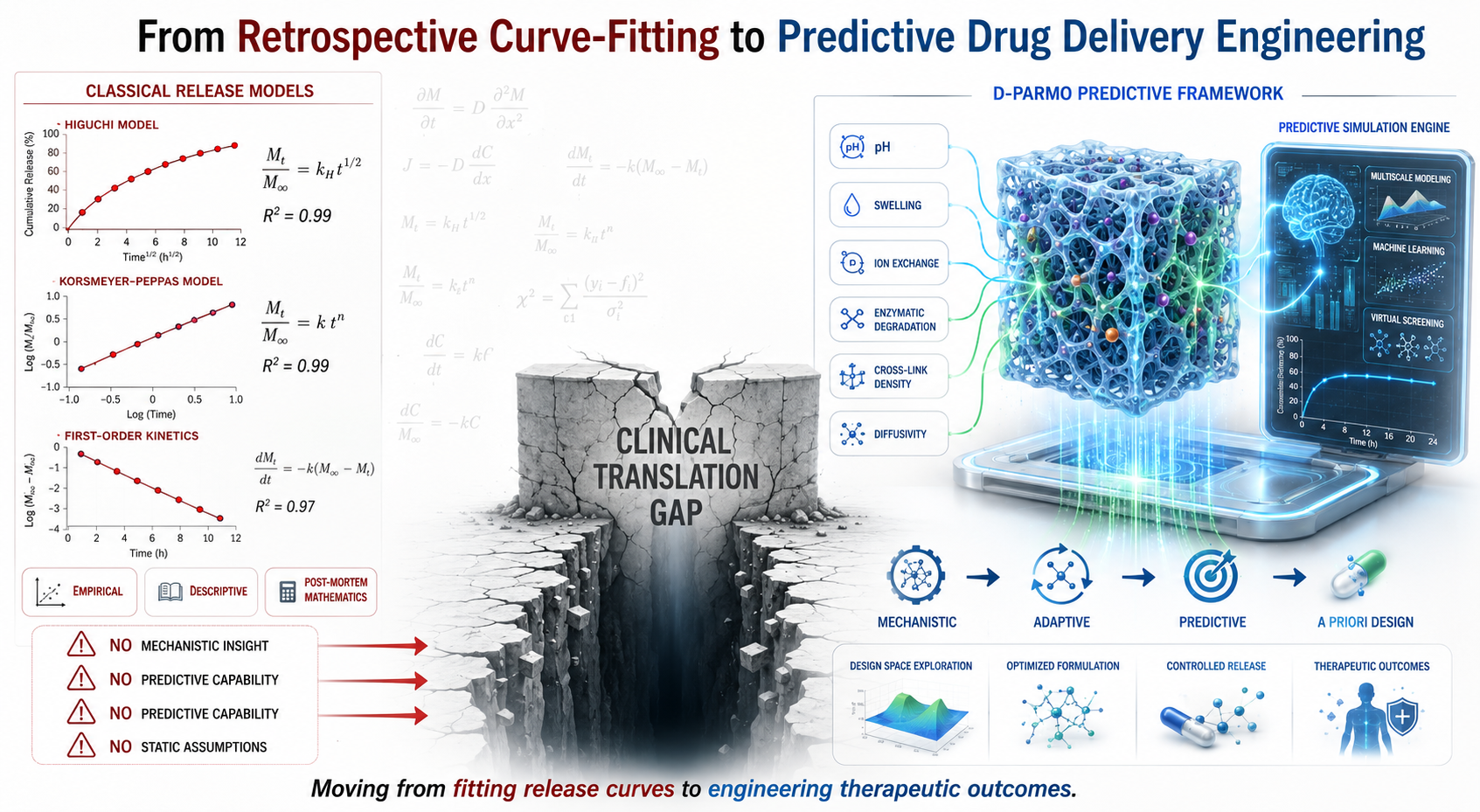
From Descriptive Math to Predictive Engineering
D-PARMO is not just another equation to paste into OriginLab. It is a paradigm shift in how we approach formulation science.
Instead of waiting for an in vitro release assay to finish to figure out what happened, D-PARMO shifts the focus to a priori prediction. It forces formulation scientists to link specific, tunable physicochemical parameters—like charge density, cross-linking geometry, and swelling thermodynamics—directly to predicted in vivo performance before the first animal model is ever used.
By dismantling the reliance on semi-empirical curve fitting, D-PARMO provides the missing blueprint for true clinical translation. It allows us to engineer polyelectrolyte complexes with intent, rather than optimizing them by accident.
The Central Provocation
Our goal with this publication was not to be polite. It was to ask the pharmaceutical and biomaterials communities a very serious question: Are we scientists engineering precise clinical therapeutics, or are we just mathematicians fitting curves to data?
If we want our chitosan-alginate nanocarriers—and indeed, all complex polymeric delivery systems—to actually reach the clinic, we must abandon the comfort of a 0.99 R² value and embrace the complexity of true predictive modeling.
I invite my peers in the drug delivery and macromolecular engineering space to read our full critique and framework here.
Do you believe classical models like Higuchi still have a place in modern nanomedicine, or are they actively holding back clinical translation?

Dr. Akeem Adeyemi Oladipo is a globally recognized Research Professor of Materials and Environmental Chemistry at Eastern Mediterranean University. Ranked among the world's Top 2% Scientists, his expertise bridges nanotechnology, renewable energy, and electro-analytical chemistry. He specializes in advanced materials synthesis for wastewater treatment, highly sensitive electrochemical biosensors, and solar energy conversion. By integrating machine learning and artificial neural networks, his research drives scalable deep-tech innovations in environmental sustainability and energy storage.



Please sign in or register for FREE
If you are a registered user on Research Communities by Springer Nature, please sign in