The Scrabble of Innovation
Published in Sustainability, Business & Management, and Economics


We often think about innovation and economic development as if they were a game of chess: a world of grand strategies, calculated moves and actors competing to occupy dominant positions on the global board. But perhaps that is not the best metaphor. Perhaps innovation is closer to Scrabble.
In Scrabble, no player starts with all the pieces. Each player receives a limited set of letters and, with them, must build the best possible words. Some letters are common. Others are rare. Some combinations produce simple words; others make it possible to construct long, sophisticated and difficult-to-replicate words.
The player’s strategy should not focus on regretting the letters they do not have, but rather on discovering what unique words can be built with the letters available.
This is precisely one of the most interesting metaphors used in the World Intellectual Property Report 2024 by WIPO. In its chapter on development, economic complexity and industrial policy, WIPO uses Scrabble to explain that the goods and services produced by a country do not emerge out of nowhere. They are combinations of pre-existing resources, knowledge and productive, technological, scientific and organizational capabilities.
Returning to the Scrabble metaphor, the “letters” are capabilities; the “words” are the products or solutions that an economy is able to generate from its available mix of resources and capabilities. Not every combination of letters forms a useful word, and not every territory possesses the same letters. Therefore, economic development does not depend only on having good ideas, but on having the right capabilities to transform available resources into value.
This metaphor is especially relevant when rethinking innovation from the perspective of the Global South. For decades, many developing economies have tried to compete by following technological trajectories designed and developed in very different contexts. They have tried to imitate the “words” that others have already written, without having the same set of “letters” available — and, in many cases, without asking what their own distinctive letters might be.
By contrast, Endemic Innovation proposes a different question: What resources, knowledge, factors, natural conditions, cultural capabilities or territorial singularities does a country or region possess that could become a source of innovation that is difficult to replicate?
In other words: what unique words can Chile, Latin America, Africa or Asia write with their own distinctive letters?
Innovation does not start from zero

One of the central contributions of the economic complexity approach, as developed by Hidalgo and Hausmann, is to show that productive knowledge is not distributed homogeneously across the world. Although technological information can, in principle, circulate globally, in practice much of the relevant knowledge remains localized, embedded in people, teams, routines, institutions, norms, networks and communities.
WIPO emphasizes that tacit knowledge — that practical, intuitive and experiential know-how — does not move easily across territories. Even codified knowledge, that is, structured and formal information, requires prior capabilities in order to be effectively absorbed and exploited.
This idea is fundamental. Innovation does not occur in a vacuum. It is not enough to import a technology, open a laboratory, create a sophisticated innovation hub or fund startups in isolation. Innovation requires an ecosystem of complementary capabilities.
Just as a surgeon needs anesthesiologists, surgical nurses, advanced medical equipment, surgical protocols and hospital information systems to operate safely and effectively, a sophisticated industry needs a set of interdependent capabilities to emerge, develop and sustain itself. WIPO captures this point by highlighting that the division of labor allows for the existence of “collective knowledge” that is greater than the sum of individual skills.
From this perspective, economic development becomes a problem of accumulating, combining and deploying capabilities. Countries with more complex economies are not necessarily those with more natural resources or more financial capital, but those capable of producing many different “words” — especially long, rare and difficult-to-produce words.
In WIPO’s terms, economic complexity captures the knowledge embedded in an economy by examining the diversity and low ubiquity — or singularity — of the products it produces.
Economic complexity scholars have formalized these logical claims about global patterns of economic development and tested them empirically. Using international trade data, they found that differences in the number of “letters” explain not only which products a given place is likely to diversify into, but also the broader pattern of diversification.
This is visualized through what is known as the Product Space.
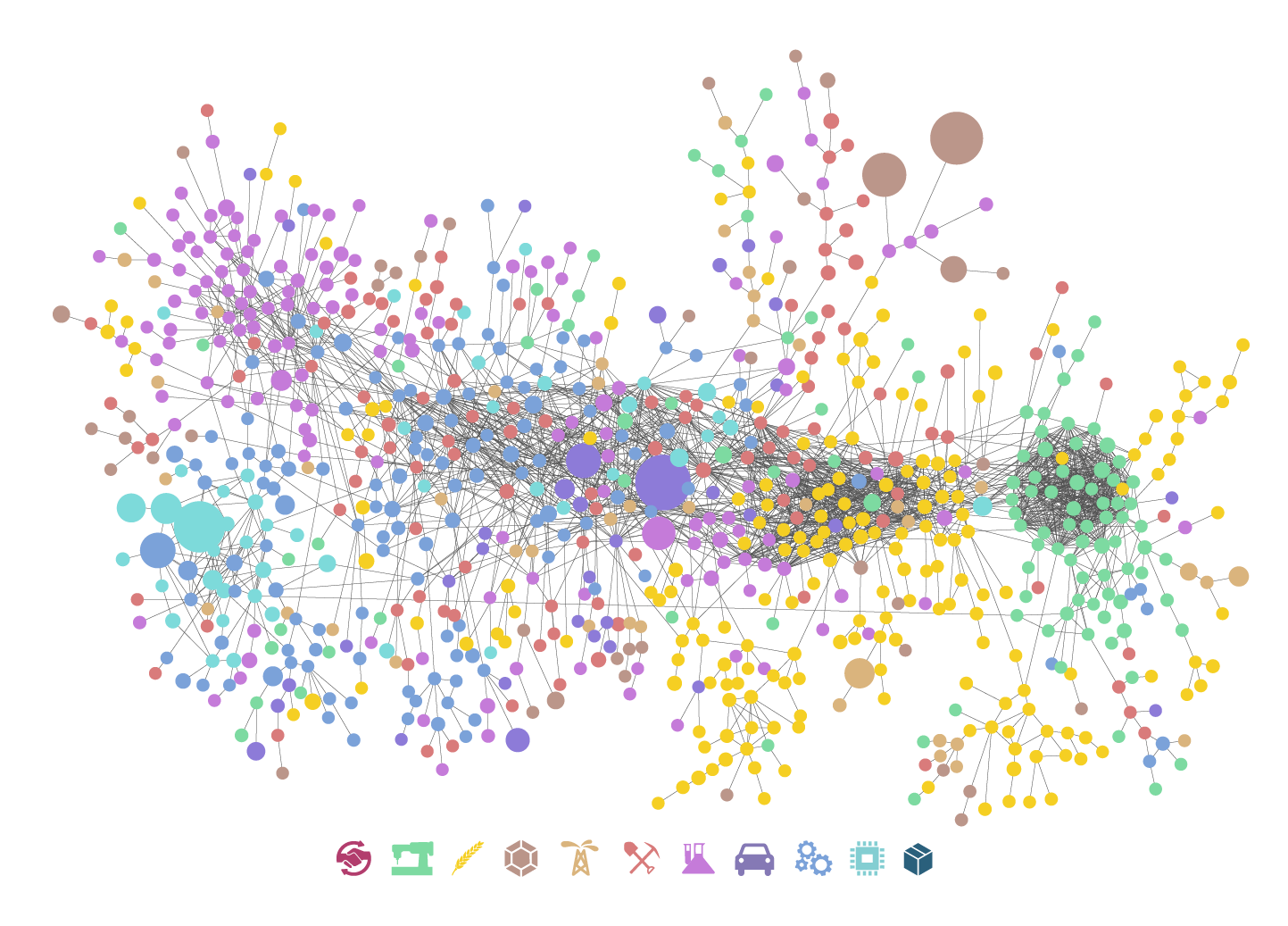
In this representation, each node corresponds to a product. The proximity between nodes approximates the similarity in the knowledge required to produce two products. The links connecting two nodes indicate primary connections between products. The Product Space is irregular, with different products clustered in different areas.
For example, garment products tend to be highly clustered, which implies that the “letters” needed to produce one type of garment are similar to those needed to produce other types of garments. The same occurs with machinery. By contrast, some weakly connected products suggest that those “words” are short or relatively unsophisticated. Oil, for instance, requires drilling into the ground, but there are relatively few other products for which drilling into the ground is a relevant capability.
By comparison, the “letters” needed to manufacture a microwave oven are closer to the letters needed to manufacture a washing machine or a dryer.
This is where a direct connection with the model of Endemic Innovation emerges. If economic complexity asks what capabilities an economy possesses and how these can be combined to diversify, Endemic Innovation asks which of those capabilities are also territorially singular, difficult to replicate and capable of becoming the basis for structural comparative advantages — and, from there, how we can develop innovation poles with a strategic country-level perspective.
Endemic letters: what others cannot easily copy

In previous publications, I have argued that Endemic Innovation emerges when a region transforms what makes it unique — its biodiversity, geography, local knowledge, natural conditions, cultural resources or scientific capabilities associated with a specific territory — into technologically sophisticated, sustainable solutions with the potential for global impact.
This approach does not propose a return to an extractive view of natural resources. Quite the opposite. It seeks to move beyond the logic of primary exports by integrating science, dynamic capabilities, access to exogenous technologies and technological absorptive capacity, together with collaboration with local communities. All of this is leveraged through resources and capabilities that are unique or very difficult to replicate.
In the language of Scrabble, “endemic letters” are those that a territory possesses in a singular way. They may include unique biological resources, such as Chilean quillay; exceptional astronomical conditions, such as the skies of northern Chile; ancestral knowledge about food, fibers, medicinal plants or ecosystem management; or specific agroecological conditions that enable innovations that cannot be replicated in the same way elsewhere.
But having “rare letters” does not guarantee the ability to write “good words”. A country may have biodiversity, critical minerals, deserts, glaciers, forests, oceans or millenary cultures and still fail to generate sophisticated innovations.
The key lies in combining those endemic letters with other letters: scientific capabilities, exogenous technologies, intellectual property, industrial design, business models, advanced human capital, specialized manufacturing, enabling regulation and fluid access to global markets.
This is why Endemic Innovation is not simply about “innovating with local resources”. It is about building new combinations between territorial singularities, capabilities and technological sophistication.
From resource abundance to capability complexity
The WIPO report is particularly relevant because it helps distinguish between having resources and having capabilities. Many Global South economies possess abundant natural resources, but this does not automatically mean that they have complex productive capabilities. The development trap emerges when a territory exports raw materials without building the scientific, technological and industrial capabilities required to capture greater value.
WIPO suggests that innovation can be analyzed through three interdependent dimensions: scientific capabilities, technological capabilities and productive capabilities. To measure them, the report uses scientific publications, international patent databases and exports. This triangulation is useful because it allows us to observe whether a country generates knowledge, whether it transforms that knowledge into protectable technology and whether it ultimately converts it into competitive products in international markets.
This distinction is crucial for Endemic Innovation. A region may have a major endemic opportunity, but if it does not develop scientific capabilities to map and study it, technological capabilities to transform it and productive capabilities to scale it, that opportunity will remain latent. It will be an interesting “letter”, but it will not become part of a competitive “word”.
Consider, for instance, a native plant with bioactive properties. In a primary-export model, it could be sold as a raw material.
In an Endemic Innovation model, that same plant could become a biotechnological platform, a nutraceutical ingredient, an agricultural bioinput, a biomaterial or a pharmaceutical solution — provided there is an architecture of capabilities capable of connecting singular resources, basic science, bioprocessing, intellectual property, regulation, market validation and industrial scaling.
The difference is not in the resource. It is in the “grammar of capabilities” built around that resource.
Context matters: not all innovations travel in the same way
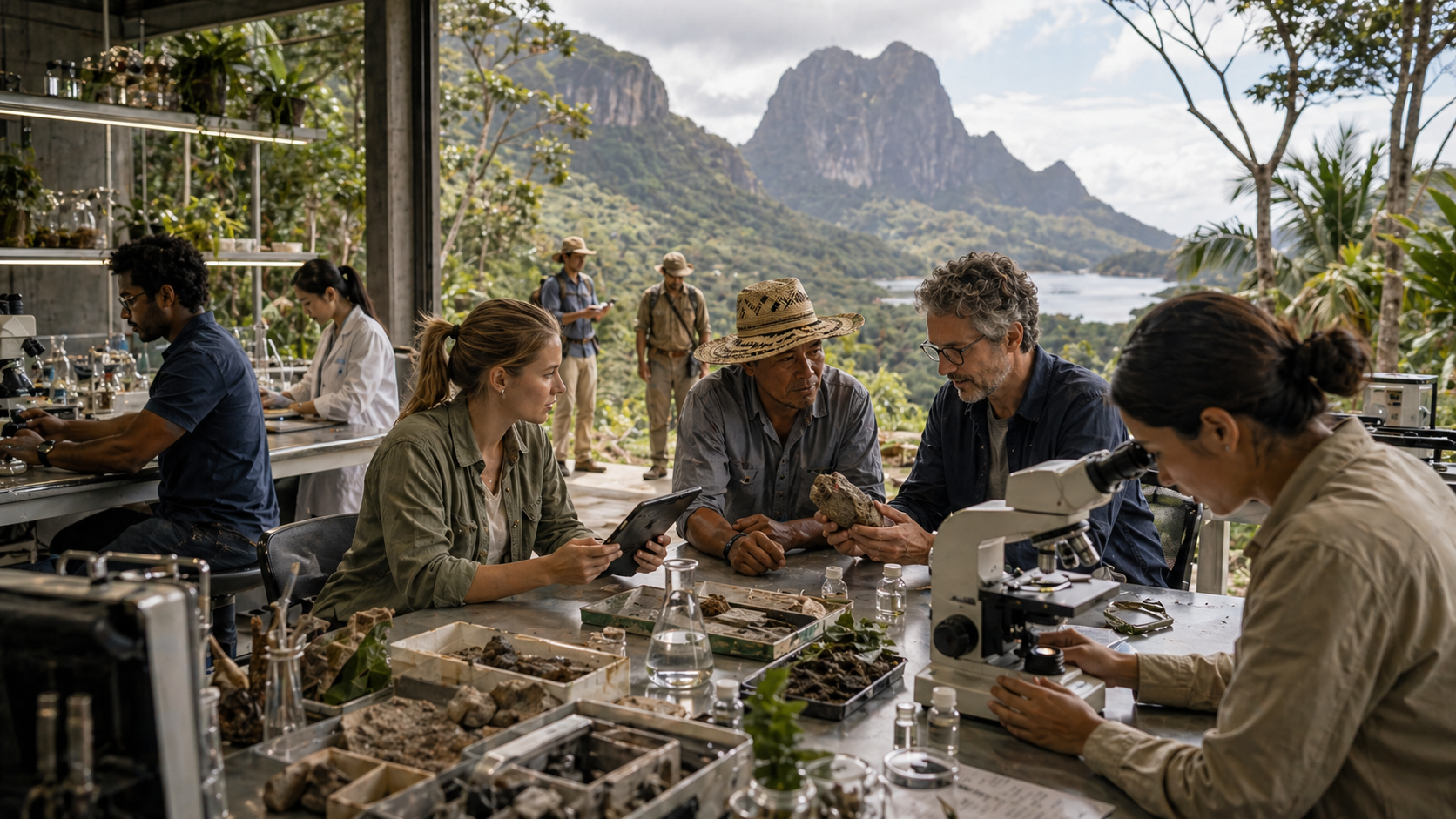
One of the most interesting chapters of the WIPO report analyzes specialization in AgTech and shows that agricultural innovation is strongly context-dependent. Technological solutions must adapt to specific agroecological conditions, including soil, climate, topography, production systems, agricultural culture and market structures.
WIPO examines hubs such as São Paulo, Nairobi and Colorado to illustrate how local capabilities shape distinct agricultural innovation trajectories.
This reinforces a central intuition of Endemic Innovation: territory matters. Not as folklore, nor as a marketing narrative, but as a strategic variable. Technology is not deployed onto neutral territories. It adapts, recombines and acquires value through its interaction with specific factors and conditions.
The case of São Paulo and sugarcane ethanol is illustrative. WIPO describes how Brazil was able to build capabilities around ethanol production, drawing on public policies, agricultural capabilities, local industry, energy demand and subsequent technological developments, including the use of sugarcane residues to produce second-generation ethanol.
From an Endemic Innovation perspective, this case shows how a territorial base — sugarcane, its value chain and its accumulated agricultural and industrial capabilities — can become a platform for energy innovation. It is not about copying an external industry, but about sophisticating a productive trajectory anchored in local conditions.
Industrial policy: choosing possible words, not technological fantasies

The Scrabble metaphor also has direct implications for public policy. A smart industrial policy should not consist of choosing fashionable industries simply because other countries are developing them. Nor should it be limited to funding research disconnected from real productive capabilities.
Rather, it should identify which “letters” a territory already possesses, which ones are missing, which words it could build with a higher probability of success and which complementary capabilities it needs to develop.
WIPO argues that industrial policies influence innovation trajectories by allocating human and financial resources toward certain scientific, technological and productive capabilities. It also suggests that successful policies should develop new capabilities, nurture emerging capabilities and protect existing advantages.
This approach is highly consistent with an Endemic Innovation agenda. Instead of asking, “How do we become the next Silicon Valley?”, a more strategic question would be: “What unique capabilities does our territory possess, and which frontier technologies could amplify them in order to generate innovation poles with a high degree of strategic differentiation?”
For Chile, for example, this could mean connecting advanced mining with clean technologies, astronomy with data science, biodiversity with biotechnology, oceans with renewable energy or biomaterials, rehabilitation with assistive technologies, or extreme territories with solutions for climate resilience and connectivity.
For other countries, the letters will be different: tropical agriculture, traditional medicine, climate-responsive architecture, languages, functional foods, unique ecosystems, dense cities, high-tech manufacturing or digital platforms adapted to local constraints.
The point is not to romanticize the local. It is to turn the local into a sophisticated basis for global differentiation.
From scattered letters to innovation ecosystems
One of the historical weaknesses of many development strategies has been to treat capabilities as isolated pieces. Science is funded without being connected to industry. Entrepreneurship is promoted without manufacturing capacity. Exports are encouraged without intellectual property. Foreign direct investment is attracted without local absorptive capacity. Professionals are trained without sophisticated demand capable of retaining them.
The WIPO approach helps us see that the problem is not necessarily the total absence of letters, but the lack of combinations. Therefore, the strategic question is not only which capabilities exist, but how they are connected.
Endemic Innovation can contribute here as an articulating framework. Its focus on singularity, community, technology and global impact makes it possible to structure a roadmap for moving from latent resources and opportunities to scalable solutions.
This process requires mapping endemic opportunities, designing sustainable strategies, absorbing exogenous technologies, validating solutions in real contexts and building mechanisms for international scaling.
In simple terms, “endemic letters” must come into contact with other letters. A native plant needs biotechnology. Ancestral knowledge needs design, scientific validation and fair appropriation models. A natural laboratory needs infrastructure, data, talent and technology transfer. A local community needs to be a partner, not a decorative element for greenwashing. A territory-based innovation needs intellectual property, standards, certifications and market access.
The Global South does not need to copy words: it needs to write its own

The promise of Endemic Innovation is particularly relevant for economies that have historically been peripheral within global innovation ecosystems. Many of them do not possess all the letters needed to compete in hyper-complex industries dominated by advanced economies. But they do possess rare, singular, territorially specific and sometimes unique letters.
The challenge is not to deny that singularity, but to activate it strategically.
The Global South should not limit itself to importing “words” written by others. It must learn to write new words from its own letters, combining them with science, technology, intellectual property, entrepreneurship and intelligent public policies. This is not a defense of isolation. It is exactly the opposite: a strategy of global insertion based on contextual and territorial differentiation.
In the Scrabble of innovation, winning does not mean having the same letters as everyone else. It means understanding the value of one’s own letters, combining them intelligently and building the words that others cannot write.
Perhaps this is one of the major tasks of the next decade: to move from imitative, generic and decontextualized innovation toward innovation that is more situated, sophisticated and strategically connected to what makes each territory unique.
Because, in the end, development is not only about accumulating more letters. It is about learning how to write, with them, a future of one’s own.
This is precisely what the Endemic Innovation model proposes — and what I invite others to explore, deepen and implement.
------------------
References
WIPO. (2024). World Intellectual Property Report 2024: Making Innovation Policy Work for Development. World Intellectual Property Organization.
Hidalgo, C. A., & Hausmann, R. (2009). The building blocks of economic complexity. Proceedings of the National Academy of Sciences, 106(26), 10570–10575.
Hausmann, R., Hidalgo, C. A., Bustos, S., Coscia, M., Simoes, A., & Yildirim, M. A. (2014). The Atlas of Economic Complexity: Mapping Paths to Prosperity. MIT Press.
Cohen, W. M., & Levinthal, D. A. (1990). Absorptive capacity: A new perspective on learning and innovation. Administrative Science Quarterly, 35(1), 128–152.
Teece, D. J., Pisano, G., & Shuen, A. (1997). Dynamic capabilities and strategic management. Strategic Management Journal, 18(7), 509–533.
Nelson, R. R., & Winter, S. G. (1982). An Evolutionary Theory of Economic Change. Harvard University Press.
Lin, J. Y. (2012). New Structural Economics: A Framework for Rethinking Development and Policy. World Bank.

PhD(c), Professor and Researcher on Innovation, Management and Sustainability topics, from Santiago, Chile.
Currently, in the context of my doctoral thesis, I am researching and developing the concept of Endemic Innovation.
Follow the Topic
What are SDG Topics?
An introduction to Sustainable Development Goals (SDGs) Topics and their role in highlighting sustainable development research.
Continue reading announcement




Please sign in or register for FREE
If you are a registered user on Research Communities by Springer Nature, please sign in