
It is that time of year again! A bit like Christmas, now is the time when journal editors wait expectantly to open their presents; or in this case present singular. I’m talking about the annual release of Impact Factors from ISI. I’m not going to go through all the reasons why Impact Factors may not be the best way to judge scientific research. Katharine made some comments about that last year and I haven’t changed my opinion much since I railed against their tyranny at another journal. But Impact Factors and the other citation metrics probably say something about a journal so I thought I’d give you the numbers for Nature Protocols and say what I’m taking from them.
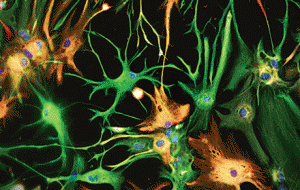
My favourite cover image from 2011.
So the 2011 Impact Factor for Nature Protocols is 9.924 which I’m really happy about. It would be a presentable number for a journal publishing primary research, and we don’t publish primary research. I would expect protocols to be formally cited less often. Also it is up 1.562 points from the 2010 value so Nature Protocols is probably being cited more than 12 months ago and hopefully that is an indication that our articles are being used more than 12 months ago. If our articles are being used more than they were then that’s good news.
Impact Factors are quite good for making comparisons between similar journals, but sadly none of the other main publishers of protocols is indexed by ISI and so don’t get given Impact Factors. I analysed the citation of those journals a few months ago and I’ll let you draw your own conclusions about what thier IF might be if they were given one. What ISI does do is put Nature Protocols in a group of journals publishing “Biochemical Research Methods”. Our colleagues at Nature Methods top that list with an IF of 19.276. However it is a bit like comparing chalk and cheese as other journals in this group are things like Acta Crystallographica Section D: Biological Crystallography (IF 12.619), Current Opinion in Biotechnology (IF 7.711) and even PLoS Computational Biology (IF 5.215). Still in the group we rank third, up from fourth last year, so again pleasing.
The numbers that please me are those that suggest that Nature Protocols articles have some longevity. If you calculate IF over 5 years instead of 2 it rises to 10.201 suggesting that Protocols are relevant well beyond their initial publication. Many journals, possibly even most (I’m eyeballing rather than having done a proper analysis) have a lower 5-year IF than their standard 2-year IF.
For a slightly more sophisticated measure there is the Eigen Factor score. This is calculated in a similar way to Google’s page rank algorithm in that not all links are of equal value and self citations aren’t counted at all. For 2011 ours is 0.10716. I’m not completely clear how to interpret that but it is more than for 2010 so that must be good!
Last up the Article Influence Score. This is derived from the Eigen Factor and then normalised for the size of the journal so that the ‘average’ journal will have an Influence of 1.000. Ours for 2011 is 4.422 which is again more than it was last year and shows, to misquote the immortal Yogi, that we are “smarter than the average journal (Boo-Boo)”.
So it’s all good (for as much as Impact Factors and similar measures can tell you anything about a journal). But at Nature Protocols we don’t really care about the value of our IF. In the next 12 months we will try to commission and publish even better protocols so that more scientists will be helped in their research. If someone can quantify that then I’d like to hear about it.





Please sign in or register for FREE
If you are a registered user on Research Communities by Springer Nature, please sign in