The Social Value of News
Published in Arts & Humanities
We get our news in a bewildering variety of ways these days, delivered 24/7 via platforms that can appear, alter and then sometimes disappear, all at dizzying speed. Whereas news once appeared as text circulating at regular intervals in printed form, augmented with the occasional illustration, we have now passed through a century of news being broadcast in sound and vision before coming out the other side with a pivot towards short-form video. The news industry now seems to be in a state of permanent flux.
It is true that many (usually older) people still get news from machines called TV sets and radios; also that a few of us (usually even older) still maintain print habits. But, increasingly, news is consumed in a fleeting fashion on smartphones. It flits past us, often without demanding deep levels of engagement. Even more worryingly, it can be hard at first glance to differentiate between news that has been carefully verified by reporters and lookalike ‘content’ that may have been generated by AI with little or nothing in the way of human input, let alone ethics.
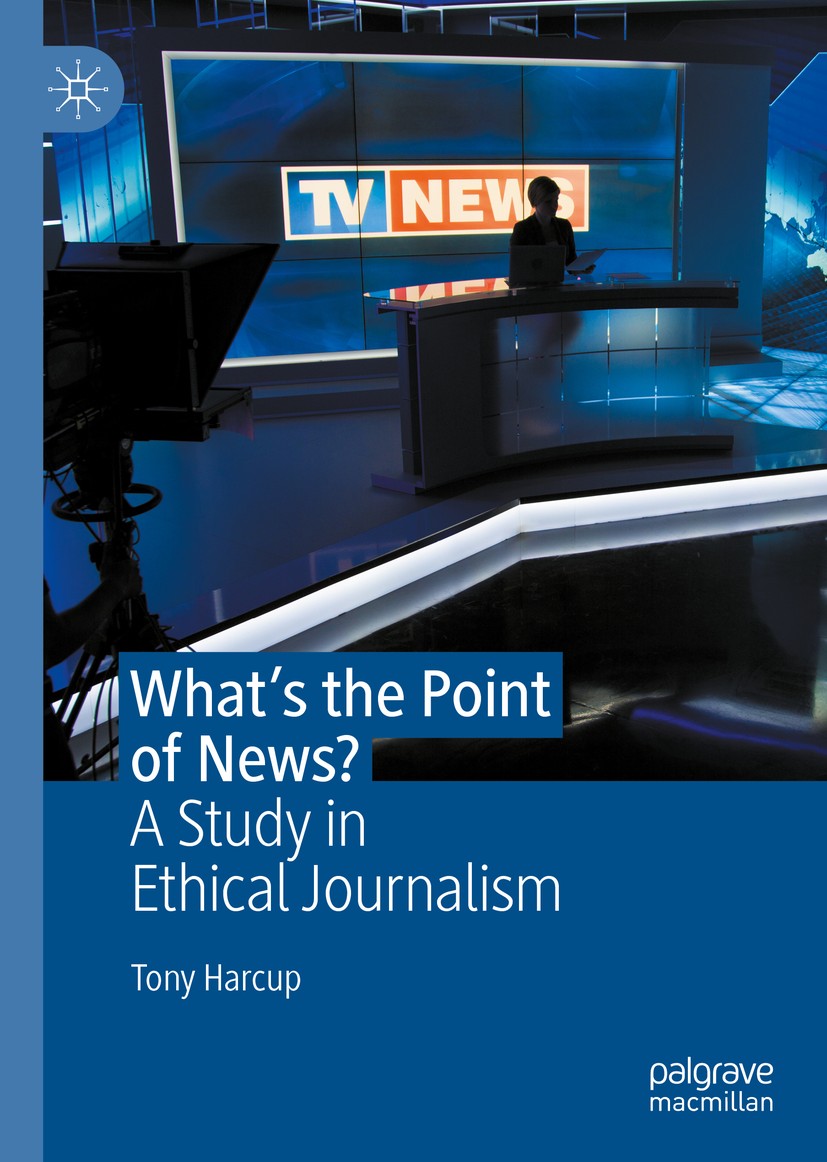
Within this context of rapid changes to the ways in which news is produced and consumed, there is a need to stand back from chasing clicks and feeding the ‘for you’ algorithm to ask ourselves: what’s it all for? This is where news values come in. News values are the reason why I believe the book What’s the Point of News? remains as relevant for journalists and scholars today as on its publication day. Because the book’s focus is, unashamedly, on the democratic value of news to citizens rather than its commercial value to multimedia corporations.
It was primarily to explore the possibilities of this democratic function of news that I embarked upon my research in the first place. A second motivation was the gradual realisation that a lot of teaching around what academics typically call news values may be missing the point. It can be useful in helping journalism students identify the most common ingredients of news stories, or the ways in which different frames can be constructed around events, but where exactly do ‘values’ – especially human values - fit in? What are often labelled in scholarly literature as ‘news values’ seem more accurately to be lists of factors or components rather than values in the sense of principles, beliefs or worth. The actual values that might or might not underpin choices made in news selection, production and presentation are often left unexamined when taxonomies of so-called news values are discussed or reproduced.
That got me thinking, and then writing. The resulting monograph, What's the Point of News?, is as much a celebration of news as it is a critique. Sure, there is much to criticise, but the news industry is not monolithic. As well as highlighting some dubious practices, it is always important to record and celebrate more positive choices made by those journalists who, individually and collectively, go out of their way to listen carefully to those with the least power in any given situation, and to direct critical questions at those with the most power. As such, What’s the Point of News? is, unapologetically, a normative account of what news should be. And could be, more often than it is, notwithstanding the difficult conditions under which many journalists labour today.
Chief among the values that ought to guide news reporting is that it should serve the public good by providing people with societally important and useful information, emphasising the social utility of news for an audience comprising not just isolated individuals but (potentially) active citizens. Amid the horror stories and the quirky tales, alongside the sensational and the entertaining, there is an urgent need for what might be thought of as socially enabling and democratically empowering information that strengthens active citizenship by promoting understanding and imaginative empathy. That may seem a lot to ask of a rough trade such as journalism, yet examples exist around the world and are discussed at length in the book.
News informed by such values serves us as citizens by, among other things, better reflecting and representing the diversity of our lives, recording people’s myriad activities not just as passive victims or bystanders but as participants in a public, social sphere. Recognition of this crucial role is already embedded in the best journalism training, which is not content simply to reproduce industry norms but also to question them. However, there ought to be scope within journalism education – as well as within journalism itself - to think even more widely and deeply about the ethics of it all; hence the book’s subtitle, A study in ethical journalism.
To this end, there is much of value we can learn by considering the principles and practices – both historical and contemporary - of alternative journalism, peace journalism, feminism and other areas of critical praxis that have emerged from within small-scale (often local) forms of citizen-focussed journalism. After all, news has never been the preserve of the corporate news industry, however much proprietors might wish that to be so, and the defence of news values cannot be left to those whose primary motive is profit. News should serve us as citizens, not just consumers. And, when ruling politicians can blithely dismiss critical scrutiny as ‘fake news’, carefully reported news has arguably never been of greater social value than it is right now.
Tony Harcup is an Emeritus Fellow at the University of Sheffield, UK. He worked as a journalist within mainstream and alternative media before becoming a teacher, researcher and author. His books include the Oxford Dictionary of Journalism (2014); Alternative Journalism, Alternative Voices (2012); and Journalism: Principles and Practice (4th ed, 2022). What’s the Point of News? is available in ebook, paperback and hardback. He can sometimes be found contributing to Bluesky as @writerlytone.
Follow the Topic
Introducing the Palgrave Macmillan Campaign for the Humanities
At Palgrave Macmillan we publish cutting-edge humanities research that has real-world impact. This research community brings together the voices of our authors and editorial team to highlight and publicize the value of the humanities and humanities research in our world today.
Continue reading announcement


Please sign in or register for FREE
If you are a registered user on Research Communities by Springer Nature, please sign in