Thermal‑Gated Self‑Repairing Polyimide Separator for Dendrite‑Suppressed Lithium Metal Batteries
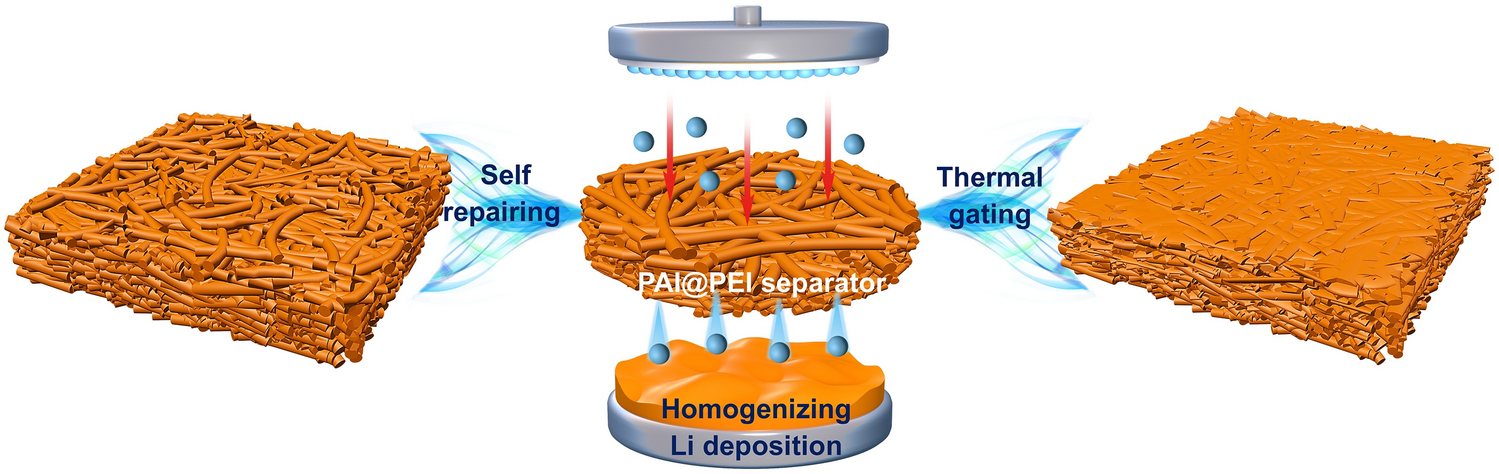

As the demand for high-energy-density lithium metal batteries continues to grow, the limitations of conventional separators in terms of thermal safety, dendrite suppression, and cycling stability become more pronounced. Now, researchers from Hebei University of Science and Technology and Xiamen University, led by Professor Guohua Sun and Professor Nanjun Chen, have presented a breakthrough strategy for developing intelligent separators with reversible thermal-gated functions and self-repairing capabilities. This work offers valuable insights into the development of next-generation separators that can overcome the safety and performance challenges in lithium metal batteries.
Why This Self-Repairing Separator Matters
- Thermal Safety: The thermal-gated function enables automatic aperture closure at 400°C for shutdown protection, addressing the "thermal runaway" barrier that limits conventional polyolefin separators.
- Longevity Enhancement: The self-repairing capability allows aperture recovery at 350°C through PAI shell-mediated remodeling, overcoming the "irreversible shutdown" limitation that permanently inactivates existing thermal-responsive separators.
- Dendrite Suppression: The polar amide and imide groups facilitate Li+ dissociation and uniform transport, enabling dendrite-suppressed lithium deposition for extended battery cycling life.
Innovative Design and Features
- Core-Shell Architecture: The separator features a polyetherimide (PEI) core encapsulated by a polyamide-imide (PAI) shell, combining the thermoplastic properties of PEI for thermal shutdown with the shape-memory resilience of PAI for self-repair.
- Record-High Shutdown Temperature: The PAI@PEI separator achieves an unprecedented aperture-closing temperature of 400°C, significantly exceeding all conventional separators (typically below 200°C) and cutting-edge alternatives.
- Polar Functional Groups: The abundant amide and imide groups in both PAI and PEI provide strong binding sites for Li+(−3.29 eV for PAI, −3.81 eV for PEI), promoting facile ion dissociation and homogeneous transport pathways.
Mechanism and Characterization
- Thermal-Gated Function: At 400°C, the PAI shell extrudes the melted PEI core to form a flat, closed-aperture structure for thermal shutdown. Upon cooling to 350°C, the shape-memory PAI shell drives remodeling of the PEI core to restore apertures, enabling reversible operation.
- Structural Confirmation: SEM characterization confirms the transition from open pores to closed apertures at 400°C and subsequent aperture recovery at 350°C, with multi-cycle testing verifying the durability of the self-repairing function.
- Superior Wettability: The polar surface exhibits a low contact angle of 19.27° with rapid electrolyte absorption within 10 seconds, compared to 42.4° for hydrophobic Celgard, ensuring excellent electrolyte uptake of 480.8% and high porosity of 88.3%.
Electrochemical Performance and Dendrite Suppression
- Exceptional Li+ Transference: The R-PAI@PEI separator achieves a Li+ transference number of 0.71, significantly surpassing commercial Celgard (0.43) and state-of-the-art modified separators, indicating highly efficient and selective Li+ transport.
- Extended Cycling Stability: Li||Li symmetric cells with R-PAI@PEI demonstrate stable cycling for over 750 hours at 1 mA cm−2 without voltage fluctuation, outperforming Celgard-based cells that fail within 275 hours due to dendrite-induced short circuits.
- Enhanced Kinetics: The separator enables high exchange current density (0.21 mA cm−2), elevated critical current density (7.52 mA cm−2), reduced nucleation overpotential (54 mV), and improved average coulombic efficiency (82%), collectively indicating superior Li deposition uniformity.
Full-Cell Performance and Practical Viability
- High Rate Capability: Li||NCM523 full cells with R-PAI@PEI deliver specific capacities of 173.4 mAh g−1 at 0.1C and 99.7 mAh g−1 at 5C, substantially exceeding Celgard-based cells particularly at high rates.
- Long-Term Cycling: The R-PAI@PEI-based full cell maintains 90.0% capacity retention after 100 cycles at 1C, compared to only 66.8% for Celgard, with smooth lithium metal morphology confirmed by post-cycling SEM analysis.
- Thermal Stability: TGA shows only 5% weight loss at 530°C, TMA confirms dimensional stability up to 300°C, and ignition tests demonstrate self-extinguishing behavior, highlighting exceptional thermal robustness and flame retardancy.
Theoretical Insights and Future Outlook
- DFT Calculations: Density functional theory reveals that PAI and PEI exhibit significantly higher binding energies with Li+ compared to conventional polypropylene and electrolyte solvents, confirming the strong affinity that facilitates Li+ desolvation and uniform migration.
- Molecular Dynamics: MD simulations show that Li+mean square displacement in PAI@PEI is twice that in polypropylene, validating the enhanced ion transport kinetics enabled by the polar polymer matrix.
- Challenges and Opportunities: Future research will focus on optimizing the core-shell ratio for faster self-repair kinetics, scaling up the electrospinning fabrication, and extending this intelligent separator design to other high-energy battery chemistries such as solid-state and sodium-metal systems.
This comprehensive study establishes a robust thermal-gated self-repairing separator platform that integrates unprecedented thermal safety, dendrite suppression, and electrochemical performance. It highlights the importance of interdisciplinary research in polymer engineering, electrochemistry, and battery safety to drive innovation in next-generation energy storage. Stay tuned for more groundbreaking work from Professor Guohua Sun at Hebei University of Science and Technology and Professor Nanjun Chen at Xiamen University!

Editor of Nano-Micro Letters, which is an Open-Access, peer-reviewed journal reported papers that have at least one dimension ranging from a few sub-nanometers to a few hundreds of micrometers. The journal is published by Springer Nature and indexed by SCI, EI, SCOPUS, Pubmed, etc. The 2025 JCR Impact Factor is 38.5. The 2025 CiteScore is 58.9.
Follow the Topic
-
Nano-Micro Letters
Nano-Micro Letters is a peer-reviewed, international, interdisciplinary and open-access journal that focus on science, experiments, engineering, technologies and applications of nano- or microscale structure and system in physics, chemistry, biology, material science, and pharmacy.