Triboelectric Wearable Sensors for Human‑Centric Smart Electronics: From Self‑Powered Sensing to Artificial Intelligence‑Assisted Human–Machine Interface Systems
Published in Bioengineering & Biotechnology, Materials, and Computational Sciences
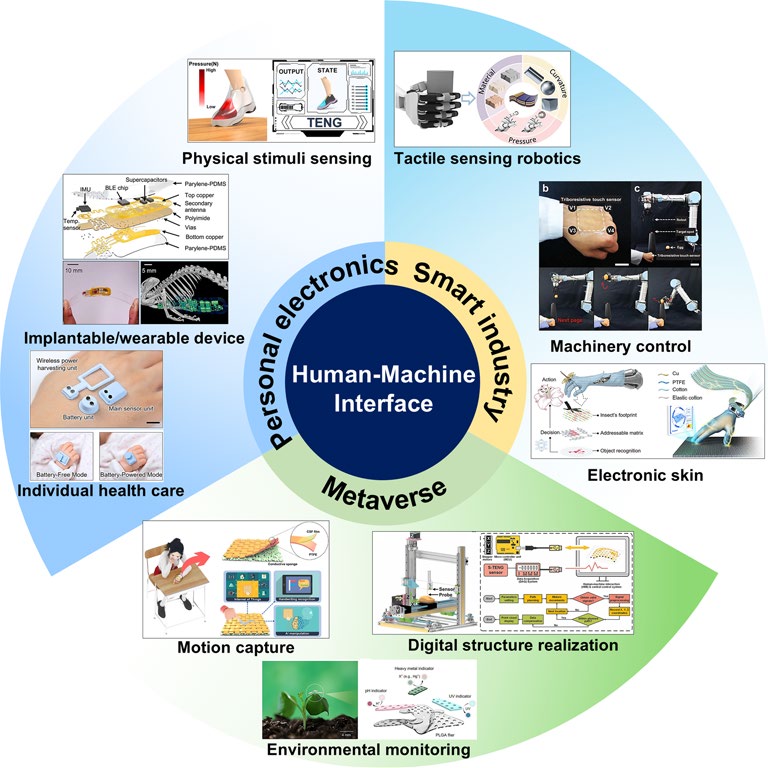



As intelligent electronics become increasingly integrated into daily life, human–machine interfaces (HMIs) require sensing platforms that are not only wearable and self-powered but also capable of translating human signals into adaptive machine functions. Now, researchers from Kyung Hee University and the National University of Singapore, led by Professor Dongwhi Choi and Professor Chengkuo Lee, have presented a comprehensive review that bridges the gap between self-powered triboelectric sensing and AI-assisted human-centric smart electronics.
Why This Review Matters
Traditional wearable sensors often rely on external power sources and suffer from limited signal interpretation capabilities, which restricts their practical deployment in real-world interactive systems. This review overcomes these limitations by systematically connecting triboelectric wearable sensors—from fundamental working principles to cutting-edge AI integration—establishing a clear pathway toward next-generation human-centric smart electronics for healthcare, gesture interaction, robotics, intelligent transportation, and the metaverse.
Innovative Framework and Mechanism
The review presents a wearable-centered framework covering self-powered sensing principles, material selection, device architectures, and fabrication strategies. At its core, triboelectric sensors operate through the contact electrification between two different material surfaces, generating self-powered electrical signals without external batteries. The researchers identify artificial intelligence-assisted signal processing, triboelectric artificial synapses, and neuromorphic computing as the critical bridges that transform passive self-powered sensing into adaptive, intelligent HMI systems. These bioinspired architectures emulate biological synaptic plasticity—including excitatory postsynaptic currents (EPSCs), paired-pulse facilitation (PPF), short-term potentiation (STP), and long-term potentiation (LTP)—enabling hardware-level preprocessing of sensory inputs with exceptional energy efficiency.
Outstanding Performance and Applications
The reviewed systems demonstrate remarkable capabilities across diverse domains. In healthcare, triboelectric stethoscopes achieve 97% diagnostic accuracy for cardiac conditions through machine learning, while AI-assisted gait analysis enables personalized rehabilitation with patient-specific pattern recognition. For gesture recognition, wristband-based systems attain 92.6% accuracy for full keyboard input, and multimodal smart gloves integrate tactile sensing, thermal feedback, and pneumatic actuation for immersive interaction. In device control, triboelectric gloves enable real-time robotic manipulation and virtual instrument playing with classification accuracies exceeding 99%. For intelligent transportation, driver-state-aware sensing systems achieve 94.72% accuracy in non-driving behavior identification, dynamically adjusting takeover time budgets in autonomous vehicles. In robotics, multimodal tactile sensors integrated with deep learning enable object recognition accuracies up to 98.1%, while soft grippers demonstrate adaptive grasping strategies for complex manipulation tasks.
Metaverse and Future Outlook
When paired with AI-driven signal processing, triboelectric wearable sensors unlock transformative metaverse applications—including real-time motion tracking, haptic feedback, and immersive virtual interaction—with recognition accuracies exceeding 95% for athletic performance analysis and 93.54% for gait-based user identification in VR environments. The convergence of multifunctional perception, embodied intelligence, natural interaction, emotional communication, and bioinspired iontronic materials points toward a future where triboelectric wearable systems evolve from simple self-powered sensing units into integrated intelligent interfaces that seamlessly connect humans, machines, and adaptive digital environments.
Stay tuned for more groundbreaking research from this collaborative team at Kyung Hee University, Chonnam National University, UCLA, and the National University of Singapore!

Editor of Nano-Micro Letters, which is an Open-Access, peer-reviewed journal reported papers that have at least one dimension ranging from a few sub-nanometers to a few hundreds of micrometers. The journal is published by Springer Nature and indexed by SCI, EI, SCOPUS, Pubmed, etc. The 2025 JCR Impact Factor is 38.5. The 2025 CiteScore is 58.9.
Follow the Topic
-
Nano-Micro Letters
Nano-Micro Letters is a peer-reviewed, international, interdisciplinary and open-access journal that focus on science, experiments, engineering, technologies and applications of nano- or microscale structure and system in physics, chemistry, biology, material science, and pharmacy.