Unlocking Reversible Mn2+/MnO2 Chemistry in Semisolid Slurry Electrodes for High-Performance Aqueous Zn–Mn Batteries
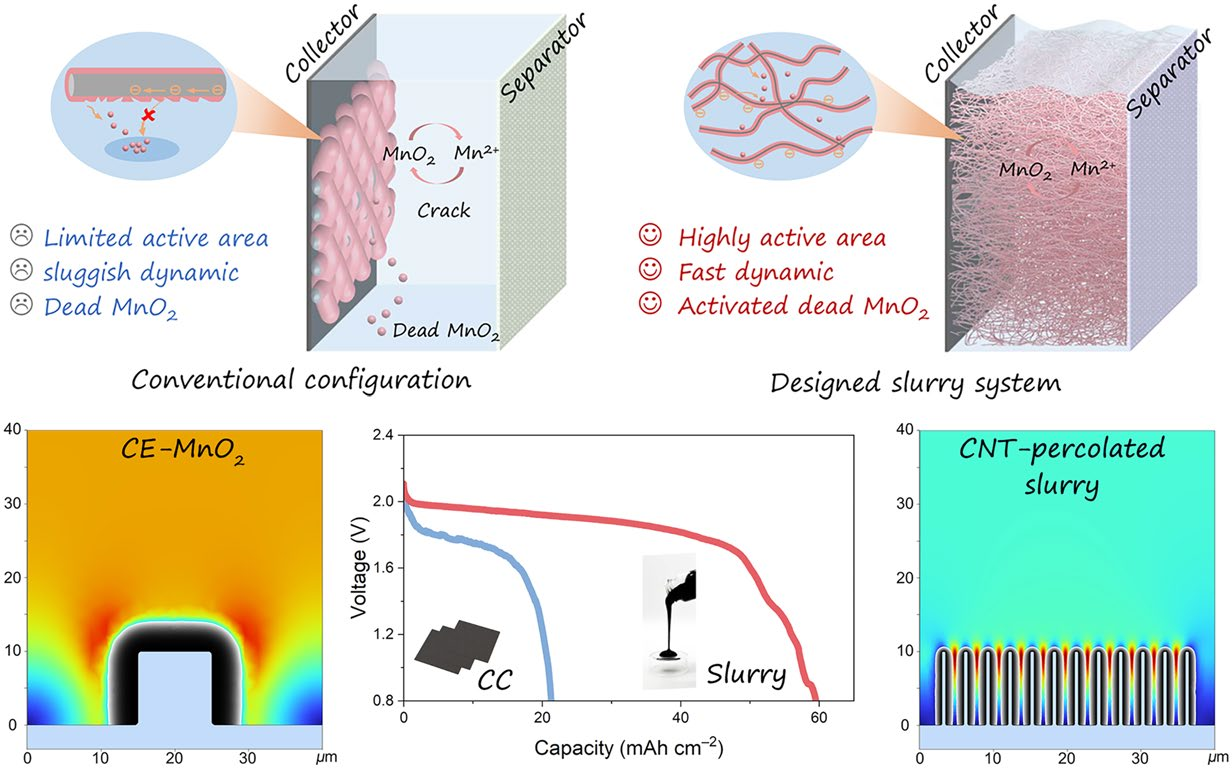
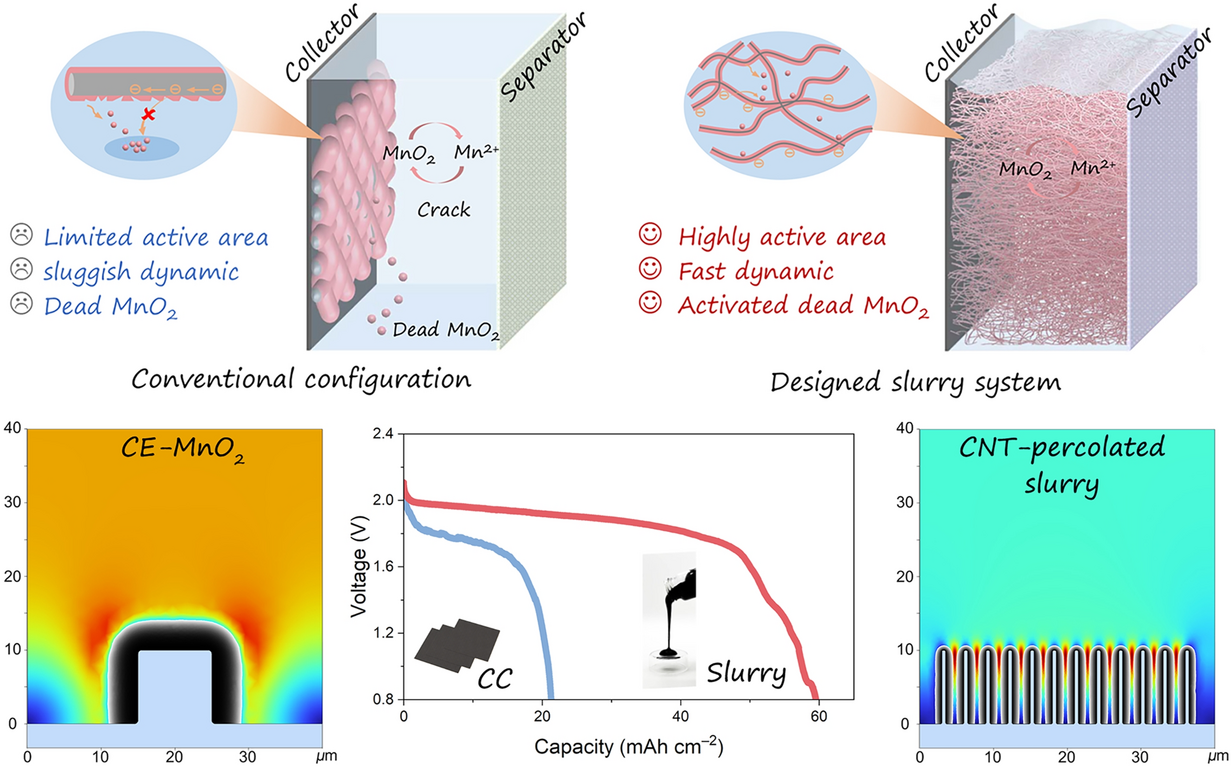

Electrolytic Zn–MnO2 batteries are promising candidates for safe and sustainable energy storage owing to their high voltage, environmental benignity, and cost-effectiveness. However, practical applications are hindered by the poor conductivity and the irreversible dissolution of conventional ε-MnO2 deposits. Herein, we report a scalable semisolid slurry electrode architecture that enables stable MnO2 deposition/dissolution using a three-dimensional percolating network of carbon nanotubes (CNTs) as both conductive matrix and deposition host. The slurry system promotes the formation of highly conductive γ-MnO2 owing to enhanced charge transfer kinetics, enabling overall dissolution rather than the localized separation typically seen in traditional electrodes. The Zn–MnO2 slurry cell exhibits a reversible areal capacity approaching 60 mAh cm−2. Moreover, the flowable nature of the slurry allows electrochemically inactive MnO2 formed during dissolution to be reconnected and reactivated by CNTs in the rheological network, ensuring deep utilization and cycling stability. This work establishes a slurry electrode strategy to improve electrolytic MnO2 reactions and offers a viable pathway toward renewable aqueous batteries for grid-scale applications.

Editor of Nano-Micro Letters, which is an Open-Access, peer-reviewed journal reported papers that have at least one dimension ranging from a few sub-nanometers to a few hundreds of micrometers. The journal is published by Springer Nature and indexed by SCI, EI, SCOPUS, Pubmed, etc. The 2025 JCR Impact Factor is 38.5. The 2025 CiteScore is 58.9.
Follow the Topic
-
Nano-Micro Letters
Nano-Micro Letters is a peer-reviewed, international, interdisciplinary and open-access journal that focus on science, experiments, engineering, technologies and applications of nano- or microscale structure and system in physics, chemistry, biology, material science, and pharmacy.