Why Accreditation Alone Is Not Enough: From Compliance to Organizational Capability
Published in Healthcare & Nursing, Public Health, and Mechanical Engineering

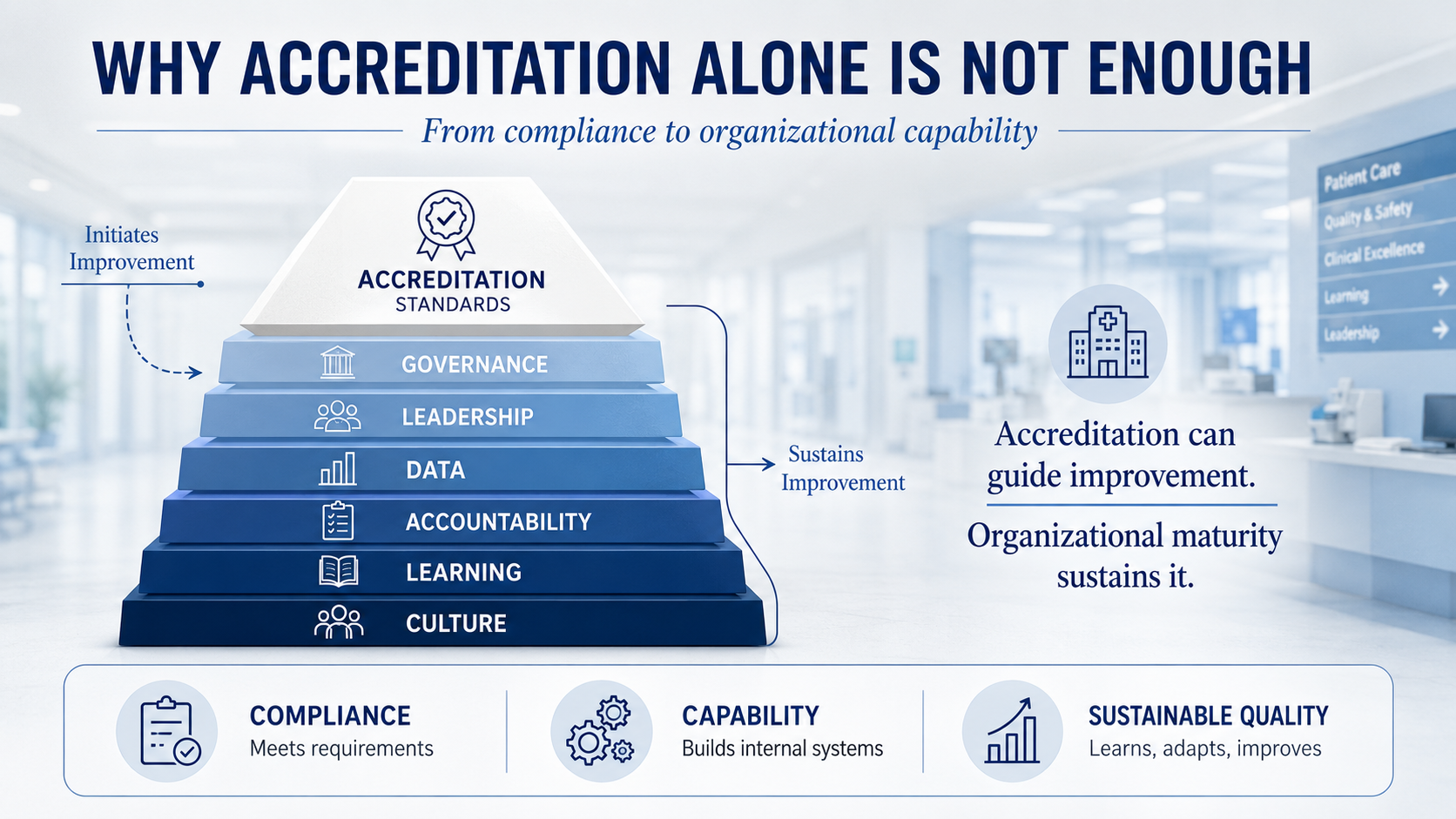


Accreditation has become one of the most recognized pathways for improving healthcare quality and patient safety.
Hospitals pursue accreditation to strengthen standards, reduce variability, improve processes, and demonstrate commitment to safer care. In many settings, accreditation also creates a shared language for quality improvement and helps organizations structure their governance systems.
Yet an important question remains:
Why do accredited hospitals still vary so much in their capacity to sustain improvement?
The answer may lie in the difference between compliance and capability.
Compliance means meeting a requirement.
Capability means developing the organizational conditions to maintain, adapt, and continuously improve those requirements over time.
This distinction is essential in healthcare.
- A hospital can implement protocols.
- A hospital can monitor indicators.
- A hospital can train teams.
- A hospital can prepare for external assessment.
But if these practices are not supported by governance structures, leadership alignment, reliable information systems, accountability, and organizational learning, quality improvement may remain fragile.
Accreditation may define what good systems should look like.
Organizational maturity determines whether those systems can work consistently under pressure.
This perspective became increasingly clear in our recent longitudinal study, Organizational Maturity as a Tool for Quality Governance: A Longitudinal Study in a Brazilian Hospital, published in International Journal for Quality in Health Care Communications.
In that study, we observed the evolution of organizational maturity over four years in a Brazilian hospital. The findings suggested that quality governance is not merely a set of formal structures, but a developing organizational capability involving coordination, monitoring, standardization, and continuous improvement.
This has important implications for accreditation.
If accreditation is treated only as a checklist, its effect may be temporary.
If accreditation is used as a governance framework, it can become a catalyst for institutional learning.
The difference is not in the standard itself.
It is in how the organization internalizes the standard.
In complex healthcare systems, quality is rarely sustained by isolated initiatives. It depends on the ability to connect strategy, operations, clinical practice, data, leadership, and frontline work.
This connection becomes especially important when hospitals face operational pressure, workforce shortages, financial constraints, digital transformation, and increasing patient safety demands.
Under these conditions, organizations may comply with standards during assessment periods while still struggling to maintain consistent performance in daily operations.
That is why accreditation should not be seen as the final destination of quality improvement.
It should be seen as part of a broader journey toward organizational maturity.
A mature healthcare organization does not improve only because external standards require it.
It improves because it has developed internal systems capable of learning, adapting, and sustaining progress.
This also helps explain why similar improvement tools may produce different results across hospitals.
Protocols, dashboards, audits, training programs, and Lean Healthcare tools do not operate in isolation. Their effectiveness depends on the organizational environment in which they are implemented.
In a recent quality improvement preprint on visual management of nursing schedules, we described how operational visibility supported workforce balancing and reduced overtime coverage in a Brazilian hospital. The intervention depended not only on a dashboard, but on routines, coordination, decision-making, and governance structures that allowed information to become action.
This reinforces a broader lesson.
Healthcare improvement is not only about adopting better tools.
It is about building organizations capable of using those tools effectively.
Accreditation can open that path.
But governance, maturity, and organizational learning are what allow hospitals to keep walking it.
Perhaps the future of accreditation in healthcare should not be limited to asking whether hospitals meet standards.
It should also ask whether hospitals are becoming more capable of improving themselves.
Related research
Rodrigues Filho RND, Morais LG. Organizational Maturity as a Tool for Quality Governance: A Longitudinal Study in a Brazilian Hospital. International Journal for Quality in Health Care Communications. 2026. DOI: 10.1093/ijcoms/lyag022.
Rodrigues Filho RND et al. Visual Management of Nursing Schedules for Workforce Balancing and Reduction of Overtime Coverage: A Longitudinal Quality Improvement Study. Research Square Preprint. DOI: 10.21203/rs.3.rs-10121229/v1.
Related literature: healthcare accreditation, quality governance, organizational maturity, Lean Healthcare, and sustainability of quality improvement interventions.






Please sign in or register for FREE
If you are a registered user on Research Communities by Springer Nature, please sign in
Nice,
Very good information for standard healthcare systems