Why can a long-lived interface persist between fully miscible fluids?


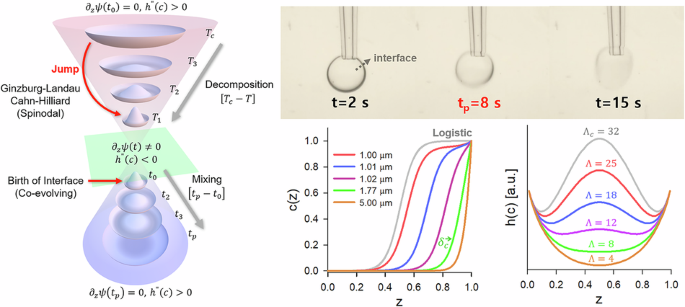

In our recent work, we introduce the Co-Evolving Variational First Principle (CVFP) to explain the emergence, persistence, and eventual decay of long-lived interfaces in fully miscible fluids.
The key idea is that the interfacial concentration field does not evolve on a fixed thermodynamic landscape. Instead, the Euler–Lagrange solution and the underlying free-energy landscape co-evolve self-consistently as a coupled pair. This hidden variational structure gives rise to optimal nonequilibrium pathways through a sequence of quasi-stationary states.
The framework reveals a dual structure between interfacial enthalpy and concentration-gradient energy, explains why long-lived miscible interfaces can form, and predicts their lifetime quantitatively across different fluid systems. It provides a unified description of the birth, persistence, broadening, and rupture of miscible interfaces within a first-principles variational framework.
The universal law behind long-lived interfaces in fully miscible fluids
Communications Physics 9, 300 (2026)
DOI: 10.1038/s42005-026-02869-0
Follow the Topic
-
Communications Physics
An open access journal from Nature Portfolio publishing high-quality research, reviews and commentary in all areas of the physical sciences.

Related Collections
With Collections, you can get published faster and increase your visibility.
Quantum machine learning: understanding capabilities, limitations, and perspectives for quantum advantage
Publishing Model: Open Access
Deadline: Dec 31, 2026
Advances in Quantum Networking: QKD and beyond
Publishing Model: Open Access
Deadline: Jan 31, 2027