Why care about medieval guide dogs?
Published in Arts & Humanities
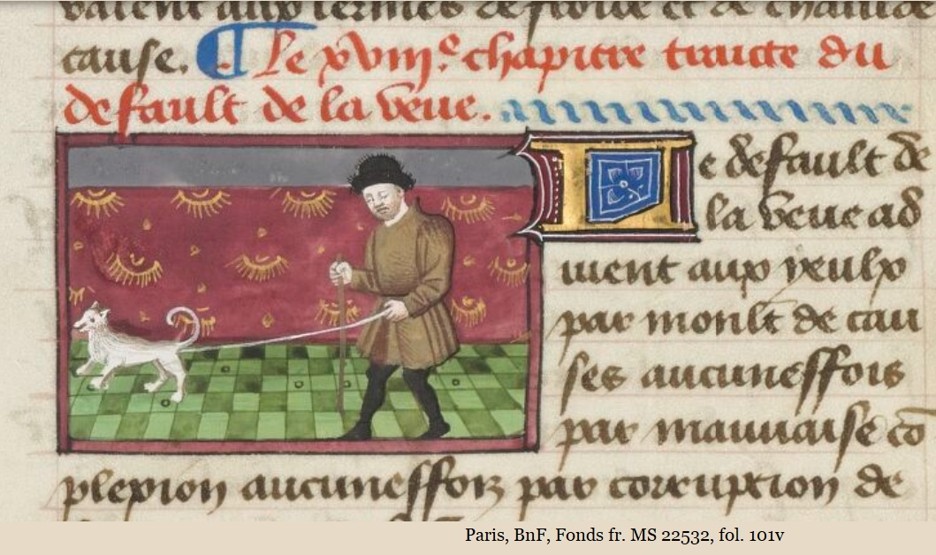


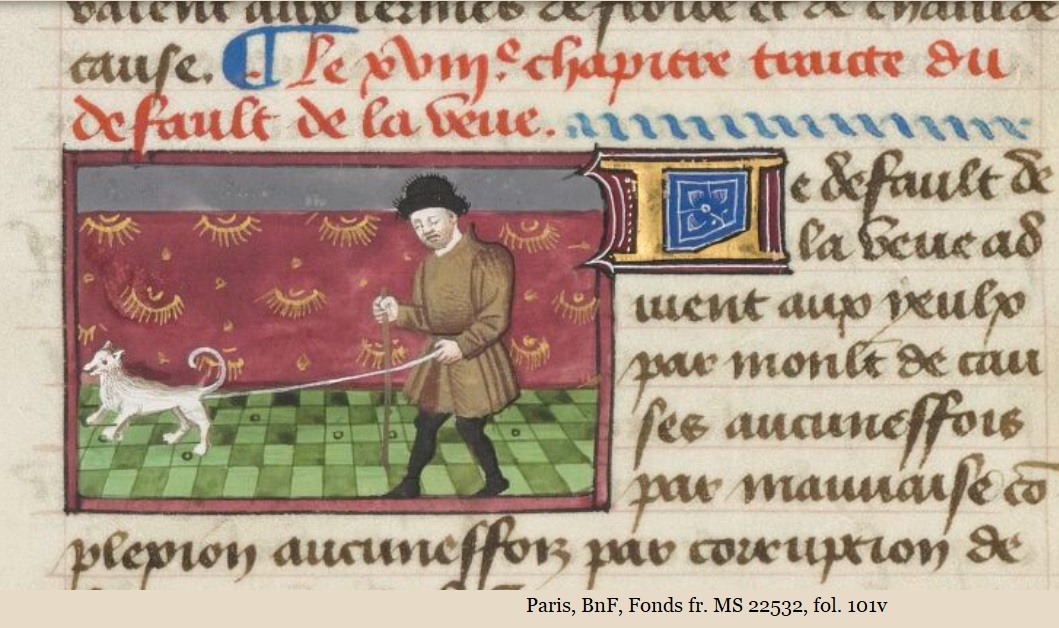
My latest book (which is forthcoming soon) explores medieval texts and manucript images depicting guide dogs. For example, my book considers the image below of a man walking with a guide dog, which is from a fifteenth-century manuscript containing a French translation of Bartholomaeus Anglicus’ De proprietatibus rerum. This encyclopaedic work includes a discussion of guide dogs in a section on “defectus visus” (“visual impairment”). My book examines examples like this image (and the text that accompanies it) using both qualitative and quantitative approaches. The goal of this investigation is to reveal new information about medieval guide dogs and their owners, including cultural attitudes toward them, and their depicted characteristics.
Why study medieval guide dogs and their owners?
Exploring this evidence can provide valuable information about cultural attitudes toward people living with blindness and visual impairments during the medieval period. Exploring the histories of medieval guide dog owners is important, because it elucidates an important but overlooked side of history; historians and literary scholars for a long time paid insufficient attention to the lives and experiences of people with disabilities in the past, which has left an important chapter of medieval cultural history unfinished.
Medieval disability studies and modern disability advocacy
Investigating medieval guide dogs and their representations also has broader value. As I show in my book, the topic is relevant to several cultural movements today. International organisations are increasingly recognising and highlighting the more culturally embedded aspects of living with a disability. The social and cultural sides of disability are, for example, emphasized in the EU Accessibility Act and the UN Convention On The Rights Of Persons With Disabilities. Exploring medieval attitudes toward guide dogs and their owners contributes to this broader movement by providing insight into some of the roots of present-day cultural attitudes toward people with disabilities.
Investigating medieval guide dogs and their owners also has another benefit. As organisations increasingly recognise the cultural aspects of disability, there is a growing awareness that paying attention to the histories of disability communities has a benefit for contemporary society. For people living with a disability today (whether blindness or another disability), it can be valuable to see the histories of our communities incorporated into broader social histories—a reminder that, as disability advocates stress, "we have always been here."1 For those outside of the disability community, it can be valuable to be reminded that body diversity has a long and important history.
1. See, for example, the survey response quoted in Esther Fox, “Curating for Change: How Can D/deaf, Disabled, and Neurodivergent Curators Drive Change in Museums in Terms of Cultural Representation and Inclusive Interpretation?” in The Museum Accessibility Spectrum: Re-Imagining Access and Inclusion, ed. by Alison F. Eardley, and Vanessa E. Jones (Oxford: Taylor & Francis Group, 2025), 195-208, p. 196.

Follow the Topic
-
Palgrave Macmillan
Palgrave Macmillan is a world-class publisher of books and journals with more than 175 years’ experience in the Humanities and Social Sciences.

Introducing the Palgrave Macmillan Campaign for the Humanities
At Palgrave Macmillan we publish cutting-edge humanities research that has real-world impact. This research community brings together the voices of our authors and editorial team to highlight and publicize the value of the humanities and humanities research in our world today.
Continue reading announcement


