Zwitterionic Ionogels Resolving the Trade‑Off Between Mechanical Strength and Autonomous Self‑Healing for Iontronics
Published in Materials
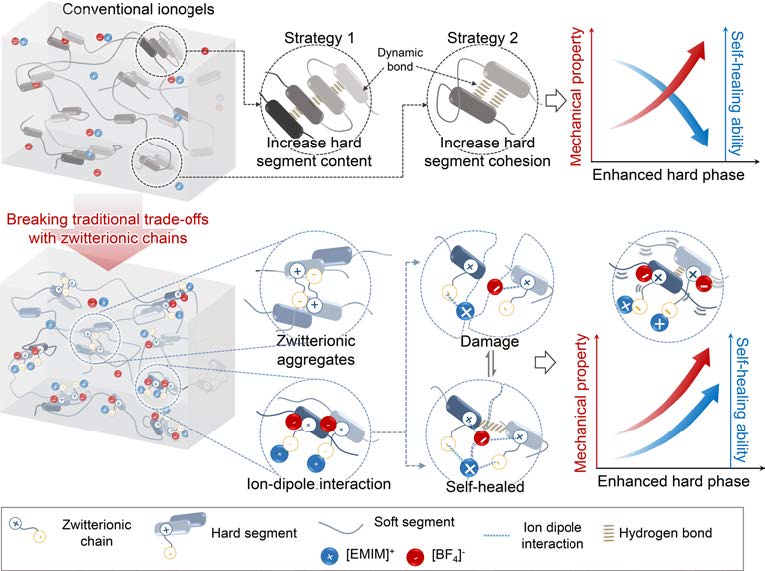
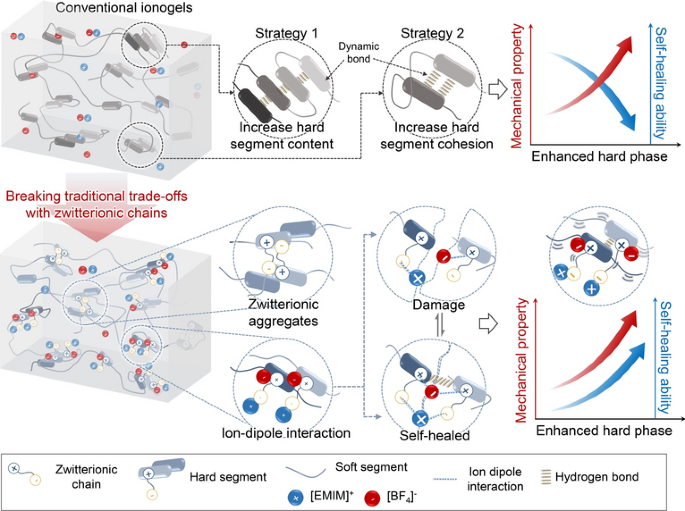

As flexible and wearable electronics continue to advance, there is an increasing need for soft materials that combine mechanical robustness, high ionic conductivity, and autonomous self-healing. Ionogels are promising candidates for wearable sensors, intelligent packaging, soft robotics, and human–machine interfaces, but conventional strengthening strategies often restrict polymer-chain mobility and compromise self-healing. Researchers from Hanyang University and KAIST have developed a zwitterionic side-chain engineered tough ionogel, ZESTI, that overcomes this trade-off through molecular-level regulation of polymer–ion interactions.
Why This Ionogel Matters
Achieving high strength and autonomous self-healing simultaneously remains challenging because dense cross-linking reinforces polymer networks but limits the molecular rearrangement required for healing. The researchers introduced hydrophilic zwitterionic side chains into a hydrophobic polyurethane backbone to address this conflict. The zwitterionic groups simultaneously regulate microphase separation, reinforce hard domains, organize the ionic liquid, and provide reversible interactions, enabling mechanical reinforcement without sacrificing molecular mobility and self-repair.
Innovative Design and Mechanism
ZESTI relies on synergistic dipole–dipole and ion–dipole interactions. Zwitterionic groups promote aggregation of polyurethane hard segments, forming physical cross-linking domains that provide mechanical reinforcement and energy dissipation. Meanwhile, their dynamic interactions with [EMIM][BF4] facilitate ion transport while maintaining the polymer microstructure. Under deformation, these reversible interactions dissociate and reform, enabling stress dissipation and molecular rearrangement. The resulting network therefore integrates mechanical strength, ionic conduction, and autonomous healing within the same molecular architecture.
Outstanding Performance
The optimized ZESTI containing 30 wt% ionic liquid achieves a tensile strength of 10.40 MPa, an elongation at break of 1606%, and a toughness of 56.03 MJ m-3. Its ionic conductivity reaches 0.07 mS cm⁻¹, approximately 28 times higher than the non-zwitterionic control, while the ion-migration activation energy decreases from 29.95 to 23.99 kJ mol-1. Remarkably, a 50 μm surface scratch completely disappears within 135 min at room temperature, and the healed material recovers its mechanical integrity after 24 h. The material also maintains stable mechanical responses during repeated deformation.
Applications and Future Outlook
The combination of toughness, ionic conductivity, and autonomous recovery enables ZESTI to function in multifunctional iontronic devices. As a damage-tolerant self-reporting packaging interface, it achieves 96.6% classification accuracy before damage and 93.1% after self-healing, demonstrating recovery of sensing functionality. As a stretchable strain sensor, ZESTI exhibits gauge factors of 1.44 and 2.07 over 0–250% and 250–500% strain, respectively, while maintaining stable signals over 1000 cycles. Overall, this work establishes zwitterionic side-chain engineering as a promising strategy for developing durable, self-healing ionic materials for wearable electronics, intelligent packaging, human–machine interfaces, and soft bioelectronics.

Editor of Nano-Micro Letters, which is an Open-Access, peer-reviewed journal reported papers that have at least one dimension ranging from a few sub-nanometers to a few hundreds of micrometers. The journal is published by Springer Nature and indexed by SCI, EI, SCOPUS, Pubmed, etc. The 2025 JCR Impact Factor is 38.5. The 2025 CiteScore is 58.9.
Follow the Topic
-
Nano-Micro Letters
Nano-Micro Letters is a peer-reviewed, international, interdisciplinary and open-access journal that focus on science, experiments, engineering, technologies and applications of nano- or microscale structure and system in physics, chemistry, biology, material science, and pharmacy.