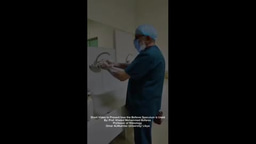
Bofares sign for the clinical diagnosis of choanal atresia
Published in Biomedical Research
Key message:
Bofares sign can be described as simple clinical and intraoperative screening test, which aimed to elucidate and search for missed unilateral as well as partial bilateral choanal atresia. It can be performed as additive routine step at the end of adenoidectomy procedure. It is beneficial test with no considerable harm.
Key words: Bofares sign, choanal atresia, adenoidectomy.
Text:
The key message of this technique is that the Bofares sign can be described as simple clinical and intraoperative screening test, which aimed to elucidate and search for missed unilateral as well as partial bilateral choanal atresia. It can be performed as additive routine step at the end of adenoidectomy procedure. It is beneficial test with no considerable harm.
Among childhood ages, there is high chance of the overlapping of the clinical manifestations of this condition with other common disease circumstances, which are considered as commonly deemed conditions, and they have somewhat same clinical manifestations of this problem, particularly adenoid enlargement, Thus, the unilateral choanal atresia even the complete one can be associated with high risk of its missing. In accordance, it will increase significantly the risk of the incomplete cure after sufficient surgical interventions.
Therefore, via this simple and safe screening test, the missed unilateral choanal atresia or missed bilateral partial choanal atresia can be illustrated.
Background:
The choanal atresia is considered as one of important disease processes in rhinology particular, and in otorhinolaryngology as general. This condition is worthwhile situation, because it might be presented as emergency circumstance especially if it is associated with bilateral and complete obliteration of posterior choana of the nasal cavity. However, this condition is due to the congenital and developmental defect of the canalization of the posterior choana, therefore, the diagnosis of the bilateral and complete choanal atresia will become very suggestable among the distressed newborns with nasal breathing difficulties. Moreover, the missing of the diagnosis will be increased among the unilateral or partial disease.
On the other hand, there is high chance of the overlapping of the clinical manifestations of this condition with other common disease circumstances, which are considered as commonly deemed conditions, and they have somewhat same clinical manifestations of this problem, namely adenoid enlargement, hypertrophied inferior turbinates, deviated nasal septum, and chronic rhinosinusitis with or without nasal polyposis. In the same context, most likely, the diagnosis of these conditions is made based on the clinical evaluation rather than the concern of the local radiological assessment. In addition, the unilateral choanal atresia is forgotten and unforeseen differential diagnosis for those conditions, which have resembled nasal obstruction related symptoms and signs. Thus, the unilateral choanal atresia even the complete one can be associated with high risk of its missing. In accordance, it will increase significantly the risk of the incomplete cure after sufficient surgical interventions.
Although, this case can be described as rare situation that we face at our practical life, but the incidence is still identifiable. For this reason, and based on my experience, always I tried to determine this problem among all patients, who present with recalcitrant nasal obstruction, particularly if the surgery was considered as the treating decision for them. However, from economic point of view, especially at our societies, it becomes very difficult to request every patient with clinically diagnosed nasal obstruction related problem for CT scan imaging. Thence, it becomes very necessary to achieve the accidental diagnosis of this condition clinically. Moreover, the thinking is motivated to find out and invent certain maneuvers to establish this aim. As long as the Bofares sign was created.
Methodology:
The aim of Bofares sign:
Bofares sign was created for the purpose of the detection of missed complete unilateral choanal atresia.
The basic principles for illustration of Bofares sign:
- The idea of this sign is depending up on the irrigation of the nasal cavity by normal saline solution. This irrigation should be provided with sufficient amount of solution and applied with strong pushing force to elucidate the resistance.
- As the clinical picture of the missed unilateral complete choanal atresia is overlapped with the clinical presentation of the other co-existing conditions, which manifested with persistent nasal obstruction that leads to the concerning of the surgical treatment as decision of choice for these conditions. Hence, the adenoid enlargement can be considered as the commonest disorder, particularly among childhood group, which may overlap with missed unilateral choanal atresia. Therefore, I recommend to perform this sign intraoperatively after the adenoidectomy. This is reasoned by the presence of the child under general anesthesia. In accordance, the child is still intubated with cuffed endotracheal tube and this will minimize the risk of aspiration during the conduction of forceful irrigation, as well as this will help in the performance of the irrigation with large amount of the solution as rapid as soon as possible for successful demonstration of this sign.
- The sign is illustrated and considered positive if the irrigated solution return to the exterior in projectile manner, immediately after remove of the inserted syringe.
How I do it?
- I recommend to demonstrate this sign as a routine step intraoperatively after every nasal surgical procedure, which was done as surgical intervention to treat different nasal obstructive condition, especially if the procedure was done as conventional technique rather than endoscopic technique.
- The large syringe of 20cc to 60cc (according to the age of the patient) will be considered for the performance of this sign.
- The syringe filled with normal saline is introduced by its head via the nostril with proper fitting of the syringe head to the nostril.
- The normal saline solution is irrigated into the corresponding nasal cavity with maximum force and shorter duration.
- The positive Bofares sign is considered if the solution immediately appear escape outside the tested nasal cavity around the head of the syringe, and just by the remove of the syringe the solution will come out as a gush in projectile forced manner.
Discussion:
The interpretation of Bofares sign:
As it is well known that the complete choanal atresia is associated with complete obliteration of the drainage from the nasal cavity to the postnasal space. The gushing of the irrigated solution in a projectile manner is explained by the complete obstruction of its flow postnasally. Moreover, this solution is accumulated under high pressure, which is produced by the forceful irrigation of large amount of the solution in short duration, thus, the projectile gush to the back is immediately elucidated just after the remove of the applied syringe. Thence, this sign can be considered as a pathognomonic sign for the diagnosis of complete choanal atresia. However, the other nasal obstructive conditions even if they are associated with complete nasal obstruction still they will present a potential spaces that allow the passage of the solution and will fail to raise the intranasal pressure, which is considered as the cornerstone for the demonstration of this sign.
Advantage of this sign:
This sign is simple test based sign can be demonstrated easily by everyone, and it helps pathognomonically in the confirmation of the diagnosis of complete choanal atresia, particularly among the patients, who are difficult to be evaluated furtherly because of lack of proper facilities.
Disadvantage of this sign:
Hence, this sign is depending mainly up on the production of high intranasal pressure to give a chance for development of the typical appearance of the projectile back gushing. Therefore, if the atresia was membranous rather than bony, it may get rupture under the effect of this high pressure, resulting in massive bleeding. The bleeding and forced solution may increase the risk of the aspiration. On the other hand, this disadvantage still can be overcame by the sustained intubation with proper sized cuffed endotracheal tube.