A case study on overshooting convective storms in the westernghats region– multi-sensor approach
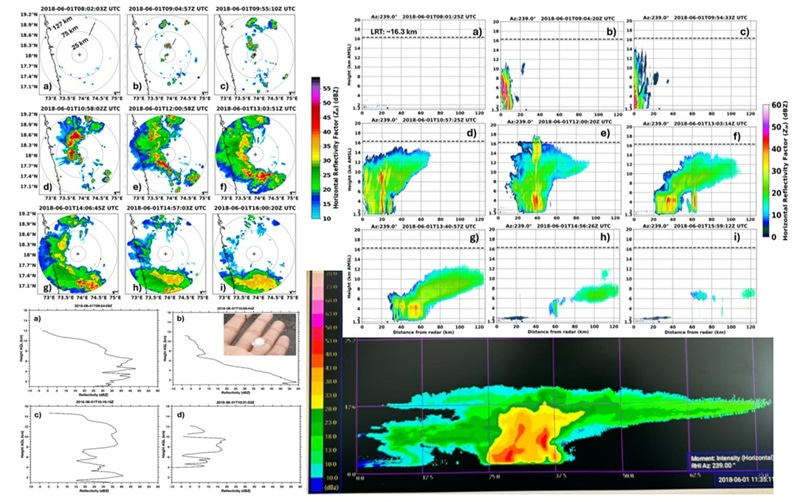
Our latest article published in Meteorology and Atmospheric Physics examines an Overshooting Convective Storm that occurred on June 1, 2018, over the Western Ghats. We identified 16,587 OCS grid points, revealing intense convection and significant rainfall. https://doi.org/10.1007/s00703-026-01153-8
A case study on overshooting convective storms in the westernghats region– multi-sensor approach
Like

Share this post

Choose a social network to share with, or copy the URL to share elsewhere

This is a representation of how your post may appear on social media. The actual post will vary between social networks

Cite this article

Devisetty, H., Krishna, U.V.M., Jha, A.K. et al. A case study on overshooting convective storms in the westernghats region– multi-sensor approach. Meteorol Atmos Phys 138, 61 (2026). https://doi.org/10.1007/s00703-026-01153-8

Overshooting Convective Storms (OCSs) are powerful weather phenomena that penetrate the tropopause, typically reaching altitudes of 16–20 km in tropical regions. Our study shows that these storms can reach beyond 17.5 km, with intense convection and significant lightning activity. This observational study focuses on an OCS event on 01 June 2018 over the Western Ghats, using data from multiple sensors. The storm exhibited near-surface reflectivity over 55 dBZ and rainfall rates exceeding 100 mm/h. It was associated with large hydrometeors and intra-cloud lightning, with storms having reflectivity greater than 45 dBZ being primary contributors to lightning. ERA5 reanalysis data indicated favorable conditions for storm development, including high Convective Available Potential Energy (~2000 J/kg) and strong updrafts. However, more work is still needed to enhance forecasting skills for predicting lightning and heavy rainfall in complex terrains.

Follow the Topic

Spotlight on Research from India
Research Publishing > Spotlight on Research from India

Related Collections

With Collections, you can get published faster and increase your visibility.

Observational and Numerical Aspects of Compound Extreme Events

Compound extreme events—such as droughts fuelling wildfires, or heatwaves intensifying drought conditions—are becoming alarmingly common. These overlapping crises are more complex, harder to predict, and far more destructive than the sum of their parts. To protect societies and ecosystems, we must deepen our understanding of how these factors interact, and develop better tools for forecasting, risk assessment, and mitigation. Individual natural hazards are explored widely throughout the globe, though the exploration of compound extreme events is limited. This topical collection will allow us to emphasize the occurrence of compound extremes and probing their dynamics with details. Research on correlated climate extremes is advancing rapidly, bringing together expertise from climate dynamics, atmospheric science, boundary-layer meteorology, statistics, climatology, policy, and the social sciences. Projections suggest that changes in circulation patterns and regional feedback, such as land–atmosphere interactions, are likely to further intensify these risks. At the same time, cutting-edge advances in spatial statistics and extreme-value theory offer powerful new approaches to untangling this complexity. This special issue will call for original research that tackles these urgent challenges. We will invite contributions on the dynamics, forecasting, and risk assessment of compound extreme events, as well as strategies for adaptation and mitigation. Studies integrating modelling, theory, and observational data are especially encouraged. The special issue will be helpful and may serve as a guideline for a clearer understanding of these escalating threats—and chart pathways to reduce their impact.

Publishing Model: Hybrid

Deadline: Nov 01, 2026