A Charged Uranium Sandwich – Behind the Uranocenium Cation
Published in Chemistry
Uranocene, [UIV(η8-COT)2] (COT = {C8H8}2–), is the archetypal actinide organometallic sandwich complex and is often viewed as an f-block analogue of ferrocene, [FeII(η5-Cp)2] (Cp = {C5H5}–). Ferrocene is easily oxidised to the ferrocenium cation, [FeIII(η5-Cp)2]+, and the reversibility of this process forms the basis of the IUPAC electrochemical reference electrode. Uranocene, on the other hand, has previously been found unwilling to give up an electron to form the uranocenium cation, [UV(η8-COT)2]+. We now report the isolation of this elusive missing partner and show that its electrochemistry and structural properties are remarkably similar to ferrocene, completing the half-century analogy.
First reported by Streitwieser in 1968, uranocene was structurally characterised by Raymond just one year later. The structure and subsequent spectroscopic analysis revealed, for the first time, that f-orbitals played a significant role in the bonding and structure of an organometallic actinide molecule. The chemistry of ferrocene has flourished since its discovery, whereas uranocene has proven to be largely unreactive, except in reactions that decompose it. It was, therefore, through an unexpected turn of events and a bit of luck that we managed to coax new reactivity out of this molecular brick.
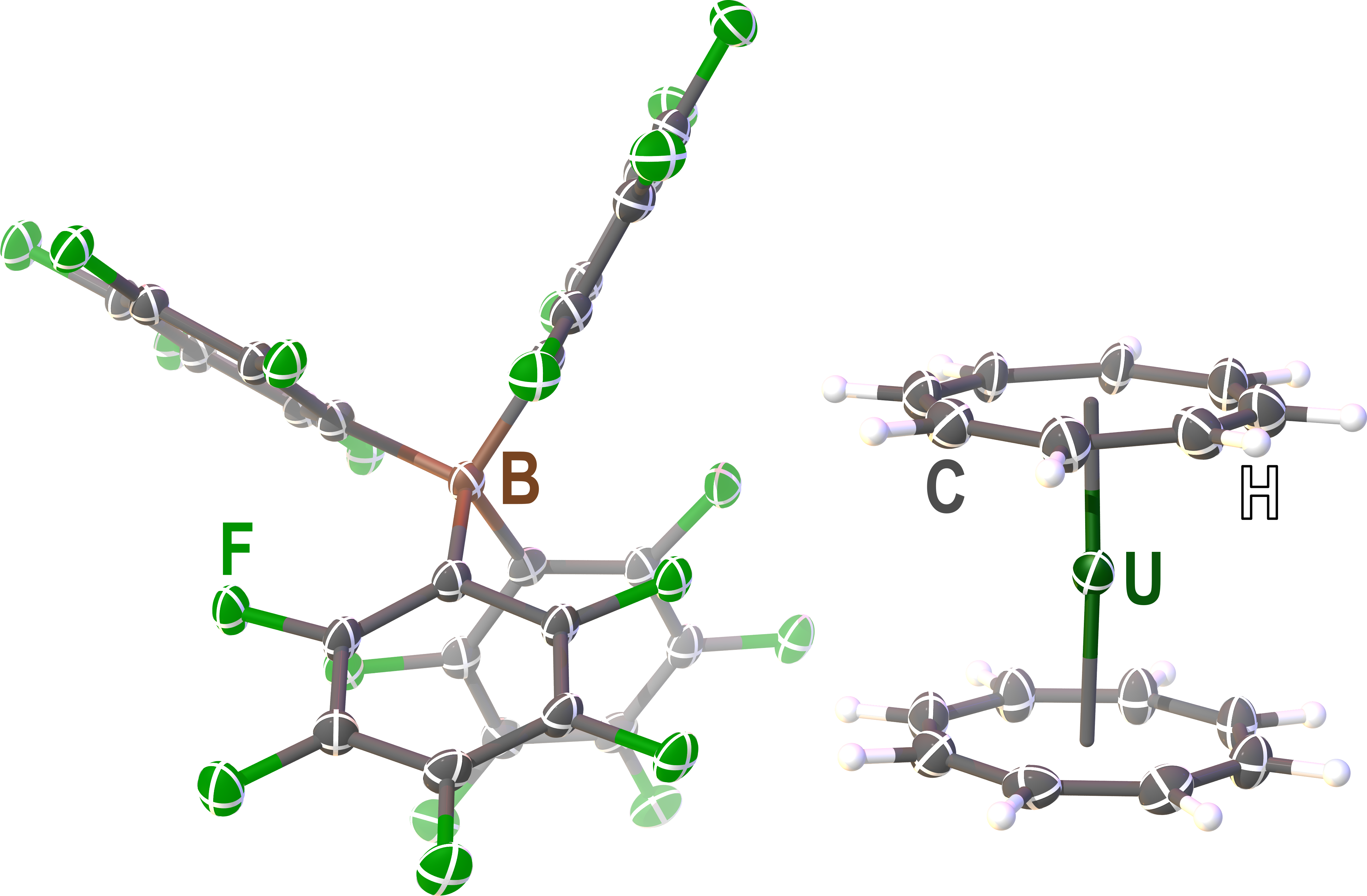
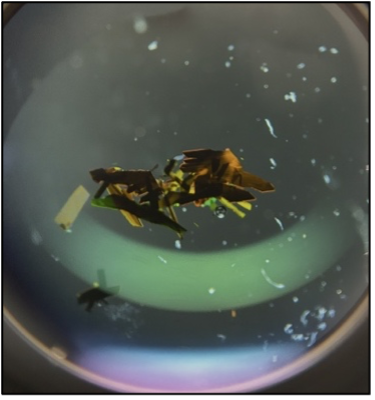
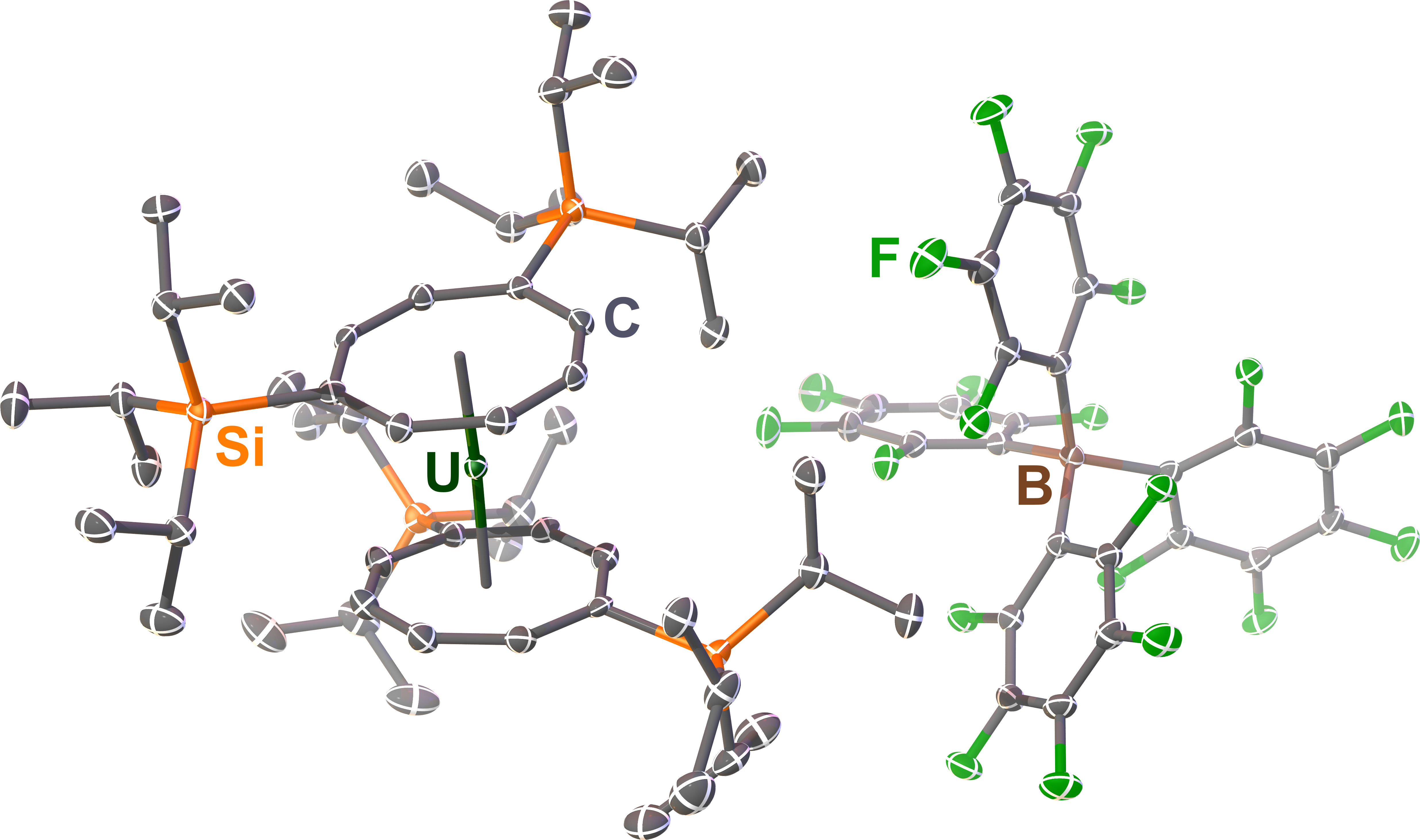
In 2025, a postdoctoral researcher in the group, Liam Griffin, was exploring the reactivity of some rare-earth molecules with the perfluorinated salt of the trityl cation – [Ph3C][B(C6F5)4]. Seeing an opportunity to give Liam experience working with uranium, and an interesting target for the group, I suggested they run this rare-earth reaction in the presence of a highly substituted uranocene analogue that Cameron had been working with – [UIV(η8-COTTIPS)2] (COTTIPS = {C8H6-1,4-(SiiPr3)2}2–). Much to my surprise, Liam’s rare-earth molecule remained unaffected, and instead the substituted uranocene was oxidised to make [UV(COTTIPS)2][B(C6F5)4], which was identified by single-crystal X-ray diffraction (crystals and molecular structure below).
Oxidation of ferrocene to the ferrocenium cation has been known since the 1950s. Conversely, before our accidental discovery, no one had isolated the uranocenium cation in any oxidation state. Two reports from the late 1970s and early 1980s by Butcher described the oxidation of uranocene as irreversible and yielding poorly defined products. These conclusions were based on electrochemical measurements in polar solvents like benzonitrile using [nBu4N][PF6] as the electrolyte, which we later found to be an unfortunate choice.
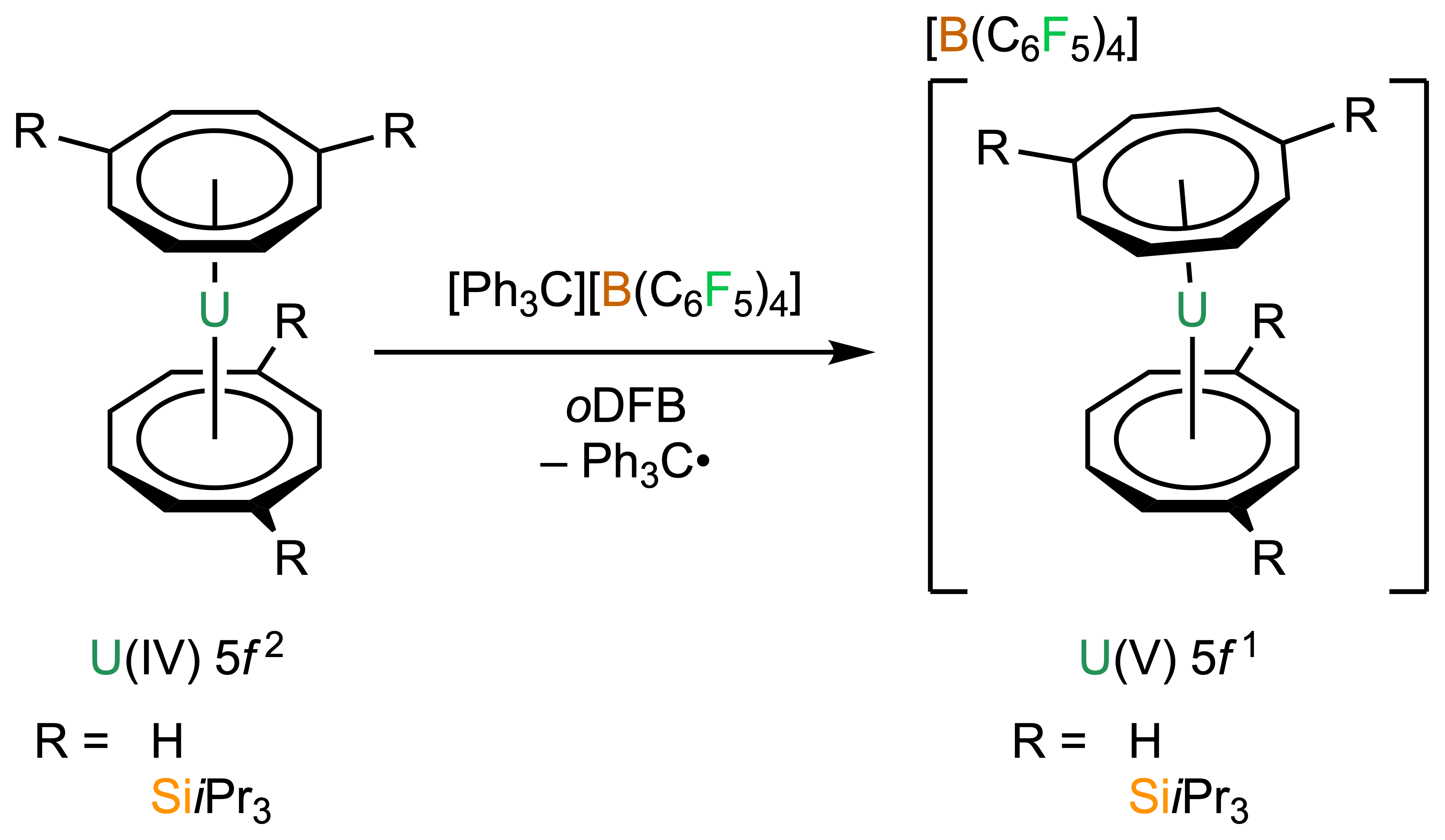
We were initially sceptical about the reproducibility of Cameron’s result, and unsure whether it was simply that the bulky tri-isopropyl-silyl substituents on the [UIV(COTTIPS)2] uranocene allowed us to stabilise the oxidised form. Therefore, Cameron set out to reproduce the initial result (sans Liam’s rare-earth additive), and to isolate the parent uranocenium complex, [UV(COT)2][B(C6F5)4], the oxidised form of uranocene. Fortunately, both proved successful; the procedure is summarised in the scheme below.
As supervisors are want to do, I then tasked Cameron with more work by adding the reduced uranocene complexes (uranocenates) [UIII(η8-COT)2]– and [UIII(η8-COTTIPS)2]– to the project so that we could ultimately compare the electronic structure and bonding across three oxidation states and two analogous ligand systems. As we began assembling a trove of structural data, a trend appeared: while the uranium–carbon bond lengths decrease as expected between the U(III) uranocenate anions, and the neutral U(IV) uranocene complexes, there was a lack of contraction upon oxidation from the U(IV) uranocenes to the U(V) uranocenium cations – this was unexpected. Bonding in f-element complexes is usually predominantly ionic in character, and so increasing the formal charge at the metal would be expected to decrease the bond lengths – yet it did not in these complexes. Normally, covalency in bonding increases in higher oxidation states, so why did our formal U(V) centres not bring the COT rings into closer contact?
To get to grips with the electronic structures of our complexes, we teamed up with colleagues, Profs Eric McInnes and David Collison, and Mr Adam Brookfield, at the EPSRC National Service for Electron Paramagnetic Resonance Spectroscopy. This proved instrumental in providing the magnetic and spectroscopic characterisation necessary to benchmark computational efforts undertaken by Dr Andrew Kerridge (Lancaster) and me. We were also extremely fortunate to have brought in a first-year PhD student to the EPR team (Iulia Turcas) who appeared unfazed by the prospect of being asked to explain the electronic structures of exotic organometallic uranium complexes at the start of her PhD.
While spectroscopic and theoretical analyses churned away, Cameron discovered that both of our uranocenium cations initiate the ring-opening living polymerisation of THF, following 1st-order kinetics. Similarly, both uranocenium cations were found to decompose immediately in the presence of [nBu4N][PF6] via fluoride abstraction, which likely explains the electrochemical data Butcher reported.
Postdoctoral researcher Benjamin Réant in our group performed an exhaustive electrochemical survey on both uranocenium cations in ortho-difluorobenzene using [nBu4N][B(C6F5)4] as the electrolyte. We found the U(V/IV) redox couples in both the parent and substituted uranocenes were diffusion-limited, and they gave peak-to-peak separations that were comparable to, or slightly less than, those of the ferrocene/ferrocenium couple at all scan rates in the same solvent/electrolyte/electrode system. By this definition, the uranocene/uranocenium redox couple is fully reversible, which provided a key piece of the puzzle. Marcus theory suggested to us that the structural reorganisation in solution upon oxidation was minimal, in line with the X-ray crystallographic measurements in the solid-state.
Finding the same structural trend between oxidation states in both solution and the solid-state led us to the conclusion that the lack of bond length contraction upon oxidation must be derived from a quirk in the electronic structure of the uranocenium cations. The spectroscopic and magnetic data suggested that both uranocenium cations were well described as containing U(V) ions, which aligned with Andrew’s multi-reference computational analyses.
Ultimately, density functional theory (DFT) provided a compelling explanation for the structural behaviour. Oxidation to U(V) resulted in a significant increase in the covalent contribution to the uranium–COT bonding. The increased electron density between the U(V) ion and the COT ring acts to resist further bond length contraction due to electron–electron repulsion. Furthermore, expulsion of electron density from the bonding region to accommodate shorter bond distances is disfavoured due to the high charge of the U(V) ion. The balance of these competing factors results in the equilibrium bond length in the uranocenium cation being essentially the same as that of neutral uranocene. This highlights a rare case of actinide–ligand covalency driving structural properties across both solid and solution phases.
So, what’s next? Transuranium analogues would test the limits of the bis-COT framework, as the increased nuclear charge even at neptunium, the next actinide element after uranium, may tip the scales between metal and ligand oxidation. There is also much still to explore about the reactivity of [UV(COT)2][B(C6F5)4]. We are excited to see where this research takes us next, so stay tuned!