A Comprehensive Review of the Functionalized Integrated Application of Gel Polymer Electrolytes in Electrochromic Devices
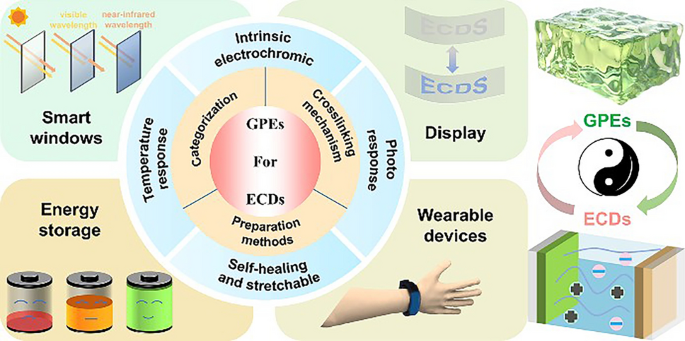
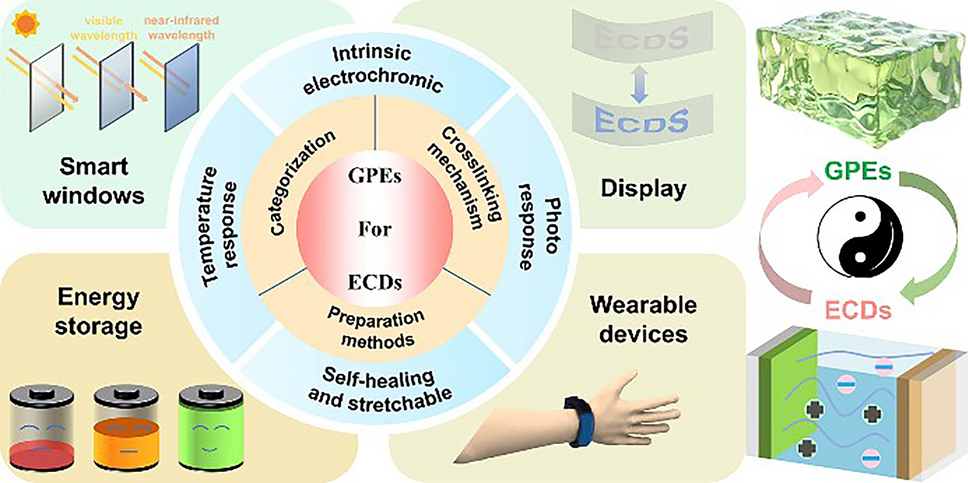

As the global push for energy conservation intensifies and the demand for low-power, flexible and wearable optical displays grows rapidly, the need for advanced electrochromic technology has surged. Now, researchers from the School of Chemistry and Chemical Engineering and the Center for Composite Materials and Structure at Harbin Institute of Technology, led by Professor Leipeng Zhang, Professor Jiupeng Zhao and Professor Yao Li, have presented a comprehensive review on the functionalized integrated application of gel polymer electrolytes in electrochromic devices. This work offers valuable insights into the development of next-generation electrochromic technologies with enhanced performance and multifunctionality.
Why Gel Polymer Electrolytes Matter
- Ion Transport Efficiency: Gel polymer electrolytes (GPEs) provide efficient ion-transport capabilities, enabling high optical modulation and fast response time in electrochromic devices while avoiding the leakage risks associated with liquid electrolytes.
- Mechanical Robustness: GPEs exhibit excellent mechanical properties and strong adhesion, which enhance device safety, streamline packaging processes, and enable applications in flexible and wearable electronics.
- Multifunctional Integration: Through rational molecular design, GPEs can be endowed with additional functionalities beyond basic electrolyte roles, including electrochromic, temperature-responsive, photo-responsive, and self-healing properties.
Innovative Design and Features
- Classification of GPEs: The review covers three main types of GPEs based on plasticizer types—hydrogels (aqueous), organogels (organic solvents), and ionogels (ionic liquids)—each offering unique advantages in terms of ionic conductivity, electrochemical stability, and operating temperature range.
- Gelation Mechanisms: The formation of GPEs relies on three-dimensional polymer networks through chain entanglement and cross-linking strategies, including physical entanglement, covalent cross-linking, dynamic covalent bonds, and non-covalent interactions.
- Preparation Methods: Both non-in situ methods (solution-casting, phase inversion, electrospinning) and in situ methods (thermal polymerization, UV-light polymerization) are discussed, with in situ preparation offering superior interfacial contact and simplified device assembly.
Functionalized GPEs and Applications
- Intrinsically Electrochromic GPEs: By incorporating viologen compounds into polymer matrices, GPEs can serve dual roles as both electrolyte and electrochromic layers, simplifying device structures and inhibiting viologen dimerization to enhance cycling stability.
- Temperature-Responsive GPEs: Utilizing polymers with lower critical solution temperature (LCST) behavior, such as poly(N-isopropylacrylamide) and hydroxypropyl cellulose, enables thermochromic functionality and thermal runaway protection for smart windows and energy storage devices.
- Photo-Responsive GPEs: Integration of photochromic materials like TiO₂ and modified viologens allows for electro-optical dual-response characteristics, enabling ultra-low voltage operation and solar-powered electrochromic systems.
- Self-Healing and Stretchable GPEs: Dynamic covalent bonds (Diels-Alder, disulfide, boronic ester) and non-covalent interactions (hydrogen bonding, ionic coordination) impart self-healing and mechanical stretchability, crucial for wearable electrochromic devices and electronic skins.
Practical Applications and Future Outlook
- Smart Windows: GPE-based electrochromic smart windows enable dynamic regulation of visible and near-infrared light transmission for energy-efficient building management, with dual-responsive systems combining electrochromism with thermochromism or photochromism.
- Energy Storage Devices: Electrochromic supercapacitors and batteries utilizing GPEs provide real-time visual monitoring of energy storage status through color changes, integrating energy storage with display functionality.
- Displays and Wearable Electronics: From flexible e-paper and multicolor displays to electronic skins and pressure sensors, GPEs enable stretchable, self-healable, and visually responsive wearable devices with simplified manufacturing processes.
- Challenges and Opportunities: The review highlights critical challenges including ion transport modulation, aging resistance under outdoor conditions, recycling and resource utilization, AI-assisted material design, and scalable manufacturing processes for commercialization.
This comprehensive review provides a roadmap for the development and application of functionalized gel polymer electrolytes in electrochromic devices. It highlights the importance of interdisciplinary research in polymer chemistry, materials science, and device engineering to drive innovation in this field. Stay tuned for more groundbreaking work from Professor Leipeng Zhang, Professor Jiupeng Zhao and Professor Yao Li at Harbin Institute of Technology!

Editor of Nano-Micro Letters, which is an Open-Access, peer-reviewed journal reported papers that have at least one dimension ranging from a few sub-nanometers to a few hundreds of micrometers. The journal is published by Springer Nature and indexed by SCI, EI, SCOPUS, Pubmed, etc. The 2025 JCR Impact Factor is 38.5. The 2025 CiteScore is 58.9.
Follow the Topic
-
Nano-Micro Letters
Nano-Micro Letters is a peer-reviewed, international, interdisciplinary and open-access journal that focus on science, experiments, engineering, technologies and applications of nano- or microscale structure and system in physics, chemistry, biology, material science, and pharmacy.