Te‑Modulated Fe Single Atom with Synergistic Bidirectional Catalysis for High‑Rate and Long–Cycling Lithium‑Sulfur Battery
Published in Bioengineering & Biotechnology and Materials
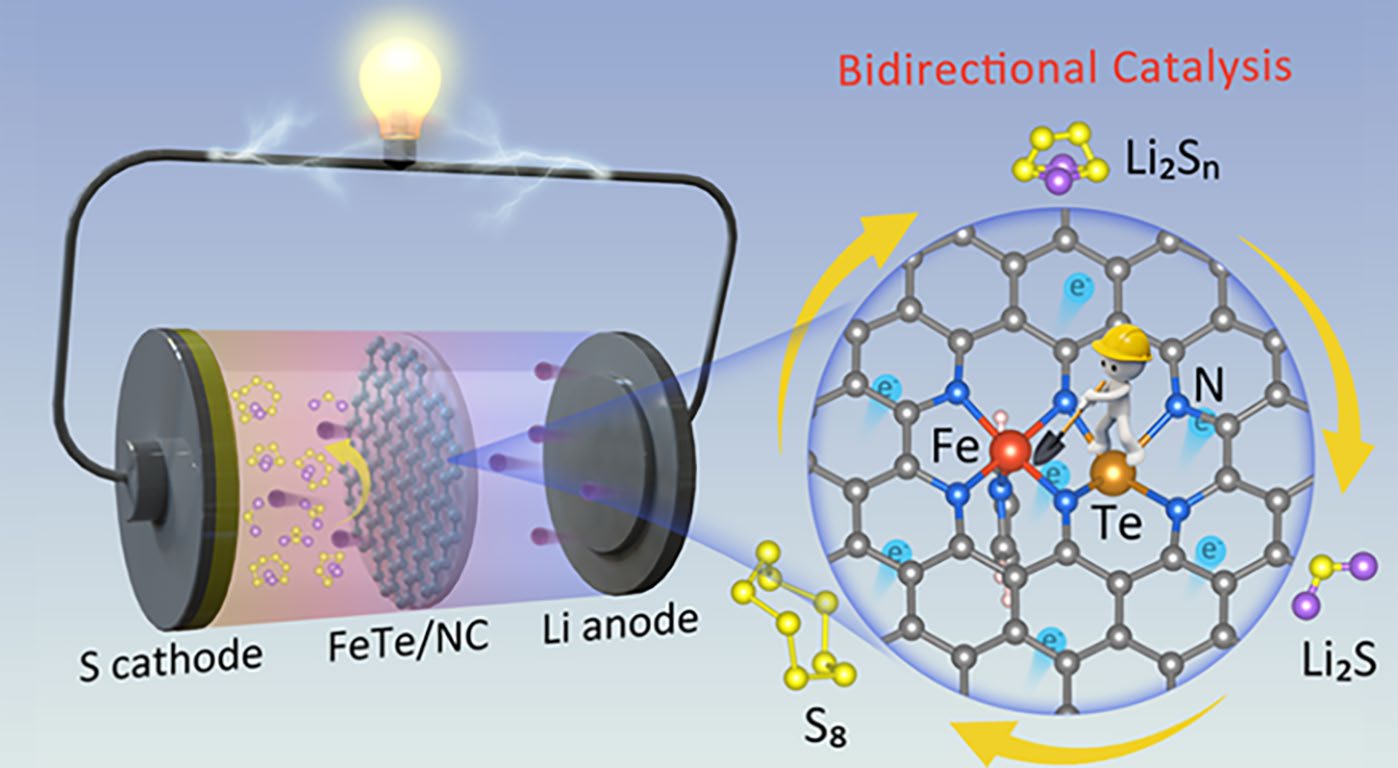

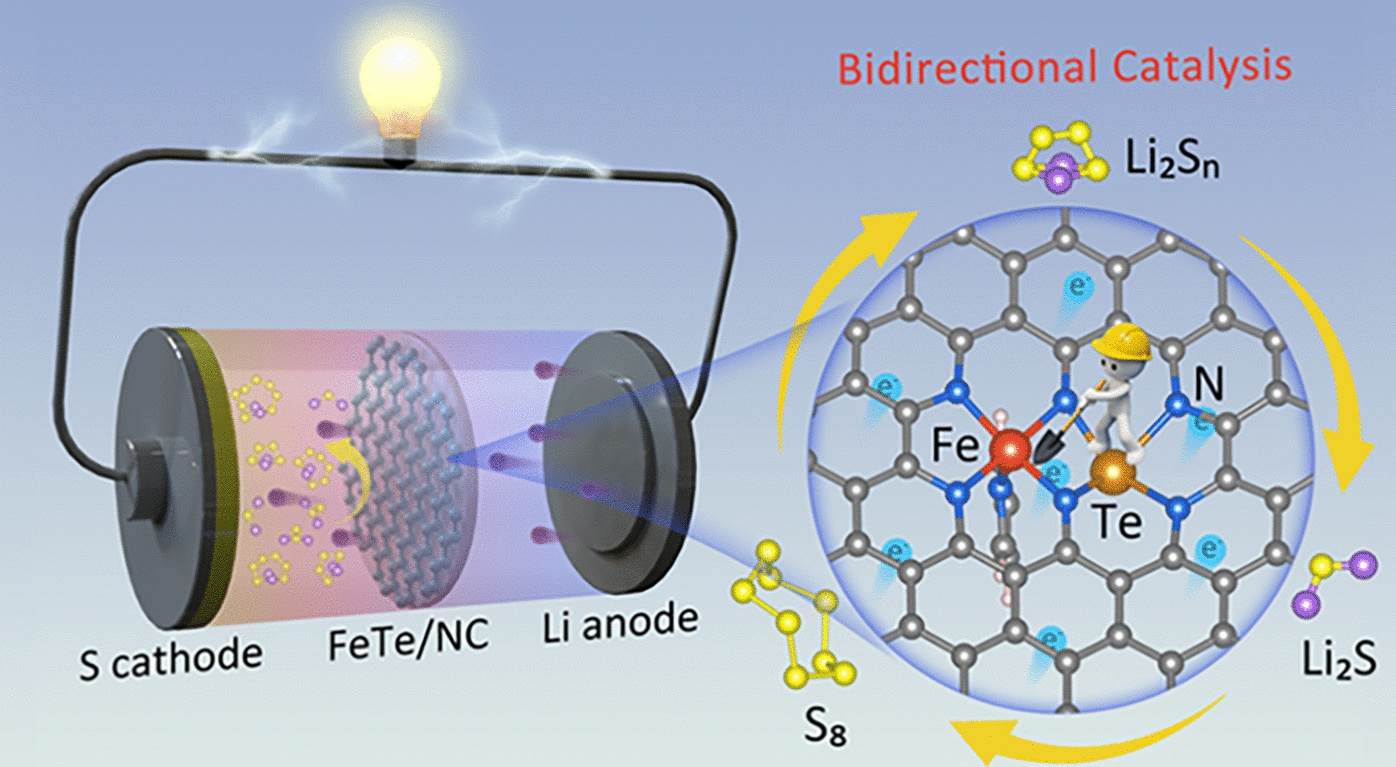

As demand grows for high-energy, low-cost energy storage, lithium–sulfur (Li–S) batteries have emerged as a promising successor to conventional lithium-ion technology. However, their practical use is hindered by the polysulfide shuttle effect and sluggish redox kinetics. Now, researchers from Shanghai University, Tongji University, and USTC—led by Prof. Hongbin Zhao, Prof. Ting He, and Prof. Jia Yu—have developed a novel Te-modulated Fe single-atom catalyst (FeTe/NC) that significantly enhances both the rate performance and cycling stability of Li–S batteries.
Why This Catalyst Matters
- Atomic-Level Design: The catalyst features an asymmetric FeN5–TeN4 coordination structure, where neighboring Te atoms modulate the electronic environment of the central Fe site.
- Enhanced Redox Kinetics: The tailored coordination boosts d–p orbital hybridization, improving both adsorption of lithium polysulfides (LiPSs) and bidirectional conversion kinetics.
- Superior Stability: Batteries using FeTe/NC-modified separators show only 0.038% capacity decay per cycle over 1000 cycles at 1C, and maintain 735 mAh g-1 at 5C.
Innovative Design and Features
- Single-Atom Precision: Fe and Te atoms are atomically dispersed on nitrogen-doped carbon, forming dual-atom active sites that promote strong sulfur affinity and fast charge transfer.
- Electronic Structure Tuning: Te modulation elevates the Fe d-band center, enhancing conductivity and facilitating LiPSs trapping and conversion.
- High-Performance Metrics: The FeTe/NC catalyst enables 5.6 mAh cm-2 areal capacity under high sulfur loading (8.7 mg cm-2) and lean electrolyte conditions (E/S = 4.9 μL mg-1).
Applications and Future Outlook
- Next-Gen Li–S Batteries: This work demonstrates a scalable strategy to design high-efficiency single-atom catalysts for practical, high-energy Li–S systems.
- Fundamental Insights: The study elucidates the structure–activity relationship in SACs, offering a blueprint for future catalyst design in energy storage.
- Industrial Relevance: With its simple one-step synthesis and exceptional electrochemical performance, FeTe/NC is a promising candidate for integration into commercial Li–S battery architectures.
This breakthrough highlights the power of atomic-level engineering in overcoming long-standing challenges in Li–S chemistry. Stay tuned for more transformative research from Prof. Zhao, Prof. He, and Prof. Yu as they continue to push the boundaries of energy storage innovation.

Editor of Nano-Micro Letters, which is an Open-Access, peer-reviewed journal reported papers that have at least one dimension ranging from a few sub-nanometers to a few hundreds of micrometers. The journal is published by Springer Nature and indexed by SCI, EI, SCOPUS, Pubmed, etc. The 2025 JCR Impact Factor is 38.5. The 2025 CiteScore is 58.9.
Follow the Topic
-
Nano-Micro Letters
Nano-Micro Letters is a peer-reviewed, international, interdisciplinary and open-access journal that focus on science, experiments, engineering, technologies and applications of nano- or microscale structure and system in physics, chemistry, biology, material science, and pharmacy.