Chirality‑Induced Suppression of Singlet Oxygen in Lithium–Oxygen Batteries with Extended Cycle Life
Published in Materials
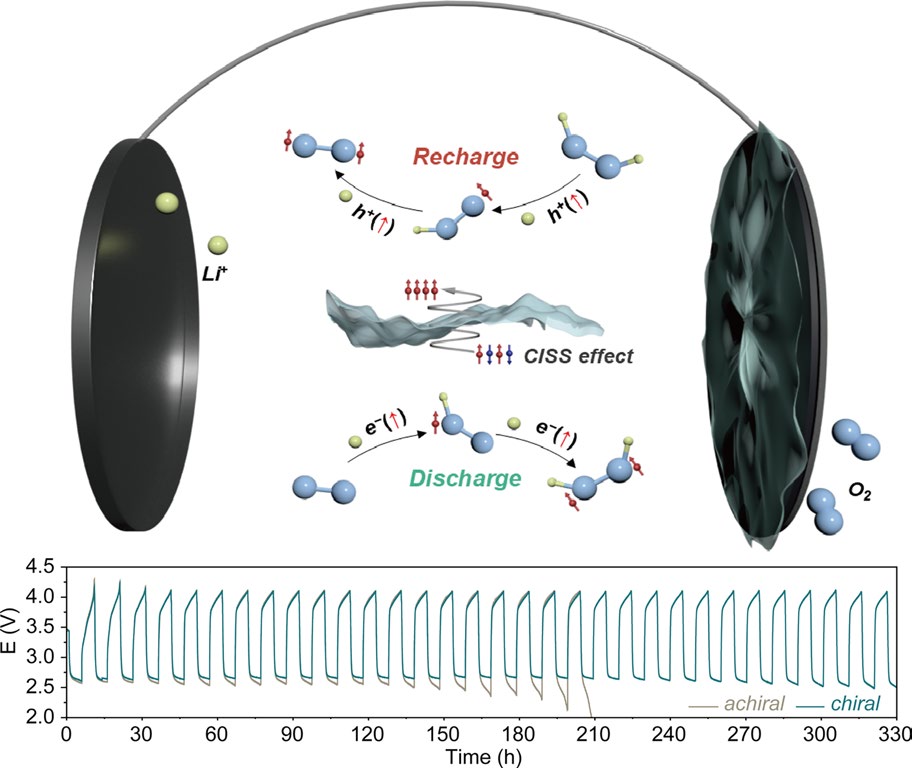
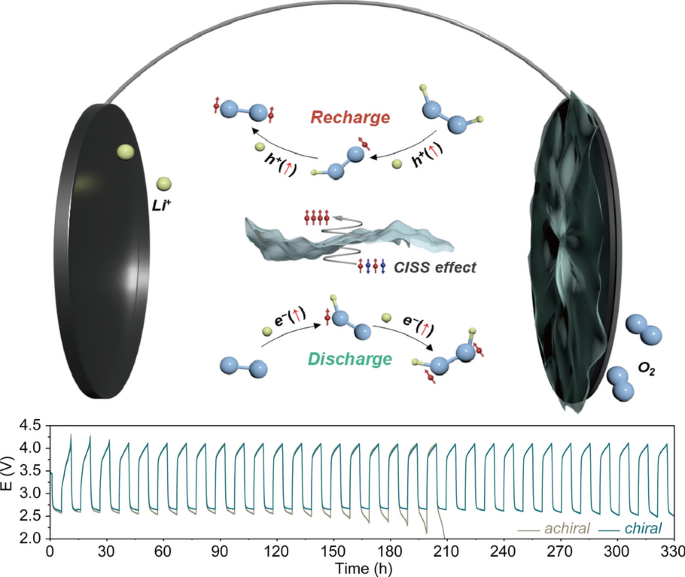

Lithium–oxygen (Li–O2) batteries hold transformative potential for next-generation energy storage due to their ultra-high theoretical energy density (~3.5 kWh kg-1). However, their practical deployment is hindered by poor cycle life caused by singlet oxygen (1O2) generation, which triggers parasitic reactions and degrades cell components. Now, a multidisciplinary team led by Prof. Dong Ha Kim (Ewha Womans University) and Prof. Filipe Marques Mota (University of Lincoln) has introduced chiral cobalt oxide nanosheets (Co3O4 NSs) as cathode materials that suppress 1O2 formation through the chirality-induced spin selectivity (CISS) effect, unlocking unprecedented stability in Li–O2 systems.
Why Singlet Oxygen Suppression Matters
-
Cycle Life Bottleneck:
1O2 is a highly reactive species formed during charge/discharge, leading to electrolyte decomposition, electrode corrosion, and rapid capacity fade. -
CISS Effect as a Game-Changer:
Chiral materials can filter electron spins, favoring triplet oxygen (3O2) formation over 1O2, thereby minimizing side reactions and enhancing reversibility. -
Performance Leap:
R-Co3O4/CP cathodes achieve 3.7× less 1O2 during discharge and 3.2× less during charge, translating to >300 hours of stable cycling vs. ~200 hours for achiral counterparts.
Innovative Design and Features
-
Scalable Chiral Co3O4 Nanosheets:
Electrodeposited using BINOL as a chirality inducer, forming binder-free, high-surface-area nanosheets on carbon paper with low Co loading (5 wt%). -
Spin-Polarized Charge Transport:
Magnetic conductive AFM confirms 64.4% spin polarization in R-Co3O4, enabling spin-selective electron transfer that suppresses 1O2 generation. -
Operando Spectroscopic Validation:
DEMS shows near-theoretical O2 evolution (2.04 e⁻/O2), while photoluminescence and UV–Vis with DMA probe confirm dramatic 1O2 suppression in real time.
Applications and Future Outlook
-
Stable Li–O2 Batteries:
R-Co3O4/CP delivers lower charge overpotentials (~0.4–0.5 V reduction), higher round-trip efficiency, and 33+ stable cycles under fixed-capacity conditions. -
Mechanistic Insights:
DFT reveals enhanced Co 3d–O 2p hybridization, lower ORR/OER overpotentials, and favorable Li2O2 surface growth, reducing reactive intermediates that trigger 1O2. -
Scalable and Sustainable:
The electrodeposition-based synthesis is low-cost, substrate-agnostic, and compatible with roll-to-roll manufacturing, offering a practical pathway to commercialization. -
Beyond Li–O2:
This CISS-enabled strategy is extendable to Li–S, metal–air, and hybrid electrolysis systems, where oxygen radical management is critical.
This pioneering study establishes chiral electrocatalysis as a new design paradigm for controlling reactive oxygen species in energy storage. By merging spintronics with electrochemistry, it opens a new frontier in high-energy, long-life batteries essential for electric aviation, grid storage, and sustainable energy futures.
Stay tuned for more breakthroughs from Prof. Dong Ha Kim, Prof. Filipe Marques Mota, and their global collaborators!

Editor of Nano-Micro Letters, which is an Open-Access, peer-reviewed journal reported papers that have at least one dimension ranging from a few sub-nanometers to a few hundreds of micrometers. The journal is published by Springer Nature and indexed by SCI, EI, SCOPUS, Pubmed, etc. The 2025 JCR Impact Factor is 38.5. The 2025 CiteScore is 58.9.
Follow the Topic
-
Nano-Micro Letters
Nano-Micro Letters is a peer-reviewed, international, interdisciplinary and open-access journal that focus on science, experiments, engineering, technologies and applications of nano- or microscale structure and system in physics, chemistry, biology, material science, and pharmacy.