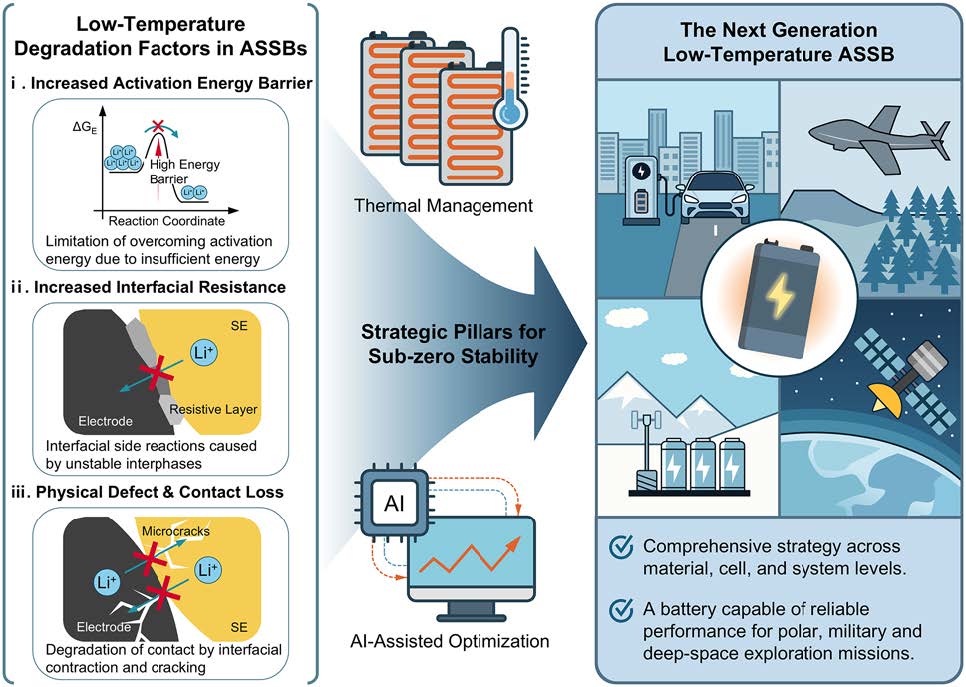

As the demand for reliable energy storage in extreme environments continues to grow, conventional lithium-ion batteries face severe limitations under sub-zero conditions, including sluggish Li⁺ transport, increased interfacial resistance, capacity loss, and safety risks associated with liquid-electrolyte freezing. Now, researchers from the University of Wollongong, Sungkyunkwan University, and Hanyang University, led by Professor Junyoung Mun, Professor Taeseup Song, and Professor Jung Ho Kim, have presented a comprehensive review of low-temperature all-solid-state batteries (ASSBs), highlighting the key challenges, recent advances, and future strategies for reliable energy storage in harsh environments.
Why Low-Temperature ASSBs Matter
Conventional lithium-ion batteries rely on organic liquid electrolytes whose viscosity increases sharply at low temperatures, suppressing Li⁺ mobility and slowing charge-transfer kinetics. These effects can lead to Li plating, capacity loss, poor reversibility, and serious safety concerns. In contrast, solid electrolytes are non-flammable and non-freezing, and can maintain relatively stable ionic conductivity at sub-zero temperatures, making ASSBs promising candidates for applications ranging from electric vehicles and military systems to polar exploration and space missions.
Understanding the Key Challenges
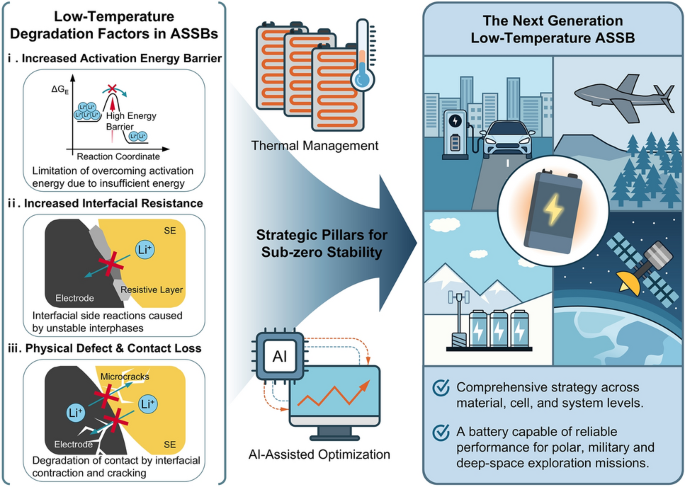
The review identifies three interconnected factors governing the degradation of ASSBs under extreme cold: suppressed Li-ion transport, increased interfacial resistance, and mechanical instability. At low temperatures, Li⁺ ions require sufficient thermal energy to overcome migration barriers, while interfacial side reactions can generate resistive interphases. Meanwhile, interfacial contraction, microcracking, and contact loss further disrupt ion transport and increase polarization.
Rather than addressing these factors independently, the authors emphasize that robust low-temperature performance requires a system-level strategy integrating materials design, interface engineering, electrode architecture, and cell engineering.
Materials Design Strategies
Three major strategies emerge from recent advances in low-temperature ASSBs:
-
Improving charge transport
Solid electrolytes with high ionic conductivity and low activation energy barriers can facilitate Li⁺ migration, while optimized electrode materials accelerate reaction kinetics. Recent examples include polymer, amorphous, sulfide, and oxide-based solid electrolytes engineered to maintain efficient ion transport at temperatures as low as −60 °C. For example, an amorphous Li3N–TaCl5-based electrolyte maintained ionic conductivities of 0.5, 0.29, and 0.07 mS cm-1 at −30, −40, and −60 °C, respectively. -
Suppressing interfacial side reactions
Chemically unstable electrode–electrolyte interfaces can form Li-ion-insulating products and substantially increase resistance at low temperatures. Strategies such as surface modification, protective interphases, and molecular-level control of electrolyte components can suppress these parasitic reactions while maintaining Li⁺ transport. -
Enhancing physical connectivity
Maintaining intimate solid–solid contact is essential because thermal contraction and microcracking can disrupt Li⁺ pathways. Optimizing particle size, electrode architecture, and interfacial structures can improve ionic percolation and regulate Li deposition, helping to mitigate contact loss and dendrite formation.
Outstanding Progress
Recent studies reviewed in this work demonstrate that ASSBs can retain meaningful electrochemical performance at temperatures far below 0 °C. For example, optimized solid electrolytes have enabled cells to deliver 137.6 mAh g-1 with 83.5% capacity retention after 100 cycles at −30 °C, while sulfide-based systems have achieved 81.2 mAh g-1 with 97% retention after 200 cycles at −20 °C. Other designs have demonstrated operation down to −40 and even −60 °C, underscoring the growing potential of ASSBs for extreme environments.
Applications and Future Outlook
Low-temperature ASSBs could enable reliable energy storage for electric vehicles, unmanned aerial vehicles, military communication systems, polar expeditions, satellites, space suits, and deep-space probes, where battery failure can have serious consequences. The review emphasizes that future breakthroughs will require more than simply improving ionic conductivity. Understanding temperature-dependent rate-limiting steps, stabilizing solid–solid interfaces, preventing dendrite growth, and maintaining mechanical contact must be addressed simultaneously.
Looking ahead, advanced in situ/operando characterization, cryogenic electrochemical analysis, first-principles calculations, 3D modeling, and AI-assisted optimization are expected to provide deeper insight into Li-ion dynamics and guide the rational design of next-generation ASSBs. Ultimately, the successful integration of materials, interfaces, electrodes, and system-level engineering could unlock safe and reliable batteries capable of operating in the most demanding sub-zero environments.
This work provides a comprehensive roadmap for advancing all-solid-state batteries toward reliable operation in extreme cold, opening new opportunities for next-generation energy storage in polar, military, aerospace, and other harsh environments.

Editor of Nano-Micro Letters, which is an Open-Access, peer-reviewed journal reported papers that have at least one dimension ranging from a few sub-nanometers to a few hundreds of micrometers. The journal is published by Springer Nature and indexed by SCI, EI, SCOPUS, Pubmed, etc. The 2025 JCR Impact Factor is 38.5. The 2025 CiteScore is 58.9.
Follow the Topic
-
Nano-Micro Letters
Nano-Micro Letters is a peer-reviewed, international, interdisciplinary and open-access journal that focus on science, experiments, engineering, technologies and applications of nano- or microscale structure and system in physics, chemistry, biology, material science, and pharmacy.