Bolstered Interfacial Field Chemistry for Deep Fast‑Charging Aqueous Zinc Metal Batteries
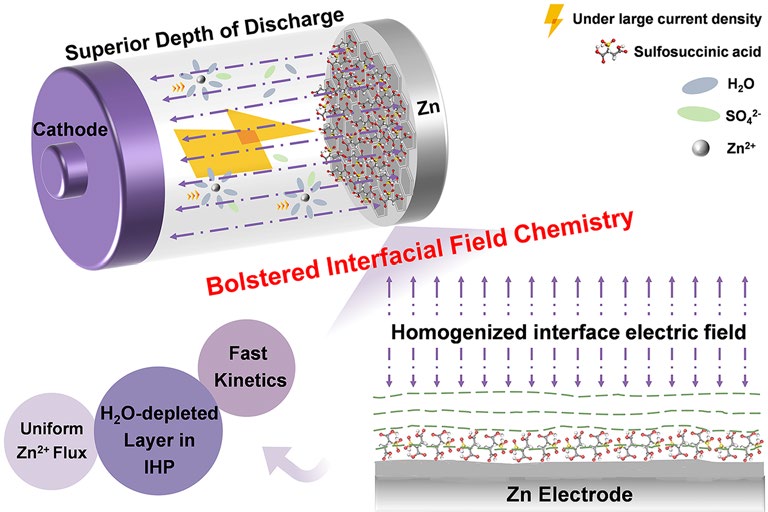
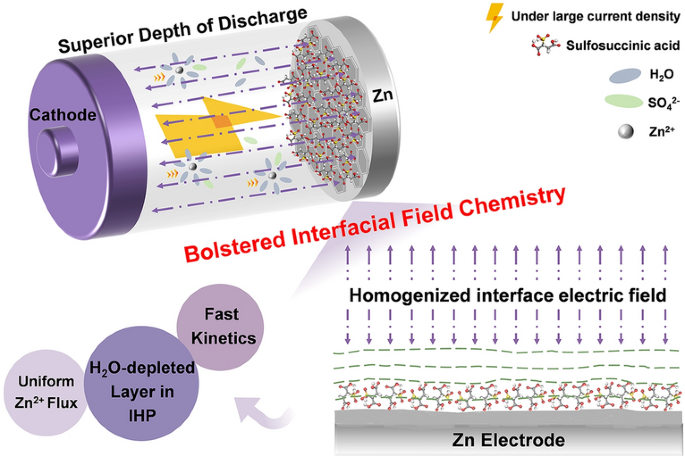

As the demand for safe, low-cost, and high-power energy storage continues to grow, aqueous zinc metal batteries have attracted significant attention. However, rapid charging and deep Zn utilization remain challenging because sluggish Zn2+ desolvation, heterogeneous interfacial fields, hydrogen evolution, corrosion, and uneven Zn deposition can accelerate dendrite growth and battery failure. Researchers have developed a sulfosuccinic acid (SUSA)-enabled interfacial field chemistry strategy to regulate the inner Helmholtz plane (IHP) of Zn anodes, enabling highly reversible Zn deposition under demanding conditions.
Why This Zinc Anode Matters
In conventional ZnSO4 electrolytes, strongly hydrated Zn2+ ions experience sluggish interfacial desolvation and charge transfer, while uneven electric fields promote non-uniform Zn nucleation and parasitic reactions. Introducing an ultratrace amount of SUSA creates a water-poor and chemically regulated IHP without substantially changing the bulk electrolyte, simultaneously improving Zn-ion transport, interfacial kinetics, and deposition uniformity.
Innovative Design and Mechanism
SUSA preferentially adsorbs onto Zn through its zincophilic carboxyl groups, displacing H2O and SO42- from the IHP and homogenizing the local electric field. DFT calculations show that SUSA binds much more strongly than water on Zn(101) and Zn(002), while preferential adsorption on Zn(101) promotes Zn(002) exposure and more uniform Zn deposition. SUSA also facilitates Zn2+ desolvation and nucleation while suppressing parasitic reactions. As a result, the Zn2+ transference number increases from 0.26 to 0.41, the apparent activation energy decreases from 21.36 to 9.57 kJ mol-1, and the nucleation overpotential decreases by 23 mV.
Outstanding Performance
The optimized electrolyte enables an average Coulombic efficiency of 99.48% over more than 1600 cycles in Zn||Cu cells at 2 mA cm-2 and 1 mAh cm-2. Zn||Zn cells operate for over 1600 h at 5 mA cm-2 and 2 mAh cm-2, and over 675 h at 10 mA cm-2 and 10 mAh cm-2. Even with a 30 μm Zn electrode, the system achieves a cumulative plating capacity of 3500 mAh cm-2 with 56.93% Zn utilization.
Applications and Future Outlook
The strategy also demonstrates practical full-cell potential. A 10 μm Zn||I₂ cell achieves more than 1490 cycles with 77.13% capacity retention at 1 A g-1, while a pouch cell delivers over 680 cycles with 70.17% retention. Stable Zn cycling is further demonstrated from −20 to 60 °C, including more than 300 h at 60 °C. Overall, this work establishes interfacial field regulation as an effective strategy for simultaneously achieving fast charging, deep Zn utilization, long-term reversibility, and broad temperature adaptability in aqueous zinc batteries.

Editor of Nano-Micro Letters, which is an Open-Access, peer-reviewed journal reported papers that have at least one dimension ranging from a few sub-nanometers to a few hundreds of micrometers. The journal is published by Springer Nature and indexed by SCI, EI, SCOPUS, Pubmed, etc. The 2025 JCR Impact Factor is 38.5. The 2025 CiteScore is 58.9.
Follow the Topic
-
Nano-Micro Letters
Nano-Micro Letters is a peer-reviewed, international, interdisciplinary and open-access journal that focus on science, experiments, engineering, technologies and applications of nano- or microscale structure and system in physics, chemistry, biology, material science, and pharmacy.