
As the global transition toward clean hydrogen economy accelerates, photocatalytic alcohol reforming has emerged as a sustainable pathway for simultaneous H₂ production and value-added chemical synthesis. However, a fundamental challenge has long persisted: photocatalytic reactions are driven by both photochemical and photothermal processes, yet their individual contributions and synergistic mechanisms have remained elusive. Now, a collaborative team led by Professor Xusheng Zheng, Professor Yu Bai, and Professor Qing Yang at the University of Science and Technology of China (USTC), in partnership with Inner Mongolia University of Technology and Wuhan University of Technology, has achieved a breakthrough that directly visualizes and decouples these two effects for the first time.
Why This Distinction Matters
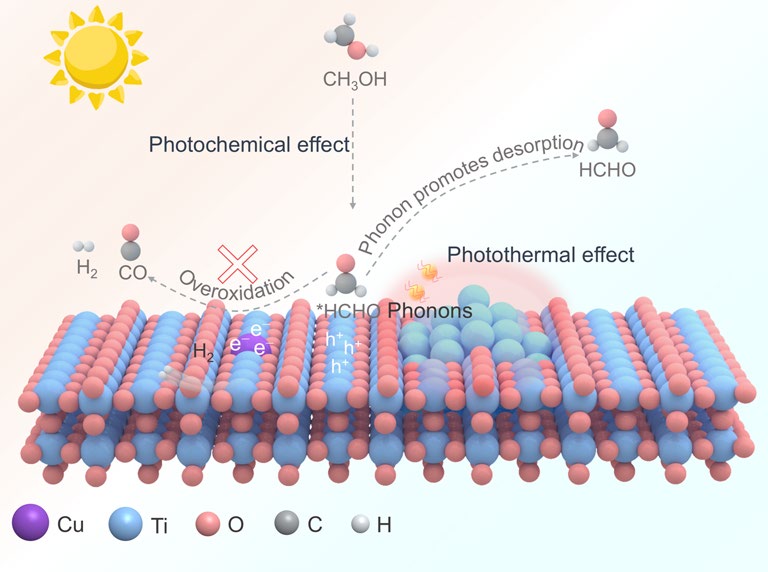
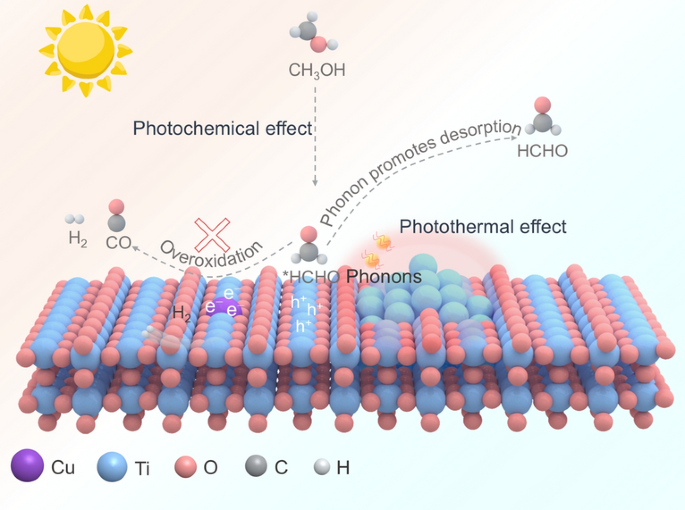
Traditional photocatalytic systems operate under the assumption that light-driven reactions are purely photochemical, while photothermal contributions are treated as secondary or even detrimental. The novel Cu–TiO2/Ti model catalyst overcomes this limitation by rationally integrating a photochemical unit (Cu single atoms on TiO2) with a photothermal unit (metallic Ti nanoparticles) within a single architecture. This design enables unprecedented mechanistic clarity: the photochemical effect drives charge carrier generation and substrate activation, while the photothermal effect generates phonons that modulate reaction kinetics and product selectivity—functions that are fundamentally distinct yet synergistically coupled.
Innovative Design and Mechanism
The catalyst is synthesized through a one-step calcination followed by Cu impregnation, creating a composite where TiO2 absorbs UV light for photochemical excitation, Ti nanoparticles harvest visible-infrared light for photothermal conversion, and isolated Cu single atoms serve as electron-accumulating cocatalysts. In situ resonant Auger electron spectroscopy (RAS)—a synchrotron-based technique with elemental and orbital specificity—reveals the formation of a directional electron transfer pathway from TiO2 to Cu sites upon photoexcitation. Quantitative RAS analysis shows that Cu incorporation reduces participator decay (electron-hole recombination) from 14.4% to 7.5% while increasing spectator decay (electron transfer to active sites) from 85.6% to 92.5%. In situ Cu K-edge XAFS further confirms that photogenerated electrons accumulate at Cu sites, forming Cuᵟ⁺ (1 < δ < 2) species that lower the H2 evolution Gibbs free energy from 0.76 eV (ground state) to 0.38 eV (excited state).
Critically, the photothermal contribution extends far beyond simple heating. Molecular dynamics simulations and in situ DRIFTS/SRPES measurements reveal that hot phonons from Ti nanoparticles lower the HCHO desorption energy barrier from 0.58 eV at 293 K to 0.52 eV at 333 K. This phonon-mediated desorption prevents HCHO overoxidation to CO—a counterintuitive finding that redefines the role of photothermal effects in selectivity control.
Outstanding Performance
Cu–TiO2/Ti delivers a remarkable H₂ yield rate of 0.511 mmol h-1 with 96.6% selectivity toward HCHO among oxidation products—among the highest reported for non-noble metal photocatalysts. The apparent quantum yield under 365 nm LED reaches 15.9%, 3.7-fold higher than TiO2/Ti without Cu. Notably, the catalyst achieves >100 hours of stable operation under continuous illumination, with Cu single atoms maintaining their atomic dispersion and oxidation state throughout the reaction—performance comparable to Pt-based noble metal catalysts.
Quantitative decoupling experiments reveal the precise contributions: the pure photochemical effect accounts for 22.9% of H2 evolution, the pure photothermal effect contributes only 3.7%, while the photochemical-photothermal synergistic effect dominates at 73.4%. Outdoor tests under natural sunlight (Hefei, China) confirm practical viability, achieving H₂ production rates up to 0.33 mmol h-1 at peak solar irradiance.
Broad Applicability
The dual-effect synergy demonstrates exceptional universality across diverse alcohol substrates. Ethanol reforming achieves 153 μmol h-1 H2 and 142 μmol h-1 acetaldehyde with 92.8% selectivity. Ethylene glycol, isopropanol, and n-butanol systems all exhibit high H₂ evolution rates coupled with >83% selectivity toward corresponding aldehyde/ketone products. This establishes a generalizable platform for selective photocatalytic dehydrogenation of biomass-derived alcohols.
Applications and Future Outlook
This work establishes a new paradigm for designing efficient solar-driven catalytic systems by demonstrating that photochemical and photothermal effects are not merely additive but mechanistically complementary. The photochemical effect initiates and drives the reaction through charge carrier generation, while the photothermal effect fine-tunes selectivity through phonon-mediated desorption—an insight that transcends methanol reforming to encompass photothermal catalysis broadly. The integration of synchrotron-based in situ spectroscopies (RAS, XAFS, SRPES) with theoretical calculations provides a general methodology for dissecting complex light-matter interactions in energy conversion systems.
By rationally coupling photochemical charge separation with photothermal phonon engineering, this approach opens promising avenues for next-generation photocatalysts that simultaneously maximize activity, selectivity, and stability under real solar irradiation conditions.
Stay tuned for more groundbreaking research from this collaborative team at USTC, Inner Mongolia University of Technology, and Wuhan University of Technology!

Editor of Nano-Micro Letters, which is an Open-Access, peer-reviewed journal reported papers that have at least one dimension ranging from a few sub-nanometers to a few hundreds of micrometers. The journal is published by Springer Nature and indexed by SCI, EI, SCOPUS, Pubmed, etc. The 2025 JCR Impact Factor is 38.5. The 2025 CiteScore is 58.9.
Follow the Topic
-
Nano-Micro Letters
Nano-Micro Letters is a peer-reviewed, international, interdisciplinary and open-access journal that focus on science, experiments, engineering, technologies and applications of nano- or microscale structure and system in physics, chemistry, biology, material science, and pharmacy.