Rational Design of Covalent Organic Frameworks for Oxygen Electrocatalysis: Recent Advances and Mechanistic Insights
Published in Bioengineering & Biotechnology, Chemistry, and Materials
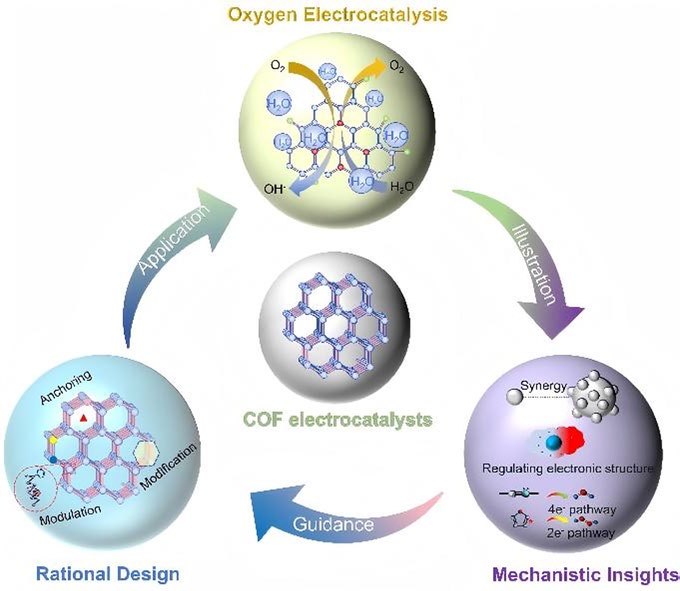
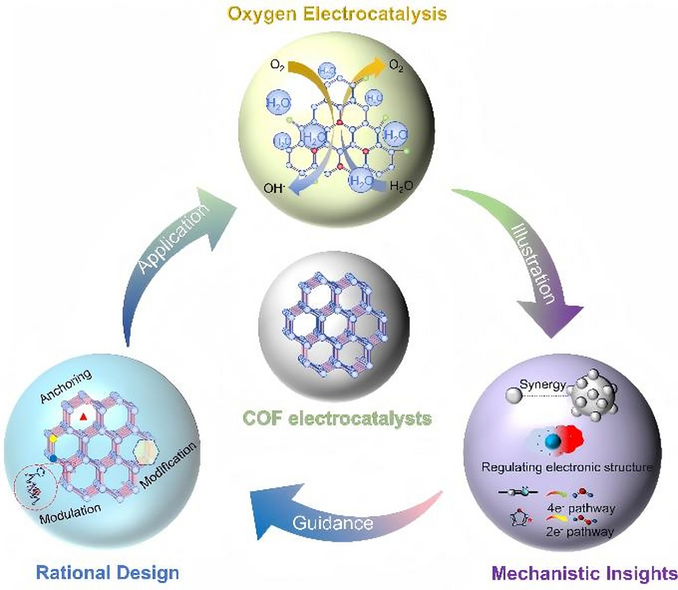

As the transition toward clean and renewable energy accelerates, efficient oxygen electrocatalysis is essential for fuel cells, water electrolyzers, metal–air batteries, and other energy-conversion technologies. However, conventional catalysts often depend on scarce noble metals, while emerging alternatives face challenges including poor conductivity, limited active-site accessibility, and insufficient stability. Researchers from Nanjing University of Aeronautics and Astronautics and Nanjing University of Information Science and Technology, led by Professors Yanping Zhu and Xiaogang Zhang, present a comprehensive review of covalent organic framework (COF)-based oxygen electrocatalysts. The review establishes a structure–property–mechanism framework linking molecular design, electronic regulation, structural engineering, and reaction-pathway control for next-generation OER and ORR catalysts.
Why These COF Electrocatalysts Matter
COFs are crystalline porous polymers whose organic building blocks, covalent linkages, pore structures, coordination sites, and functional groups can be deliberately engineered. The review classifies oxygen electrocatalytic COFs into porphyrin-based, metal-based, metal-free, and radical COFs, highlighting distinct approaches to constructing M–N4 sites, post-synthetic metal centers, heteroatom-rich active environments, and radical catalytic sites. This molecular-level tunability enables COFs to move beyond empirical composition optimization toward precise control of oxygen-intermediate adsorption and reaction pathways.
Innovative Design and Mechanism
A central theme is that high-performance COF electrocatalysts require simultaneous regulation of active sites, electronic structure, and mass transport. Metal anchoring can generate isolated single atoms, dual-metal centers, or coupled single-atom/nanoparticle sites, while induced polarization, supramolecular interactions, edge-site engineering, and catalytic-linkage design further reshape local electronic environments. For example, theory-guided Ir@COF-C4N was predicted to exhibit an OER overpotential of 220 mV and experimentally achieved approximately 268–280 mV at 10 mA cm-2. Heteroatoms, donor–acceptor structures, fluorination, and asymmetric units can generate charge gradients and built-in polarization, while pore and topology engineering improves active-site exposure and mass transport.
Outstanding Performance
The review highlights substantial advances across COF oxygen electrocatalysis. Representative systems achieve ORR half-wave potentials of up to 0.89 V, while bifunctional catalysts reach approximately 0.85 V for ORR and 330 mV OER overpotential. Fluorinated Co-porphyrin COF/graphene oxide achieves an OER overpotential of 261 mV. COFs also enable selective two-electron oxygen reduction, with some edge-defect systems achieving >99% H2O2 selectivity and H2O2 production rates exceeding 1200 mmol g-1 h-1. These results demonstrate that molecular and structural engineering can simultaneously regulate activity, selectivity, and reaction pathways.
Applications and Future Outlook
The review identifies a shift from empirical screening toward theory-guided and mechanism-driven COF design. DFT, advanced spectroscopy, artificial intelligence, and machine learning can establish quantitative relationships between framework structure, electronic properties, intermediate adsorption, and catalytic activity, while high-throughput screening can accelerate discovery of new COF architectures. Remaining challenges include improving intrinsic conductivity, exposing dense active sites while preserving crystallinity, and maintaining stability under realistic electrochemical conditions. Future efforts are expected to emphasize dynamic operando characterization, binder-free electrodes, multifunctional COF/MOF-derived architectures, and theory–experiment–AI closed-loop design for applications in fuel cells, water splitting, metal–air batteries, and broader energy-conversion systems.

Editor of Nano-Micro Letters, which is an Open-Access, peer-reviewed journal reported papers that have at least one dimension ranging from a few sub-nanometers to a few hundreds of micrometers. The journal is published by Springer Nature and indexed by SCI, EI, SCOPUS, Pubmed, etc. The 2025 JCR Impact Factor is 38.5. The 2025 CiteScore is 58.9.
Follow the Topic
-
Nano-Micro Letters
Nano-Micro Letters is a peer-reviewed, international, interdisciplinary and open-access journal that focus on science, experiments, engineering, technologies and applications of nano- or microscale structure and system in physics, chemistry, biology, material science, and pharmacy.