Biomimetic PD‑1‑Functionalized Immunostimulatory Nanomedicine Enables STING Activation and Durable Antitumor Immunity in Hepatocellular Carcinoma
Published in Bioengineering & Biotechnology, Cancer, and Public Health
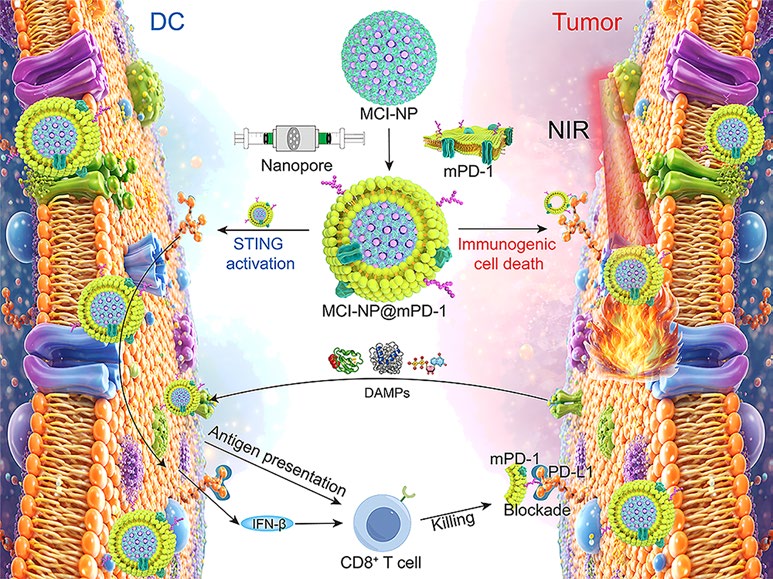
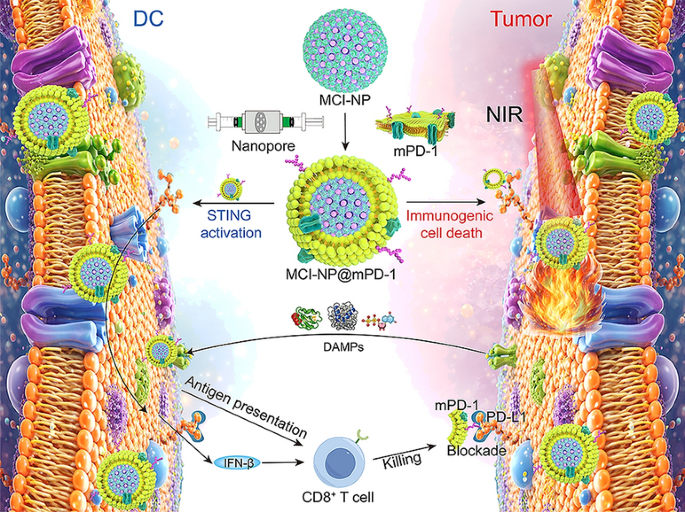

Hepatocellular carcinoma (HCC) remains a major challenge in cancer treatment, particularly because many tumors exhibit an immunologically “cold” microenvironment with poor antigen presentation and insufficient cytotoxic T-cell responses. Although immune checkpoint blockade has transformed cancer therapy, its efficacy in HCC remains limited. Researchers from Mengchao Hepatobiliary Hospital of Fujian Medical University, Fujian Medical University, the General Hospital of Ningxia Medical University, and the Fujian Institute of Research on the Structure of Matter have developed a biomimetic nanomedicine integrating photothermal therapy, STING activation, and localized immune checkpoint blockade to convert immune-cold HCC into an immune-active state and induce durable antitumor immunity.
Why This Nanomedicine Matters
The limited response of HCC to immunotherapy is closely associated with insufficient tumor antigenicity, inefficient antigen presentation, and impaired T-cell activation. The STING pathway connects innate and adaptive immunity by promoting type I interferon signaling, dendritic-cell maturation, and antigen cross-presentation. However, STING activation alone may be insufficient because immune-cold tumors lack sufficient endogenous danger signals and tumor antigens. This highlights the need for a strategy that can simultaneously generate tumor antigens, activate innate immunity, and overcome adaptive immune resistance.
Innovative Design and Mechanism
The researchers constructed a carrier-free coordination nanomedicine, MCI-NP, by co-assembling the STING agonist MSA-2 and indocyanine green (ICG) through Cu2+ coordination. The resulting nanoparticles show a photothermal conversion efficiency of 52.3%, while near-infrared irradiation induces photothermal and immunogenic tumor-cell death, promoting the release of calreticulin, HMGB-1, and ATP. Meanwhile, MSA-2 activates the STING–TBK1–IRF3 pathway and stimulates IFN-β production. MCI-NP was further cloaked with PD-1-overexpressing cell membranes to generate MCI-NP@mPD-1, enhancing tumor accumulation while locally blocking the PD-1/PD-L1 immune checkpoint.
Outstanding Performance
MCI-NP@mPD-1 combined with 808 nm laser irradiation produced strong antitumor effects in vitro and in vivo. PD-1 membrane camouflage increased tumor accumulation by approximately fivefold, while the tumor temperature reached approximately 58.1 °C after irradiation. The combined treatment strongly suppressed tumor growth and achieved an 80% survival rate at day 60. It also substantially remodeled the tumor immune microenvironment, increasing IFN-γ, granzyme B, IFN-β, and TNF-α levels by 8.7-, 2.6-, 3.8-, and 4.9-fold, respectively, while reducing immunosuppressive factors. CD4⁺ and CD8⁺ T-cell infiltration increased, whereas regulatory T cells decreased from 25.5% to 7.3%.
Applications and Future Outlook
Beyond primary tumor suppression, MCI-NP@mPD-1 generated systemic antitumor immunity capable of controlling distant disease. In postoperative pulmonary metastasis and bilateral tumor models, the treatment inhibited metastatic and non-irradiated tumors while inducing pronounced immune memory, with effector memory T cells reaching 41.0% of CD8⁺CD44⁺ T cells and 51.6% of CD4⁺CD44⁺ T cells. The nanomedicine also showed favorable biosafety under the tested conditions. Overall, this integrated platform provides a promising strategy for combining tumor ablation, innate immune activation, and checkpoint blockade to overcome immune resistance and establish durable systemic immunity against HCC.

Editor of Nano-Micro Letters, which is an Open-Access, peer-reviewed journal reported papers that have at least one dimension ranging from a few sub-nanometers to a few hundreds of micrometers. The journal is published by Springer Nature and indexed by SCI, EI, SCOPUS, Pubmed, etc. The 2025 JCR Impact Factor is 38.5. The 2025 CiteScore is 58.9.
Follow the Topic
-
Nano-Micro Letters
Nano-Micro Letters is a peer-reviewed, international, interdisciplinary and open-access journal that focus on science, experiments, engineering, technologies and applications of nano- or microscale structure and system in physics, chemistry, biology, material science, and pharmacy.