Ultramicropore‑Confined Solvation and Interphase Regulation Unlock High‑Performance Hard Carbon Anodes for Sodium‑Ion Batteries


As the demand for low-cost and sustainable energy-storage technologies continues to grow, sodium-ion batteries (SIBs) have attracted increasing attention as a promising alternative to lithium-ion batteries. However, the larger size of Na⁺ ions makes efficient and reversible sodium storage challenging. Hard carbon is considered one of the most promising anode materials for SIBs, yet achieving high initial Coulombic efficiency, large plateau capacity, fast charge-transfer kinetics, and long-term cycling stability simultaneously remains a major challenge.
A research team has now developed a molecular-level strategy to regulate both the pore structure and interfacial chemistry of hard carbon. By introducing iodine-mediated oxidative cross-linking into starch precursors, the researchers fabricated spherical hard carbon containing abundant ultramicropores and carbonyl-rich surfaces. The resulting architecture enables confined electrolyte solvation and promotes the formation of inorganic-rich interphases, leading to substantially improved sodium-storage performance.
Engineering Hard Carbon at the Molecular Level
Starch is an attractive precursor for hard carbon because of its low cost, natural abundance, high carbon content, and intrinsic spherical morphology. However, direct pyrolysis of starch can cause extensive glycosidic-bond cleavage, generating volatile intermediates and resulting in severe foaming, structural collapse, and carbon loss.
To overcome this problem, the researchers introduced iodine during the precursor oxidation process. Iodine promotes oxidative aromatization and interchain cross-linking at the molecular level, converting the starch framework into a more thermally stable conjugated network.
This stabilization suppresses the formation and volatilization of levoglucosan during subsequent carbonization, allowing the spherical framework to be preserved. Remarkably, the iodine-mediated strategy increases the carbon yield to 45.5%, compared with less than 10% for iodine-free samples.
Creating Abundant Ultramicropores
The resulting hard carbon possesses a distinctive combination of structural characteristics. It contains abundant ultramicropores smaller than 0.9 nm, with the pore distribution mainly concentrated around 0.5–0.6 nm. At the same time, the material exhibits an exceptionally low external surface area of only 1.5 m2 g-1.
This unusual architecture is important because it combines a low accessible external surface with abundant internal ultramicropores. Such a structure can reduce excessive electrolyte penetration while providing confined spaces for reversible Na⁺ storage.
The material also contains abundant carbonyl (C=O) functionalities, which provide additional sodium-storage sites and play an important role in regulating the local interfacial chemistry.
Ultramicropores as Molecular Sieves
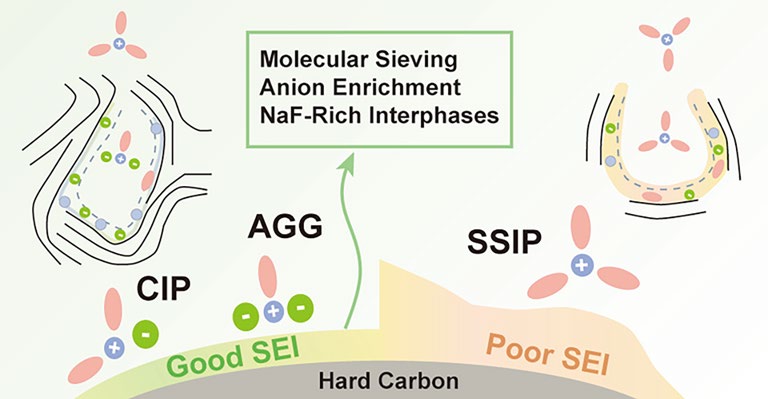
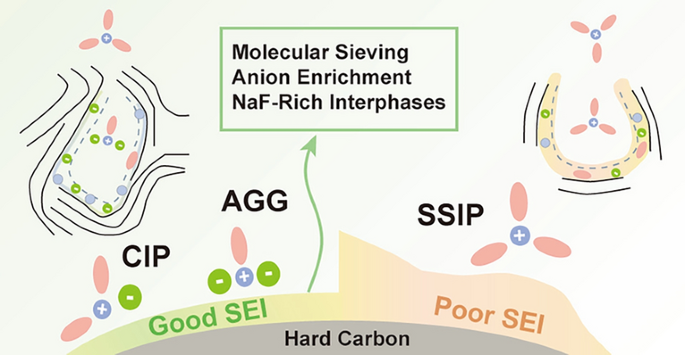
One of the key findings is that these ultramicropores can function as molecular sieves for the electrolyte.
DFT calculations show that when the pore diameter is below 0.804 nm, ethylene carbonate (EC) molecules are sterically excluded from the confined space, whereas Na⁺ can still maintain strong adsorption. This means that the ultramicropores can selectively restrict bulky solvent molecules while allowing sodium ions to access the carbon framework.
Meanwhile, PF6⁻ adsorption becomes increasingly favorable in appropriately sized ultramicropores. Carbonyl groups further strengthen the interaction with PF6⁻.
Together, these effects create an anion-enriched interfacial environment, shifting the electrolyte structure toward contact ion pairs and aggregates. This confined environment favors anion-derived interfacial reactions and promotes the formation of inorganic-rich interphases.
Constructing a NaF-Rich Interphase
The regulation of electrolyte solvation is closely connected with the formation of the solid electrolyte interphase (SEI).
The combination of ultramicropore confinement and carbonyl-rich surfaces promotes PF₆⁻ accumulation and decomposition, facilitating the formation of a NaF-rich inorganic interphase. Such an interphase can reduce the interfacial energy barrier and facilitate Na⁺ transport.
This provides an important connection between the nanoscale carbon structure and electrochemical behavior:
Ultramicropore confinement → selective solvation regulation → anion enrichment → inorganic-rich SEI → accelerated Na⁺ transport.
Excellent Sodium-Storage Performance
The optimized hard carbon delivers an impressive combination of electrochemical properties.
It achieves a reversible capacity of 352.9 mAh g-1 at 0.1C, together with an initial Coulombic efficiency of 88.4%. Notably, the plateau capacity accounts for 64.1% of the total discharge capacity, highlighting the contribution of ultramicropore filling to sodium storage.
The material also exhibits excellent rate capability, retaining a capacity of 288.9 mAh g-1 at 5C. When the current density returns to 0.1C, the original capacity can be fully recovered.
Long-term cycling further demonstrates its structural and electrochemical stability, with 95.6% capacity retention after 200 cycles at 0.33C.
Revealing a Three-Stage Sodium-Storage Mechanism
In situ XRD and Raman spectroscopy provide further insight into how sodium is stored within the carbon framework.
The sodium-storage process can be divided into three stages.
Stage I (2.5–0.6 V): Na⁺ adsorption dominates. Sodium ions interact with external surface sites, open pores, edge defects, structural defects, and carbonyl functionalities.
Stage II (0.6–0.01 V): Na⁺ progressively enters the graphitic carbon layers, accompanied by the formation of NaCx species.
Stage III (0.01–0 V): The abundant ultramicropores facilitate pore filling at the low-voltage plateau, resulting in the formation of quasi-metallic sodium clusters.
Importantly, these sodium clusters are highly reversible. Phenolphthalein experiments provide visual evidence of sodium-cluster formation at potentials below 0.01 V, while the coloration disappears during subsequent charging.
From Structural Design to Battery Performance
The study demonstrates that high-performance hard carbon anodes cannot be designed solely by controlling total pore volume or surface area. Instead, pore size, surface functionality, electrolyte solvation, and interphase chemistry must be considered together.
The iodine-mediated cross-linking strategy provides a way to establish this connection at the molecular level. By controlling the precursor chemistry, the researchers simultaneously regulate the carbon framework, generate ultramicropores, introduce carbonyl functionalities, modify electrolyte solvation, and promote the formation of an inorganic-rich interphase.
The resulting synergy between nanoconfinement, interfacial chemistry, and sodium-storage behavior enables the hard carbon to overcome the conventional trade-off among initial Coulombic efficiency, plateau capacity, rate capability, and cycling stability.
Toward Next-Generation Sodium-Ion Batteries
Overall, this work presents a molecular-level design strategy for hard carbon anodes in which precursor engineering determines the final pore architecture and surface chemistry, which in turn regulate electrolyte behavior and sodium-storage kinetics.
Follow the Topic
-
Nano-Micro Letters
Nano-Micro Letters is a peer-reviewed, international, interdisciplinary and open-access journal that focus on science, experiments, engineering, technologies and applications of nano- or microscale structure and system in physics, chemistry, biology, material science, and pharmacy.