Ultrathin Gallium Nitride Quantum‑Disk‑in‑Nanowire‑Enabled Reconfigurable Bioinspired Sensor for High‑Accuracy Human Action Recognition
Published in Materials and Computational Sciences
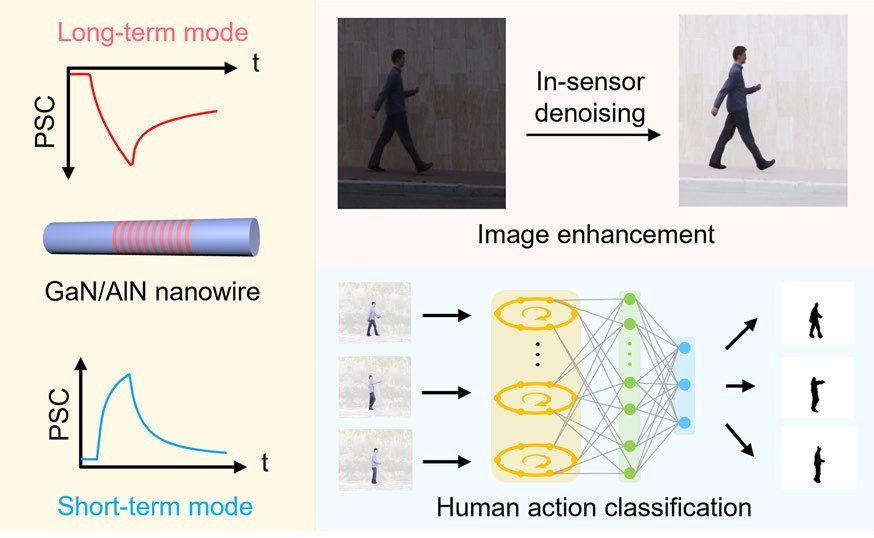

As artificial vision systems evolve, bridging the gap between sensing and processing remains a key challenge. Now, researchers from the University of Science and Technology of China, led by Prof. Yong Yan and Prof. Haiding Sun, have developed a reconfigurable bioinspired vision sensor using GaN/AlN quantum-disk-in-nanowires (QD-NWs) that emulates the human retina’s dual-cell system—delivering in-sensor computing for high-accuracy human action recognition (HAR).
Why This Bioinspired Sensor Matters
- Dual-Mode Operation: Mimics Parvo cells (slow, high-contrast vision) and Magno cells (fast, motion-sensitive vision) via voltage-tunable persistent photocurrent (PPC).
- In-Sensor Computing: Combines image enhancement and reservoir computing in a single device, reducing latency and power consumption.
- High Accuracy: Boosts HAR accuracy from 51.4% to 81.4% through synergistic integration of both photoresponse modes.
Innovative Design and Features
- Quantum-Confined Stark Effect (QCSE): Enables bias-tunable control over carrier recombination, switching between long-term and short-term PPC.
- Nanowire Architecture: Ultrathin GaN/AlN QD-NWs grown on Si substrates offer CMOS compatibility, strain relaxation, and strong optoelectronic tunability.
- Reservoir Computing System: Uses short-term PPC for temporal feature extraction and long-term PPC for image denoising and enhancement.
Applications and Performance
- Image Enhancement: Under negative bias, the sensor enhances image contrast in real time—improving SNR from 1/0.3 to 1/0.15 without external processing.
- Human Action Recognition: Under positive bias, the sensor acts as a hardware-based reservoir, classifying 10 human actions from the Weizmann dataset with >95% accuracy.
- Robustness: Maintains >90% recognition accuracy even under 50% device noise, outperforming software-only approaches.
Conclusion and Outlook
This work introduces a compact, intelligent vision sensor that unites biological inspiration with semiconductor engineering, enabling real-time, low-power, high-accuracy visual perception. The QD-NW platform opens new pathways for neuromorphic vision systems, edge AI, and smart surveillance applications.
Stay tuned for more breakthroughs from Prof. Yong Yan and Prof. Haiding Sun’s team at USTC!

Editor of Nano-Micro Letters, which is an Open-Access, peer-reviewed journal reported papers that have at least one dimension ranging from a few sub-nanometers to a few hundreds of micrometers. The journal is published by Springer Nature and indexed by SCI, EI, SCOPUS, Pubmed, etc. The 2025 JCR Impact Factor is 38.5. The 2025 CiteScore is 58.9.
Follow the Topic
-
Nano-Micro Letters
Nano-Micro Letters is a peer-reviewed, international, interdisciplinary and open-access journal that focus on science, experiments, engineering, technologies and applications of nano- or microscale structure and system in physics, chemistry, biology, material science, and pharmacy.