Multiphysics Modeling and Analysis for Dendrite Problems in Solid‑State Lithium/Sodium Metal Batteries
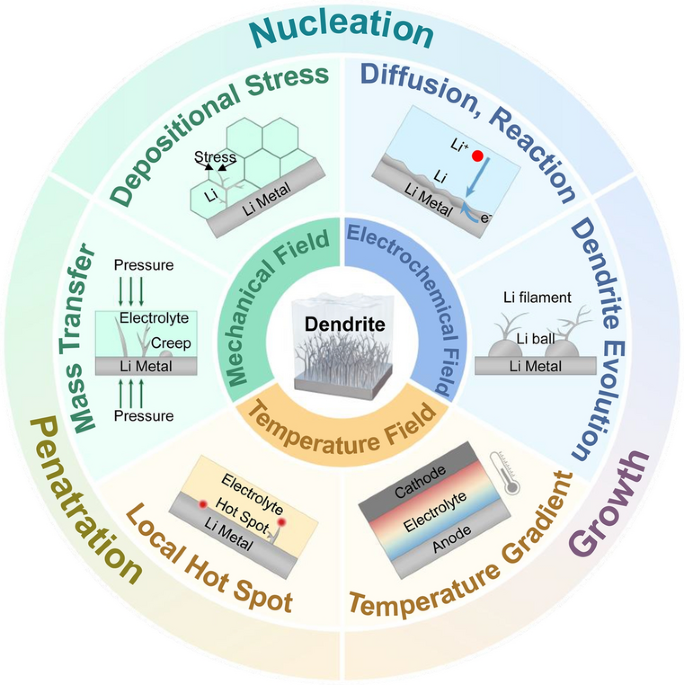

As solid-state batteries race toward commercialization, a critical roadblock remains: metal dendrites. Now, researchers from the Institute of Physics (Chinese Academy of Sciences), POSTECH, and the Chemical Defense Institute have delivered a comprehensive review that redefines how we understand—and ultimately defeat—dendrite formation in solid-state lithium and sodium metal batteries.
Why This Review Matters
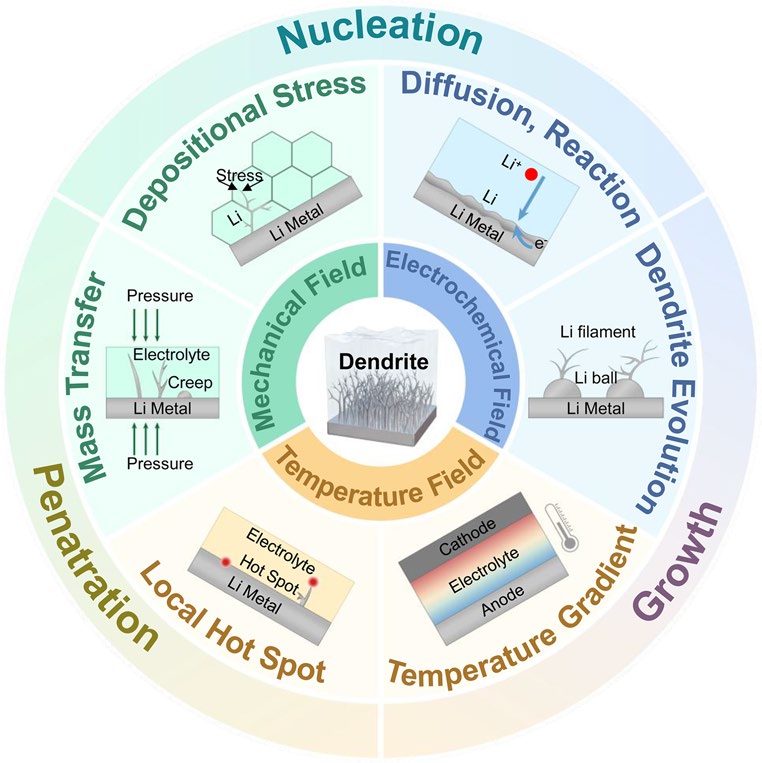
Traditional approaches have studied dendrite growth by examining individual factors: electrochemistry alone, mechanics alone, or thermal effects alone. The authors demonstrate that dendrite growth in solid-state systems is essentially a multiphysics phenomenon, where electrochemical processes, thermal gradients, and mechanical stress fields are all interconnected and reinforce each other. Ignoring any one of these factors leads to incomplete or even misleading predictions.
A Unified Multiphysics Framework
The review systematically maps the entire dendrite lifecycle:
- Experimental Morphologies: From whisker-like and mossy structures in liquid electrolytes to linear, branched, and delaminating morphologies in solid electrolytes (LLZO, LPSC, NZSP)—the authors provide the first comprehensive comparison across both Li and Na systems, highlighting how substrate properties, current density, and electrolyte chemistry dictate growth patterns.
- Single-Physics Foundations: Critical models are dissected—from Sand's Time for electrochemical initiation, to stress-driven plastic flow and fracture mechanics, to temperature-modulated nucleation barriers. Each field's governing principles are clarified before integration.
- Coupled Field Dynamics: The core innovation lies in dual- and tri-field coupling. Electrochemical–thermal coupling reveals temperature's paradoxical role: uniform heating promotes smooth deposition, while localized hotspots accelerate dendrite growth. Electrochemical–stress coupling exposes how stack pressure can either suppress dendrites (via lithium creep and plastic flow) or catastrophically worsen them (via wedge-expansion and crack propagation). The electrochemical–thermal–mechanical tri-field model finally provides a unified stability landscape, showing how stack pressure, temperature gradients, and current density jointly determine the safe operating window.
Mechanism-Guided Suppression Strategies
Building on this physical understanding, the authors categorize practical strategies into three physics-based pillars:
- Electrochemical Field Regulation: Optimizing interface kinetics (e.g., lithiophilic 3D scaffolds, solvent-in-salt electrolyte designs), engineering ion transport pathways (amorphous grain boundaries, porous frameworks), and applying external fields (pulsed currents, magnetic fields via Lorentz force).
- Thermal Field Control: Leveraging self-healing Joule heating at high current densities, proactive thermal management for uniform nucleation, and thermal-gradient-induced compressive stress to boost critical current density by nearly 3×.
- Stress Field Management: Precise stack pressure application, dynamic "expansion bolt" multilayer electrolytes that generate in-situ compressive stress, and compliant substrates (e.g., PDMS, porous graphene) that dissipate deposition-induced stress to prevent localized concentration.
Outstanding Insights
- Dendrite growth in polycrystalline electrolytes follows intergranular vs. transgranular pathways governed by the competition between grain boundary resistance and fracture toughness—not simply shear modulus.
- The "memory effect" in sodium systems: cracks from prior cycles create persistent nucleation sites, establishing a destructive feedback loop between dendrite growth and mechanical failure.
- A quantitative stability criterion: the peak-to-valley current ratio (ip/iv) distinguishes stress-dominated stable deposition (ip/iv < 1) from electrochemistry-dominated unstable growth (ip/iv > 1).
Future Outlook
The authors identify five critical frontiers:
(1) quantitative in-situ multiphysics characterization across scales;
(2) 3D anisotropic coupled models spanning atomic to pack level;
(3) fully resolved tri-field coupling mechanisms;
(4) multiphysics-guided high-throughput materials discovery;
(5) standardized benchmarking protocols with unified multiphysics testing conditions. They also emphasize that sodium systems—despite sharing morphological similarities with lithium—exhibit distinct SEI mechanics, surface-growth-dominated deposition, and unquantified pressure/thermal windows, demanding dedicated research rather than direct parameter transplantation.
This review establishes the foundational theoretical framework for the next generation of dendrite-resistant solid-state batteries—bridging fundamental physics with engineering design.
Stay tuned for more groundbreaking research from this collaborative team at the Institute of Physics (CAS), POSTECH, and beyond!

Editor of Nano-Micro Letters, which is an Open-Access, peer-reviewed journal reported papers that have at least one dimension ranging from a few sub-nanometers to a few hundreds of micrometers. The journal is published by Springer Nature and indexed by SCI, EI, SCOPUS, Pubmed, etc. The 2025 JCR Impact Factor is 38.5. The 2025 CiteScore is 58.9.
Follow the Topic
-
Nano-Micro Letters
Nano-Micro Letters is a peer-reviewed, international, interdisciplinary and open-access journal that focus on science, experiments, engineering, technologies and applications of nano- or microscale structure and system in physics, chemistry, biology, material science, and pharmacy.