Multifunctional Conductive and Elastic Matrices‑Engineered Si Nanocomposite Anodes for Liquid and Solid‑State Lithium Batteries
Published in Materials
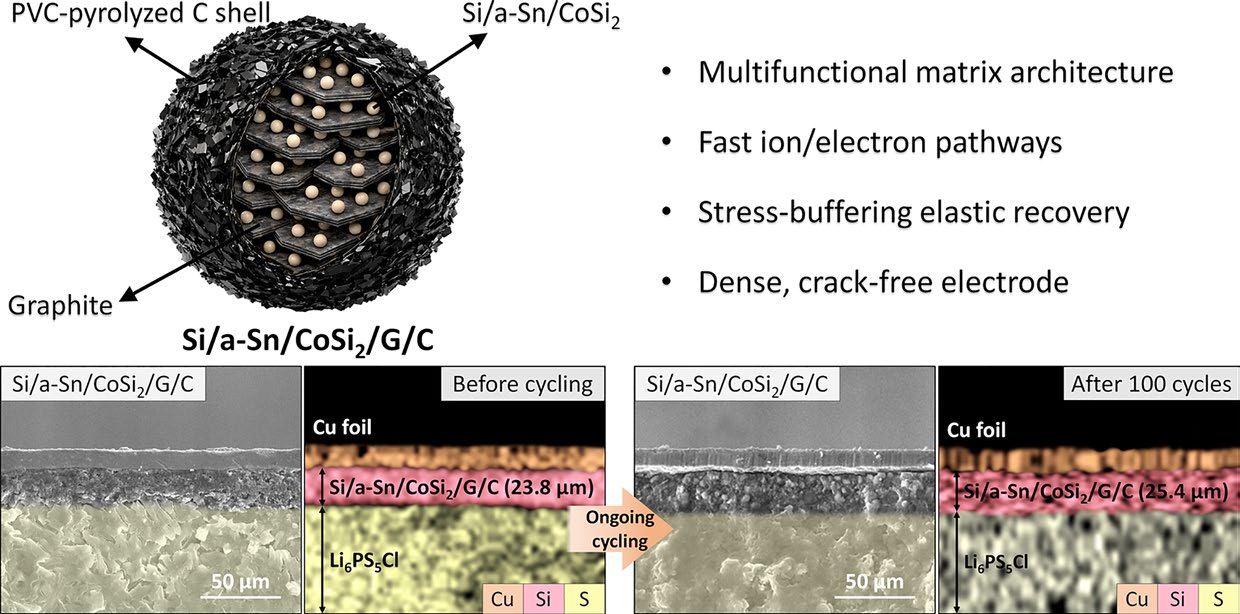

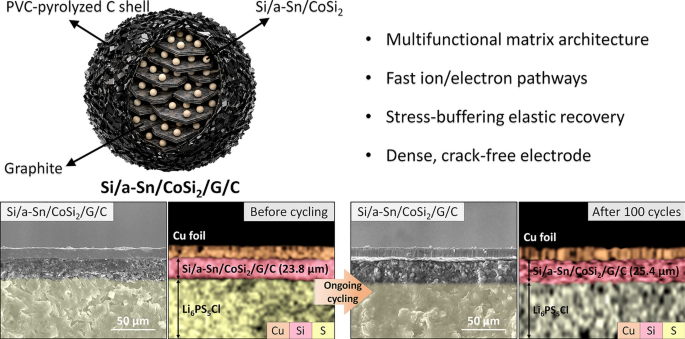

As the demand for higher-energy-density lithium-ion batteries (LIBs) and all-solid-state lithium batteries (ASSLBs) continues to intensify for electric vehicles and grid storage, conventional graphite anodes face a fundamental capacity ceiling at 372 mAh g-1. Silicon, with its exceptional theoretical capacity of 3579 mAh g-1, has long been regarded as the ultimate anode candidate — yet its practical deployment has been crippled by severe volume expansion exceeding 300%, intrinsic electronic insulation, and catastrophic chemo-mechanical degradation. Now, researchers from Kumoh National Institute of Technology, Korea Electrotechnology Research Institute (KERI), and Kookmin University, led by Prof. Cheol-Min Park, Dr. Yoon-Cheol Ha, and Prof. Jae-Hun Kim, have presented a transformative silicon nanocomposite anode that overcomes these longstanding barriers through a uniquely hierarchical, multifunctional matrix architecture.
Why This Anode Matters
Traditional silicon anode designs typically rely on high fractions of carbonaceous components or complex nanostructures to buffer volume changes and enhance conductivity — approaches that inevitably dilute active material content and compromise scalability. The novel Si/a-Sn/CoSi2/G/C nanocomposite breaks this paradigm by integrating four distinct, synergistically optimized matrices within a single, scalable fabrication route, achieving simultaneous optimization of electronic conduction, mechanical robustness, and elastic stress recovery without sacrificing practical manufacturability.
Innovative Design and Mechanism
The material is synthesized through a simple yet powerful two-step process: high-power mechanical milling followed by a single heat treatment. This yields a hierarchical architecture comprising:
- Amorphous Sn matrix: A well-deformable, electronically conductive network that homogenizes ~10 nm Si nanocrystallites and maintains continuous electronic percolation
- CoSi2 framework: A mechanically robust and elastically recoverable transition metal silicide (TMS) phase with exceptional deformation energy (177.967 × 10⁻¹⁰ J) and high electronic conductivity (2.186 × 10⁻¹ S cm-1)
- Graphite scaffold: A highly Li-reversible, stress-mitigating carbon backbone that provides extended conductive pathways and additional structural buffering
- PVC-pyrolyzed carbon shell: A highly elastic (77.1% elastic energy fraction), electronically conductive outer layer that encapsulates the composite and suppresses interfacial degradation
Nanoindentation and cross-sectional SEM analyses reveal that this multimatrix design enables multilevel stress redistribution with elastic recovery, reducing electrode swelling from 179% (pristine Si) to merely 32.6% during lithiation, while maintaining a crack-free, dense morphology even after 100 cycles.
Outstanding Performance
In LIB half-cell configuration, Si/a-Sn/CoSi2/G/C delivers a high reversible capacity of 1255.4 mAh g-1 with an initial Coulombic efficiency of 80.7% and retains 91.4% capacity over 100 cycles. Rate capability tests demonstrate exceptional high-rate performance, achieving 725.2 mAh g-1 at 3C with full capacity recovery upon returning to 1C — outperforming most previously reported Si/TMS-based anodes in cycle life, capacity retention, and reversible capacity.
When paired with an NCM811 cathode in a LIB full-cell, the device achieves a remarkable energy density of 434.4 Wh kg-1 at 0.1C with durable cycling stability (81.2% retention at 1C over 100 cycles) — a 40% improvement over conventional graphite|NCM811 full-cells (309.1 Wh kg-1).
Solid-State Battery Breakthrough
Critically, the nanocomposite demonstrates seamless compatibility with sulfide-based ASSLBs employing Li6PS5Cl solid electrolyte. Unlike conventional alloy anodes that require high fractions of solid electrolyte in the anode layer — diluting energy density — the Si/a-Sn/CoSi2/G/C anode operates effectively in an SE-free configuration thanks to its intrinsic conductive–percolation network. The ASSLB full-cell delivers an energy density exceeding 300 Wh kg-1 (estimated at 301.2 Wh kg-1 with 30 μm LPSC), with 89.3% capacity retention over 150 cycles at 0.3C. Cross-sectional SEM confirms minimal electrode expansion (6.7% after 100 cycles) and stable interfacial contact with the solid electrolyte, while XPS verifies the formation of a self-limiting, stable interphase.
Applications and Future Outlook
This work establishes Si/a-Sn/CoSi2/G/C as a practical and scalable silicon-based anode platform, bridging the gap between laboratory innovation and industrial manufacturability for next-generation LIBs and ASSLBs. By demonstrating that multifunctional conductive–elastic matrices can concurrently resolve the electronic, ionic, and mechanical bottlenecks of silicon anodes through a simple, industry-compatible synthesis route, this research opens promising avenues for high-energy batteries combining ultra-high capacity, fast charging, and long-term durability.
Stay tuned for more groundbreaking research from this collaborative team at Kumoh National Institute of Technology, KERI, and Kookmin University!

Editor of Nano-Micro Letters, which is an Open-Access, peer-reviewed journal reported papers that have at least one dimension ranging from a few sub-nanometers to a few hundreds of micrometers. The journal is published by Springer Nature and indexed by SCI, EI, SCOPUS, Pubmed, etc. The 2025 JCR Impact Factor is 38.5. The 2025 CiteScore is 58.9.
Follow the Topic
-
Nano-Micro Letters
Nano-Micro Letters is a peer-reviewed, international, interdisciplinary and open-access journal that focus on science, experiments, engineering, technologies and applications of nano- or microscale structure and system in physics, chemistry, biology, material science, and pharmacy.