Hetero‑Solvent Microenvironment for Selective CO2 to Ethanol Electrolysis via Interfacial Water Control
Published in Chemistry

As global efforts to achieve carbon neutrality intensify, electrochemical CO2 reduction (CO2RR) has emerged as a promising pathway for converting waste CO2 into value-added chemicals and fuels. However, the competing hydrogen evolution reaction (HER) severely limits the selectivity and efficiency of CO2-to-C2+ conversion. Now, a collaborative team led by Professor Chanyeon Kim (DGIST), Professor Chang Hyuck Choi (POSTECH), and Professor Seoin Back (Korea University) has presented a breakthrough strategy that redefines interfacial water management for selective CO2-to-ethanol electrolysis.
Why This Microenvironment Matters
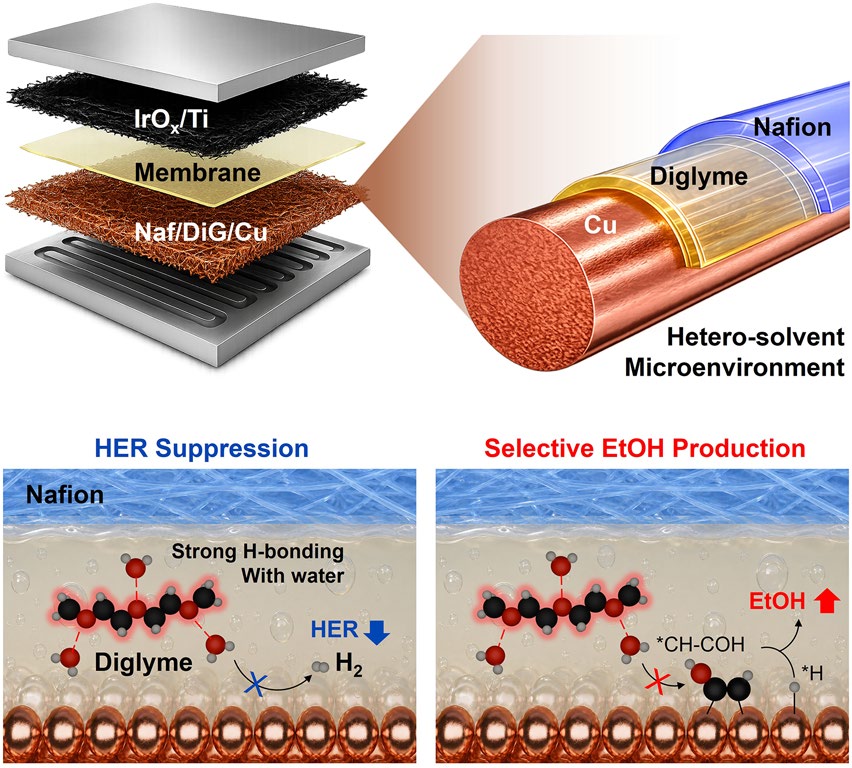
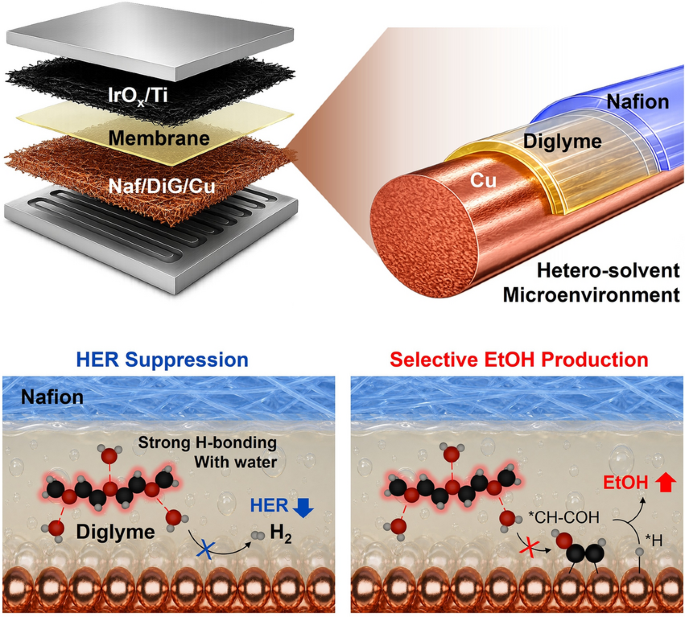
Traditional approaches to suppress HER have focused on tuning catalyst hydrophobicity or modifying bulk electrolyte pH—yet these methods either impede CO2 mass transport or fail to inhibit water dissociation under neutral/alkaline conditions. The novel hetero-solvent microenvironment overcomes these limitations by confining diglyme (DiG) near the Cu catalyst via a Nafion protective layer, fundamentally restructuring interfacial water hydrogen-bonding networks without altering the catalyst itself.
Innovative Design and Mechanism
The Naf/DiG/Cu electrode architecture strategically localizes DiG within the catalytic microenvironment rather than the bulk electrolyte. In situ surface-enhanced infrared absorption spectroscopy (SEIRAS) and ab initio molecular dynamics (AIMD) simulations reveal that DiG strengthens the hydrogen-bonding network of interfacial water, substantially reducing free-water populations prone to dissociation. This modulation simultaneously suppresses the Volmer step of HER and redirects hydrogenation pathways: the solvent-mediated Eley-Rideal (ER) mechanism favoring ethylene formation is kinetically hindered (1.468 eV barrier), while the Langmuir-Hinshelwood (LH) pathway promoting ethanol becomes dominant (0.951 eV barrier).
Outstanding Performance
The Naf/DiG/Cu electrode achieves unprecedented CO2-to-ethanol metrics under neutral conditions. The ethanol partial current density reaches 89.5 mA cm-2 at 3.6 V cell voltage—2.6-fold higher than Naf/Cu and 5.3-fold higher than bare Cu. Notably, the ethanol-to-ethylene selectivity ratio is fundamentally inverted: while conventional Cu intrinsically favors C2H4, the hetero-solvent microenvironment steers selectivity toward C2H5OH across all tested potentials. HER is suppressed by 2.4-fold compared to bare Cu, with overall CO2RR activity reaching 219.6 mA cm-2.
Scalability and Record-Breaking Results
Because this strategy engineers the microenvironment rather than the catalyst, it readily extends to other systems. When applied to Cu-Ag bimetallic catalysts, the Naf/DiG/Cu-Ag electrode delivers a record-breaking ethanol partial current density of 184.2 mA cm-2 at 3.6 V—the highest reported for MEA-based CO2RR under neutral conditions—while maintaining an exceptional ethanol-to-ethylene ratio of 2.6. Long-term stability tests demonstrate 100 hours of continuous operation at 150 mA cm-2 with minimal degradation, confirming that DiG remains stably confined within the microenvironment.
Applications and Future Outlook
This work establishes interfacial water control via hetero-solvent microenvironments as a universal design principle for aqueous electrocatalysis. Beyond CO2RR, the strategy opens promising avenues for ammonia synthesis, water electrolysis, and organic electrosynthesis where interfacial water management is critical. By decoupling microenvironment engineering from catalyst design, this approach offers a scalable, cost-effective pathway toward industrial-scale electrochemical manufacturing.
Stay tuned for more groundbreaking research from this collaborative team at DGIST, POSTECH, Korea University, and KIST!

Editor of Nano-Micro Letters, which is an Open-Access, peer-reviewed journal reported papers that have at least one dimension ranging from a few sub-nanometers to a few hundreds of micrometers. The journal is published by Springer Nature and indexed by SCI, EI, SCOPUS, Pubmed, etc. The 2025 JCR Impact Factor is 38.5. The 2025 CiteScore is 58.9.
Follow the Topic
-
Nano-Micro Letters
Nano-Micro Letters is a peer-reviewed, international, interdisciplinary and open-access journal that focus on science, experiments, engineering, technologies and applications of nano- or microscale structure and system in physics, chemistry, biology, material science, and pharmacy.