Coordination–Entropy Regulation: Toward Unified Design of Hydrogel Electrolytes for Practical Wide‑Temperature Zinc‑Ion Batteries
Published in Materials
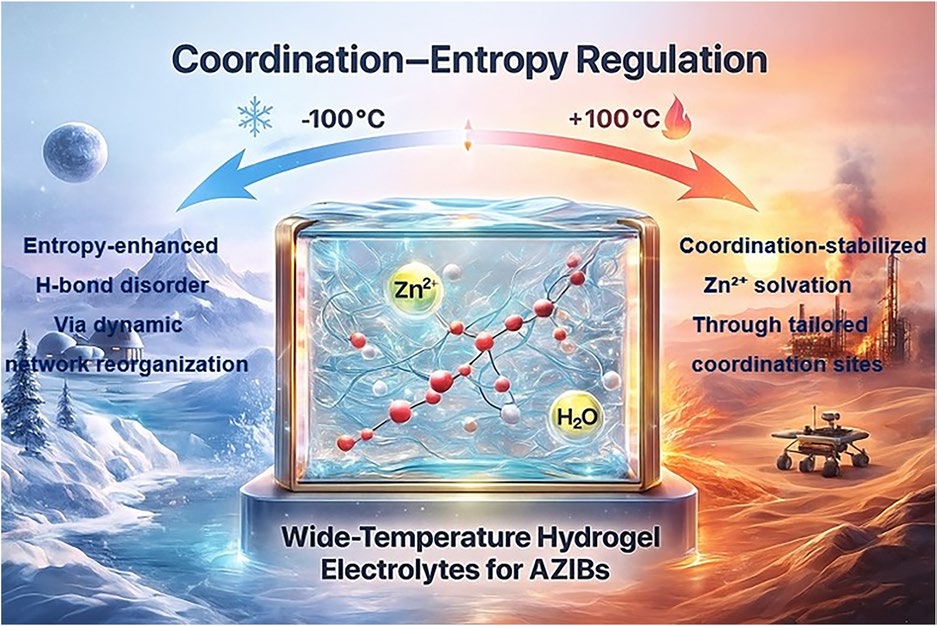
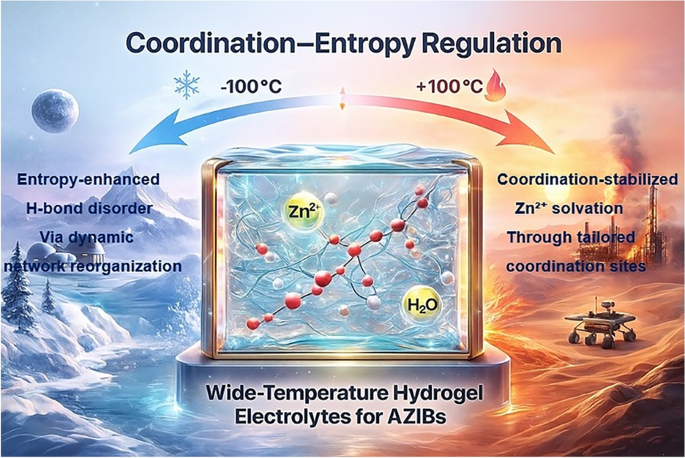

As the demand for all-climate energy storage systems continues to grow, conventional aqueous zinc-ion batteries face critical limitations in wide-temperature operation. Now, researchers from Jilin University, led by Professor Hong Zhang, Professor Ke Lu, and Professor Chun Cheng Yang, have presented a breakthrough coordination–entropy regulation framework that bridges the gap between molecular solvation chemistry and macroscopic electrochemical stability.
Why This Framework Matters
Traditional hydrogel electrolyte design typically suffers from isolated optimization strategies—focusing on either coordination chemistry or structural disorder independently—which fails to address the coupled thermodynamic and kinetic challenges under extreme temperatures. The novel coordination–entropy (C-E) regulation framework overcomes this limitation by unifying Zn2+ solvation chemistry, electrolyte thermodynamics, and interfacial dynamics into a single design paradigm, enabling stable battery operation from −100°C to +100°C.
Innovative Design and Mechanism
The framework is built upon the synergistic coupling of two complementary regulation mechanisms. Coordination regulation reconstructs Zn2+ solvation environments by introducing polymer functional groups, anions, or cosolvents that partially replace coordinated water molecules in the primary solvation shell, thereby lowering desolvation barriers and stabilizing interfacial reaction pathways. Entropy regulation increases the diversity of accessible ionic configurations and transport states across multiple structural scales—including mixing entropy, ionic entropy, configurational entropy, and topological entropy—thereby maintaining ion-transport continuity and structural adaptability under temperature variation. Monte Carlo and molecular dynamics simulations reveal that this intrinsic coupling enables a unique three-dimensional percolation network of dynamically exchangeable coordination states, facilitating fast Zn2+ migration with low energy barriers throughout the bulk material and at electrode interfaces.
Outstanding Performance
The C-E framework delivers exceptional wide-temperature electrochemical stability. Representative systems achieve ultrawide-temperature operation from −70°C to +80°C with Coulombic efficiencies exceeding 99.7%. The framework enables Zn||Zn symmetric cells to cycle stably for over 10,500 hours, while full cells maintain 91.7% capacity retention after 11,000 cycles at −20°C and retain 90% capacity after 750 cycles at 90°C. The material exhibits characteristic wide-temperature signatures: Arrhenius-type thermally activated ion transport, suppressed hydrogen-bond ordering at low temperatures, and inhibited water evaporation and parasitic reactions at elevated temperatures. Notably, flexible pouch cells demonstrate stable operation under bending, puncture, and cutting conditions.
Applications and Future Outlook
When applied to practical aqueous zinc-ion batteries, the C-E framework achieves exceptional metrics: high ionic conductivity (up to 254.5 mS cm-1), excellent mechanical robustness, and ultrawide-temperature adaptability spanning from deep cryogenic to elevated thermal conditions. This work establishes a new family of theory-informed electrolyte design principles, opening promising avenues for next-generation energy storage systems combining high safety, all-climate operability, and scalable manufacturing.
Stay tuned for more groundbreaking research from this collaborative team at Jilin University!

Editor of Nano-Micro Letters, which is an Open-Access, peer-reviewed journal reported papers that have at least one dimension ranging from a few sub-nanometers to a few hundreds of micrometers. The journal is published by Springer Nature and indexed by SCI, EI, SCOPUS, Pubmed, etc. The 2025 JCR Impact Factor is 38.5. The 2025 CiteScore is 58.9.
Follow the Topic
-
Nano-Micro Letters
Nano-Micro Letters is a peer-reviewed, international, interdisciplinary and open-access journal that focus on science, experiments, engineering, technologies and applications of nano- or microscale structure and system in physics, chemistry, biology, material science, and pharmacy.