In Situ Defect Healing Suppresses Mn Dissolution Chain Reactions in Aqueous Sodium-Ion Cathodes
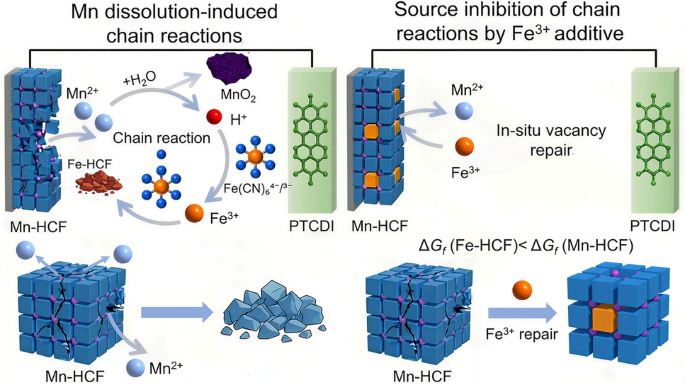

As the demand for safe, low-cost, and environmentally friendly energy storage continues to grow, aqueous sodium-ion batteries (ASIBs) have emerged as a compelling alternative to conventional lithium-ion systems. Among promising cathode materials, sodium manganese hexacyanoferrate (Mn-HCF) stands out with a high theoretical capacity of 170 mAh g-1 and an attractive operating voltage above 3.2 V. Yet its practical deployment has been severely hindered by rapid capacity fading driven by manganese dissolution—a problem that conventional strategies have only managed to delay, not solve. Now, researchers from Sun Yat-sen University, led by Professor Gongzheng Yang and Professor Chengxin Wang, have unveiled the hidden degradation mechanism and introduced a breakthrough in situ surface repair strategy that fundamentally transforms how we stabilize Mn-based cathodes.
Why This Cathode Matters
Traditional approaches to mitigating Mn dissolution—including lattice doping, surface coating, and electrolyte additives—operate on a common limitation: they merely slow the initial leaching of Mn2+ without addressing the catastrophic secondary reactions that follow. The novel insight from this work reveals that Mn dissolution is not the end of degradation, but the beginning of a self-propagating chain reaction that actively destroys the cathode structure from within.
Innovative Design and Mechanism
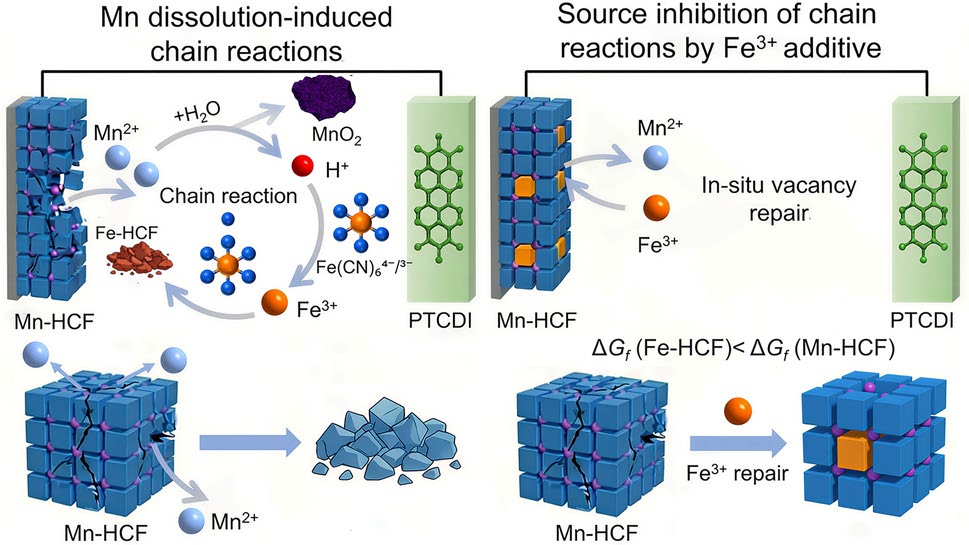
Through systematic in situ and ex situ characterization, the team elucidated a previously overlooked degradation chain reaction:
1. Mn2+ Dissolution: Under oxidizing conditions, Mn2+ leaches from the lattice, creating vacancies.
2. Water Oxidation Catalysis: Dissolved Mn2+ catalyzes interfacial water oxidation, generating protons that acidify the local environment.
3. Ligand Decomposition: The acidic conditions protonate and decompose Fe(CN)64-/3- cyanide ligands, releasing Fe2+/3+ ions.
4. Surface Precipitation: The released Fe ions re-coordinate with residual Fe(CN)64- and Na+ to precipitate NaxFe[Fe(CN)6] (Fe-HCF) on the electrode surface.
5. Lattice Collapse: As this chain reaction continues, the original Mn-HCF framework progressively disintegrates.
To sever this chain at its source, the researchers introduced iron(III) trifluoromethanesulfonate (Fe(OTf)3) into a concentrated 17.6 m NaClO4 aqueous electrolyte. The strategy leverages two key principles:
• Thermodynamic Driving Force: Fe-HCF exhibits a more negative Gibbs free energy of formation (ΔGf) than Mn-HCF, meaning it is intrinsically more stable and less soluble. This thermodynamic preference drives Fe3+ to spontaneously occupy Mn vacancies as they form.
• Structural Coherence: Mn-HCF and Fe-HCF share nearly identical face-centered cubic structures with a lattice mismatch of only 2.29% (10.50 Å vs. 10.26 Å) and C≡N stretching modes differing by less than 1 cm-1. This minimal strain enables coherent epitaxial overgrowth, allowing Fe3+ to seamlessly patch vacancy defects without introducing interfacial stress.
The concentrated "water-in-salt" electrolyte further constrains Mn loss by reducing free water activity, while the Fe3+ additive actively repairs emerging vacancies in real time—transforming passive protection into dynamic self-healing.
Outstanding Performance
The in situ repaired Mn-HCF cathode delivers exceptional electrochemical metrics:
• High Capacity: 118.5 mAh g-1 initial discharge capacity at 2 A g-1.
• Ultralong Cycling Stability: 80% capacity retention after 20,000 cycles at 2 A g-1, corresponding to an ultra-low capacity fade rate of 0.001% per cycle.
• Enhanced Rate Capability: 168.6, 145.7, 128.8, 102.8, and 85.1 mAh g-1 at 0.5, 1, 2, 5, and 10 A g-1, respectively—significantly outperforming the blank system.
• High-Loading Validation: Even at a practical mass loading of ~16 mg cm-2, the electrode retains 80% capacity after 500 cycles at 1 A g-1.
In situ XRD and Raman spectroscopy confirmed that the Fe3+ repair strategy fundamentally alters structural evolution: the severe cubic-to-tetragonal phase transition (4.06% volume change) in the blank electrolyte is suppressed to a modest 2.19% in the repaired system, with the tetragonal phase fraction significantly reduced. The C≡N blue shift during charging is attenuated from 75 cm-1 to 61 cm-1, indicating alleviated Jahn–Teller distortion and stabilized cyanide frameworks.
Notably, the strategy proves broadly applicable beyond Mn-HCF. When applied to Fe-HCF cathodes, Fe(OTf)3 similarly suppresses iron ion dissolution and extends cycle life, demonstrating its generalizability across the Prussian blue analog family.
Applications and Future Outlook
When paired with a PTCDI (3,4,9,10-perylenetetracarboxylic diimide) organic anode in a full-cell configuration, the stabilized Mn-HCF cathode achieves a high output voltage of ~1.4 V with exceptional longevity. The Fe(OTf)3 additive is used at low concentration (≤0.2 M), costing less than 5% of the base electrolyte, making this approach highly cost-effective and scalable.
This work establishes a paradigm shift in cathode stabilization: rather than merely delaying dissolution, real-time vacancy refilling at the atomic scale halts degradation at its origin. By revealing the chain reaction mechanism and delivering a practical in situ repair solution, this research opens promising avenues for next-generation aqueous sodium-ion batteries combining high safety, low cost, and unprecedented cycling stability for grid-scale energy storage.
Stay tuned for more groundbreaking research from this collaborative team at Sun Yat-sen University!

Editor of Nano-Micro Letters, which is an Open-Access, peer-reviewed journal reported papers that have at least one dimension ranging from a few sub-nanometers to a few hundreds of micrometers. The journal is published by Springer Nature and indexed by SCI, EI, SCOPUS, Pubmed, etc. The 2025 JCR Impact Factor is 38.5. The 2025 CiteScore is 58.9.
Follow the Topic
-
Nano-Micro Letters
Nano-Micro Letters is a peer-reviewed, international, interdisciplinary and open-access journal that focus on science, experiments, engineering, technologies and applications of nano- or microscale structure and system in physics, chemistry, biology, material science, and pharmacy.