Electron Redistribution by Fluorine‑Induced Dual Defects in Cu3P Accelerated Charge Transfer Toward High‑Performance Electrochemical Chloride Ion Removal
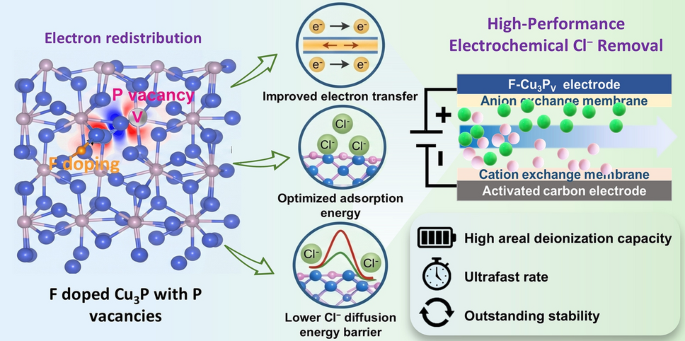

As global freshwater scarcity intensifies and industrial wastewater treatment demands escalate, electrochemical chloride ion removal has emerged as a critical technology for clean water production and environmental protection. Yet its practical deployment has been fundamentally hindered by sluggish reaction kinetics — particularly when scaling to high-mass-loading electrodes (>10 mg cm⁻²) required for commercial viability. Conventional extrinsic strategies, such as conductive additives or structural engineering, offer only constrained effectiveness because they fail to circumvent the intrinsic material limitations. Now, researchers from Tongji University, Kashi University, and Shanghai Ocean University, led by Prof. Jie Ma, have unveiled a transformative intrinsic enhancement strategy that redefines the performance ceiling of electrochemical deionization.
Why This Electrode Matters
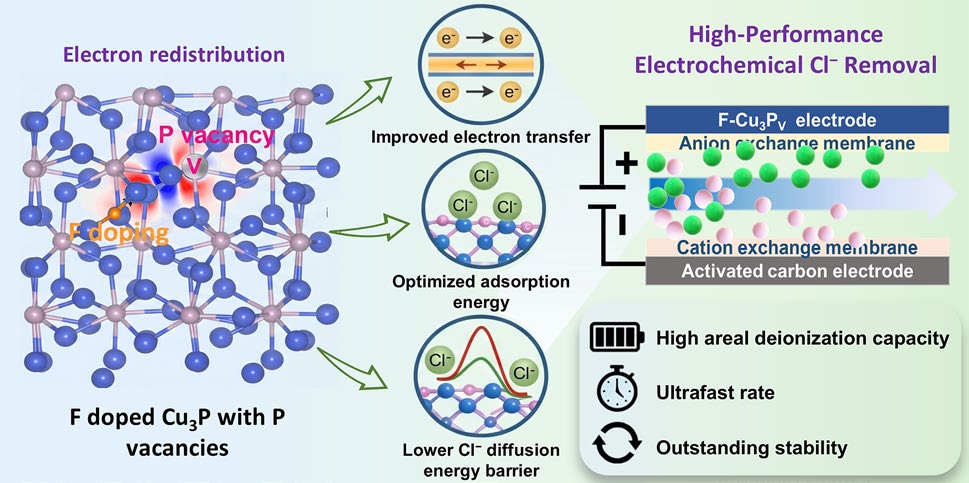
Traditional approaches to accelerating electrode kinetics rely on extrinsic modifications — adding conductive components or engineering pore structures — which inevitably reach diminishing returns. The novel F-Cu3Pv electrode breaks through this bottleneck by leveraging heteroatom doping to trigger self-adaptive dual defect formation, fundamentally rewiring the intrinsic electronic structure of copper(I) phosphide. This intrinsic strategy achieves what extrinsic methods cannot: simultaneous enhancement of electron transfer, ion adsorption, and diffusion kinetics through controlled electron redistribution at the atomic level.
Innovative Design and Mechanism
The material is synthesized through a facile two-step route: low-temperature phosphation of Cu(OH)2 nanowire arrays followed by controlled molten salt treatment with NH4F. Density functional theory (DFT) calculations reveal the elegant mechanism:
- F doping (electronegativity: 3.98) induces lattice distortion and surface reconstruction, reducing phosphorus vacancy formation energy from 1.21 eV to 0.63 eV
- Dual defects (F doping + P vacancies) synergistically modulate intrinsic electron redistribution, as confirmed by Bader charge analysis and density of states calculations
- Enhanced conductivity: The F-Cu3Pv model exhibits markedly increased electronic states near the Fermi level, accelerating intrinsic charge-transfer kinetics
- Optimized Cl⁻ capture: Electron redistribution strengthens Cl⁻ adsorption (charge transfer: 0.83e vs. 0.56e for pristine Cu3P) and lowers diffusion energy barriers (0.38 eV vs. 0.48 eV)
HRTEM, EPR, and XPS analyses confirm the successful incorporation of F atoms and the generation of rich P vacancies, with lattice expansion and maintained nanorod array morphology.
Outstanding Performance
The F-Cu3Pv-2 electrode delivers exceptional electrochemical chloride ion removal metrics that surpass state-of-the-art counterparts:
- Superior areal deionization capacity (ADC): 3.16 ± 0.02 mg cm-2 — more than doubling that of pristine Cu₃P
- Ultrafast areal deionization rate (ADR): 0.106 ± 0.001 mg cm-2 min-1, achieving comparable salt removal in less than half the time
- Outstanding cycling stability: 95.65% capacity retention after 70 cycles, compared to 86.67% for pristine Cu₃P
- Energy-efficient operation: Lower energy consumption across all applied voltages (1.0–1.6 V), with competitive performance against previously reported electrodes
In Ragone plots and Kim-Yoon comparisons, F-Cu3Pv -2 stands distinctly apart from other Faradaic materials, Ag-based electrodes, and carbon materials, occupying the optimal region of high ADC and rapid ADR simultaneously.
High-Mass-Loading Practicality
Critically, the F-Cu3Pv electrode achieves an exceptional balance of areal, volumetric, and gravimetric deionization capacities — a trilemma that typically plagues high-mass-loading electrodes. Radar plot analysis confirms that F-Cu3Pv-2 simultaneously delivers the highest ADC, VDC, and GDC among comparable high-loading electrodes, attributed to the intrinsic kinetic enhancement that mitigates the sluggish transport associated with increased electrode thickness.
Applications and Future Outlook
This work establishes heteroatom doping-induced dual defects as a viable and generalizable pathway to overcome intrinsic kinetic bottlenecks in Faradaic electrode materials. By demonstrating that controlled electron redistribution through F doping and P vacancies can concurrently optimize conductivity, adsorption, and ion diffusion, this research opens promising avenues for next-generation electrochemical water treatment systems combining ultrafast desalination, high capacity, and long-term durability.
Stay tuned for more groundbreaking research from this collaborative team at Tongji University, Kashi University, and Shanghai Ocean University!

Editor of Nano-Micro Letters, which is an Open-Access, peer-reviewed journal reported papers that have at least one dimension ranging from a few sub-nanometers to a few hundreds of micrometers. The journal is published by Springer Nature and indexed by SCI, EI, SCOPUS, Pubmed, etc. The 2025 JCR Impact Factor is 38.5. The 2025 CiteScore is 58.9.
Follow the Topic
-
Nano-Micro Letters
Nano-Micro Letters is a peer-reviewed, international, interdisciplinary and open-access journal that focus on science, experiments, engineering, technologies and applications of nano- or microscale structure and system in physics, chemistry, biology, material science, and pharmacy.