Moisture‑Resistant Scalable Ambient‑Air Crystallization of Perovskite Films via Self‑Buffered Molecular Migration Strategy
Published in Bioengineering & Biotechnology, Electrical & Electronic Engineering, and Materials
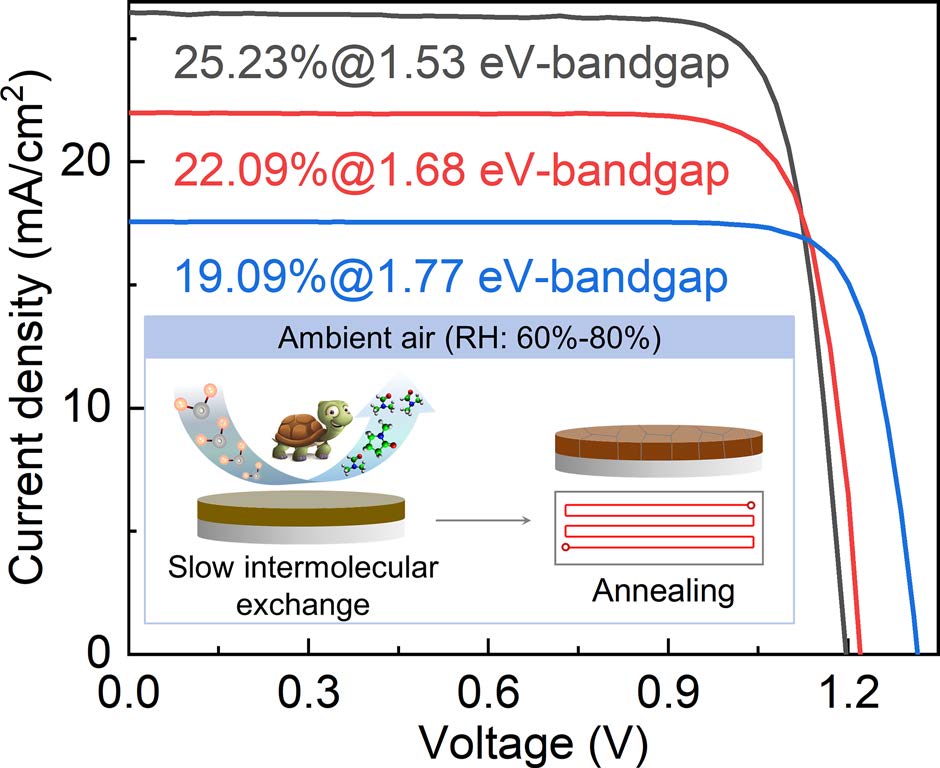
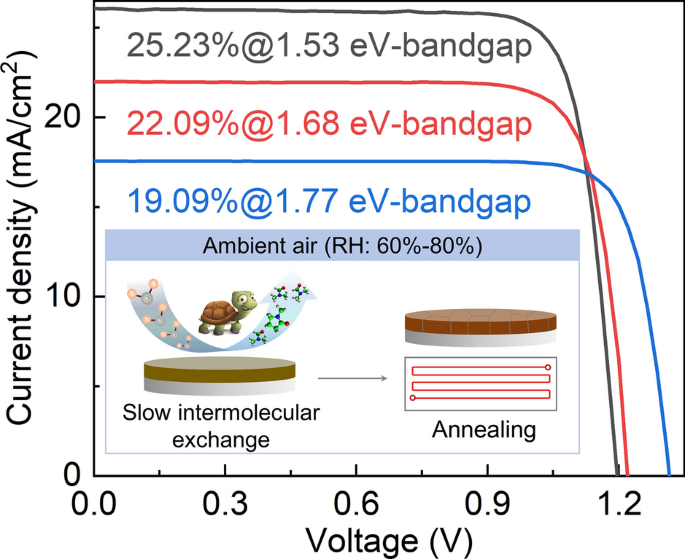

As perovskite solar cells (PSCs) move toward commercialization, their extreme sensitivity to ambient moisture remains a major barrier to scalable, low-cost manufacturing. Now, researchers from Xidian University, led by Prof. Weidong Zhu and Prof. Chunfu Zhang, have developed a self-buffered molecular migration strategy that enables moisture-resistant, ambient-air crystallization of perovskite films—achieving record efficiencies without the need for strict humidity control.
Why Self-Buffered Molecular Migration Matters
- Moisture Tolerance: A BABr shielding layer slows intermolecular exchange between perovskite intermediates and ambient moisture, suppressing premature crystallization and impurity formation.
- Broad Process Windows: Enables high-quality film formation under 60–80% relative humidity and extended air exposure times (up to 60 min).
- Scalable and Cost-Effective: Eliminates the need for glovebox environments and tight humidity control, reducing manufacturing complexity and cost.
Innovative Design and Features
- Surface Shielding Layer: n-Butylammonium bromide (BABr) forms a hydrophobic barrier that modulates solvent–moisture interactions during ambient annealing.
- Enhanced Crystallinity: Promotes larger grain size, higher phase purity, and reduced defect density in final perovskite films.
- Versatile Chemistry: Strategy successfully extended to other shielding agents (MACl, PEACl, CF3-PEABr, etc.) and multiple bandgaps (1.53, 1.68, 1.77 eV).
Applications and Performance
- Record Efficiency: 1.68 eV-bandgap PSCs achieve 22.09% PCE in ambient air (50–60% RH), the highest reported for this bandgap under air processing.
- Excellent Stability: Retains 94% of initial PCE after 1000 h in 60–80% RH, outperforming control devices.
- High Reproducibility: Devices fabricated across 30–80% RH and 10–55 min air exposure consistently exceed 20.5% PCE.
Conclusion and Outlook
This work introduces a universal, scalable strategy for ambient-air perovskite crystallization, unlocking wider processing windows, higher efficiencies, and improved stability for next-generation photovoltaic manufacturing. It marks a critical step toward industrial-grade perovskite solar cells processed in open air.
Stay tuned for more innovations from Prof. Weidong Zhu and Prof. Chunfu Zhang’s team at Xidian University!

Editor of Nano-Micro Letters, which is an Open-Access, peer-reviewed journal reported papers that have at least one dimension ranging from a few sub-nanometers to a few hundreds of micrometers. The journal is published by Springer Nature and indexed by SCI, EI, SCOPUS, Pubmed, etc. The 2025 JCR Impact Factor is 38.5. The 2025 CiteScore is 58.9.
Follow the Topic
-
Nano-Micro Letters
Nano-Micro Letters is a peer-reviewed, international, interdisciplinary and open-access journal that focus on science, experiments, engineering, technologies and applications of nano- or microscale structure and system in physics, chemistry, biology, material science, and pharmacy.