Cobalt-Based Electrocatalysts for Sustainable Nitrate Conversion: Structural Design and Mechanistic Advancements
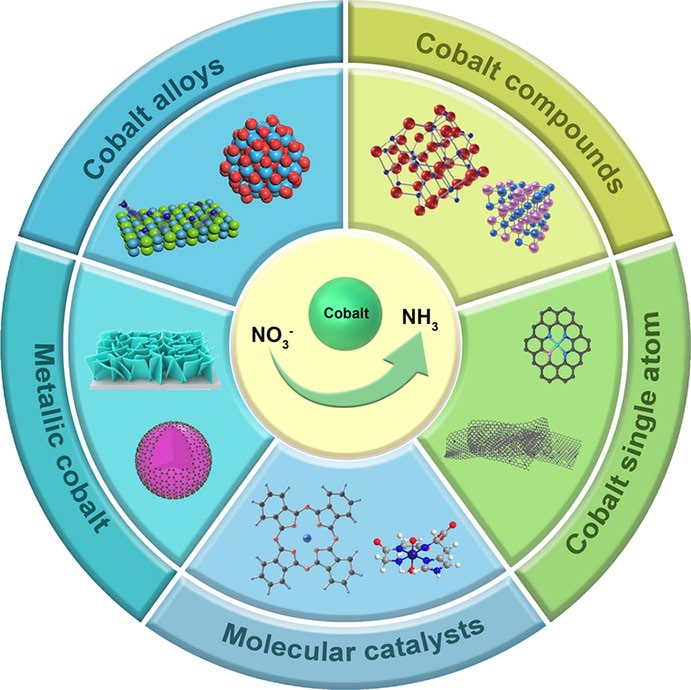
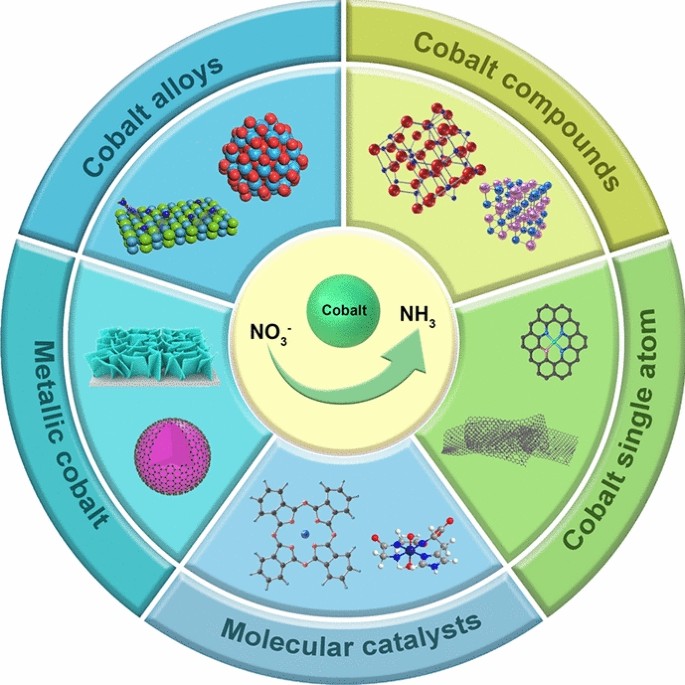

With agricultural run-off and industrial effluents pushing nitrate levels to record highs, electrocatalytic nitrate reduction (NO3RR) offers a rare “two-birds-one-stone” opportunity: clean water + green NH₃. A multinational team—Zhengzhou University, Wenzhou University & Nankai University—led by Prof. Zhijie Kong and Prof. Zheng-Jun Wang has now delivered the first comprehensive roadmap for cobalt-based catalysts that can hit industrial current densities while keeping Faradaic efficiencies > 95 %.
Why Co Matters
- Earth-abundant & recyclable: Co price ≈ 1/10 of Ru, yet its 3d-electron manifold delivers near-optimal d-band centres for N–O scission and H* supply.
- HER sweet-spot: Moderate H-chemisorption suppresses H2 loss, funnelling protons into the 8 e⁻/9 H⁺ NH3 pathway.
- Coordination versatility: Co–Co, Co–O, Co–P, Co–N, Co–B & Co-single-atom motifs enable atom-scale tuning that Cu/Fe simply cannot match.
Design Toolkit Highlighted
- Electronic descriptor: Work-function ≤ 4.7 eV plus Ed ≈ EF maximises NO3⁻ adsorption while starving the Heyrovsky step—Co foils already give 96 % FE at −0.24 V vs RHE.
- Alloying & tandem catalysis: Ru₁₅Co₈₅ hollow nanododecahedra push onset to +0.4 V vs RHE (3.2 mmol h-1 mg-1, 97 % FE) via a three-step relay (spontaneous redox → electrochemical → hydrogenation).
- Oxygen-vacancy engineering: Mn-doped Co3O4 nanotubes lower the PDS barrier from 0.83 → 0.42 eV, hitting 99.5 % NH3 selectivity in neutral media.
- Single-atom & molecular platforms: CoP1N3/C boosts NH4⁺ FE to 92 % by breaking N–N coupling; Co-phthalocyanine/CNT co-reduces CO2 + NO3⁻ to methylamine with 84 % yield—opening a C–N circular economy.
From Lab to Factory
- Flow-cell validation: Poly-cobalt-cluster coordination polymer NJUZ-2 sustains 470 mA cm-2 at −0.5 V, yielding 3.4 mol h-1 g-1 NH3—20× H-cell output.
- Real wastewater: Co foam remains best among 15 commercial metals even with 11 773 ppm Ba2+, 3 824 ppm SO42-; long-term Co-leaching < 0.05 mg L-1.
- Reactor roadmap: Membrane-electrode assemblies (MEA) and Zn–NO3⁻ batteries are spotlighted as the shortest path to kA-scale plants, yet demand catalyst layers < 80 µm and Cl⁻-tolerant active sites.
Challenges & Next Steps
- Scale-up synthesis: Continuous spray-drying or carbothermal shock for kg-batch Co-alloy nanocages.
- Durability: Suppress surface reconstruction (Co3+ → CoOOH) via protective carbon or B-doped skins.
- Product diversification: Target urea, methylamine or hydrazine by coupling CO2 or CH2O streams.
- Machine-learning: Fast-screen Co–M–X ternaries (M = Cu, Fe, Ni, Al; X = O, P, S) against 105 crystal facets.
- System integration: Pair catalyst innovation with membrane-free or MEA reactors; recover NH3 by gas-permeable membranes or stripping columns.
By bridging surface-science insights with reactor engineering, this review positions cobalt at the heart of next-generation nitrogen-recycling plants—turning an environmental liability into a carbon-free feedstock for fuels, fertilisers and fine chemicals. Stay tuned for pilot-scale demonstrations from the Henan Green Catalysis Center and Wenzhou Bay Batteries Hub!

Editor of Nano-Micro Letters, which is an Open-Access, peer-reviewed journal reported papers that have at least one dimension ranging from a few sub-nanometers to a few hundreds of micrometers. The journal is published by Springer Nature and indexed by SCI, EI, SCOPUS, Pubmed, etc. The 2025 JCR Impact Factor is 38.5. The 2025 CiteScore is 58.9.
Follow the Topic
-
Nano-Micro Letters
Nano-Micro Letters is a peer-reviewed, international, interdisciplinary and open-access journal that focus on science, experiments, engineering, technologies and applications of nano- or microscale structure and system in physics, chemistry, biology, material science, and pharmacy.