A New Route to Optical Nonreciprocity Hidden in Ordinary Materials
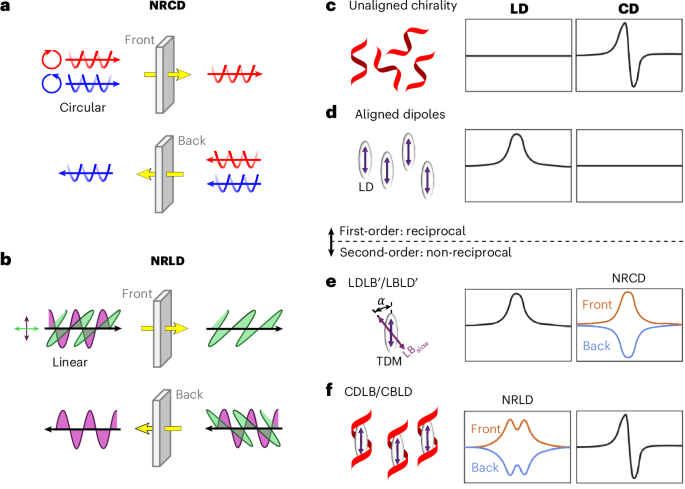

The project began with a simple question: could optical nonreciprocity arise in ordinary materials? The breakthrough came when Ph.D. student Thomas Ugras recognized an unexpected prediction hidden within the mathematics of polarized light. While revisiting the Stokes-Mueller formalism, Thomas identified a pathway through which chiral and linear optical effects could interfere, producing a directional asymmetry in the absorption and emission of linearly polarized light.
To test the idea, we turned to self-assembled semiconductor magic-size clusters, nanomaterials that spontaneously organize into highly ordered films possessing both linear and chiral optical responses. The experiments confirmed the prediction: identical polarized light incident on opposite faces of the same film produced different optical responses. In one direction the material preferentially interacted with one linear polarization, while from the opposite side the preferred polarization was reversed.
The most surprising aspect of the work is not the discovery of a new material. Rather, the work reveals that a fundamentally new optical response can emerge from materials that researchers already know how to make. The results suggest that nonreciprocal optical functionality may be far more accessible than previously thought, opening opportunities for compact photonic devices, optical encryption, polarization-based imaging, and quantum technologies.
The paper is available here:
🔗 https://doi.org/10.1038/s41563-026-02660-0
Cornell news coverage:
🔗 https://news.cornell.edu/stories/2026/07/researchers-break-light-symmetry-simple-materials
#NatureMaterials #Photonics #Optics #MaterialsScience #Nanotechnology #Chirality #Polarization #Nonreciprocity #QuantumScience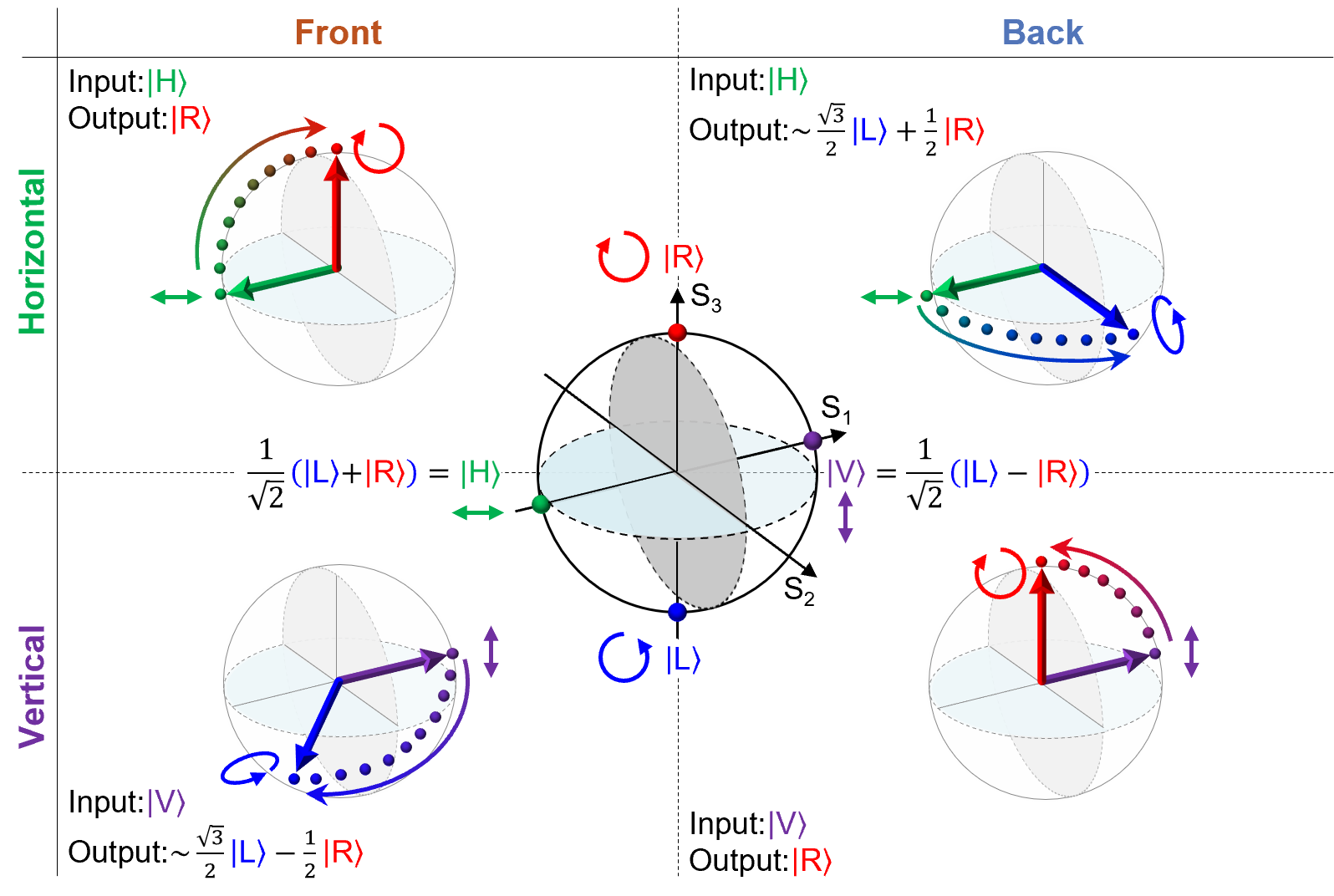

Follow the Topic
-
Nature Materials
A monthly multi-disciplinary journal that brings together cutting-edge research across the entire spectrum of materials science and engineering, including applied and fundamental aspects of the synthesis/processing, structure/composition, properties and performance of materials.




Please sign in or register for FREE
If you are a registered user on Research Communities by Springer Nature, please sign in