Why Does Egypt's Construction Industry Still Waste So Much Material — And What Would It Take to Stop?
Published in Earth & Environment and Civil Engineering


The problem hiding in plain sight
Construction consumes roughly 40% of the world's raw materials, and a huge share of what gets ordered never makes it into a finished building. In Egypt, where the construction sector has been growing faster than almost any other part of the economy, that waste problem is amplified: an estimated 40–50 million tons of construction and demolition waste are generated every year, much of it ending up in landfills that aren't equipped to handle it safely.
What struck us going into this study was how much prior research on Egyptian construction waste stopped at description. Study after study documented what was being wasted, or proposed frameworks for disposal — but far fewer asked practitioners directly: what do you, the people actually running these projects, believe is causing this, and what are you actually doing about it?
Going straight to the people who see it happen
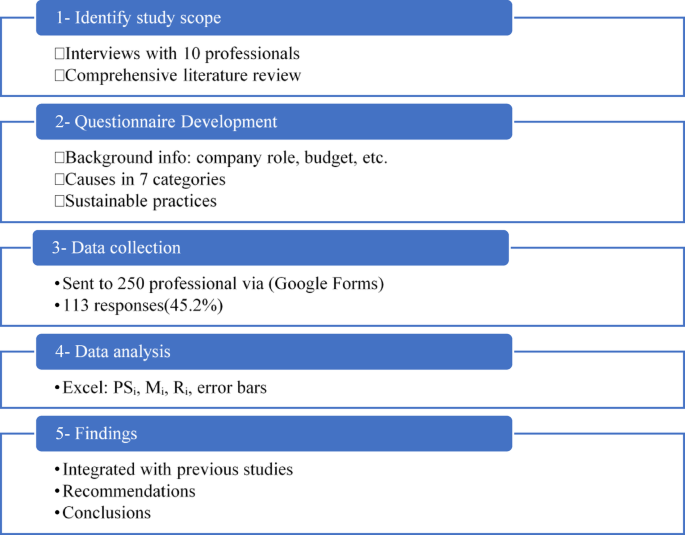
So we built a two-part questionnaire and sent it to 250 construction professionals across Egypt — contractors, consultants, and project owners — and got 113 valid responses back. The survey asked people to do something surprisingly revealing: rank 42 different possible causes of material waste, grouped into seven categories (design, procurement, handling and storage, human factors, management, site conditions, and external factors), from most to least important. Then we asked a second question: which sustainable practices — from waste auditing to BIM adoption to Site Waste Management Plans — are they actually using, not just aware of.
What the data told us
The results didn't confirm what we half-expected going in. We assumed procurement mistakes or material handling would top the list. Instead, human-related causes dominated — lack of skilled labor came out as the single highest-ranked cause of material waste, ahead of poor communication and plain negligence. Site conditions came a close second, with poor site layout and organization ranking as the top issue in that category.
Perhaps the most interesting tension in the data showed up when we asked about sustainable practices rather than causes. When professionals were asked to weigh strategies purely on economics, "Reduce" won clearly (39.8%). But when asked to weigh the same strategies on environmental grounds, "Recycle" won by a wide margin (58.4%). That gap between what's cheap and what's green is, in many ways, the whole policy problem in miniature — and it explains why recycling rates in places with strong regulatory backing (much of Europe) run far ahead of places where the market alone is expected to make it happen (the U.S. sits around 35%, and Egypt faces similar structural gaps).
Why this isn't just an academic exercise
The practical upshot of the study is that a lot of Egypt's construction waste problem doesn't need new technology — it needs training, supervision, and coordination. Waste auditing, efficient resource use, Site Waste Management Plans, and eco-design at the design stage all ranked as the practices professionals see as most effective — and notably, these are mostly organizational fixes, not expensive ones. BIM adoption, while valued for quality control and clash detection, ranked more modestly, likely reflecting real barriers around cost and technical capacity that are worth taking seriously rather than assuming BIM alone will solve the problem.
Where we go from here
We end the paper arguing for an integrated approach: better workforce training, stricter site supervision, proactive design coordination, and — critically — policy reforms like mandating Site Waste Management Plans, since voluntary adoption alone hasn't closed the gap. We also flag a clear next step for the field: using smart technologies (sensor-based tracking, image recognition, predictive waste modelling) to move from ranking causes after the fact to catching them as they happen on site.
Egypt's construction sector doesn't lack awareness of its waste problem. What it lacks, based on what practitioners told us, is the training, structure, and enforcement to act on that awareness consistently.
Read the full paper, "An empirical assessment of material waste drivers and sustainability strategies in Egypt's construction sector," open access in Discover Sustainability (2025) 6:1154. https://doi.org/10.1007/s43621-025-01976-2
Authors: Mohamed M. Ghoneim, Ayman Halabya, Osama Morsy Moussa & Abbas Atef Hassan, Department of Civil Engineering, Military Technical College, Cairo, Egypt

Follow the Topic
-
Discover Sustainability
A multi-disciplinary, open access, community-focussed journal publishing results from across all fields relevant to sustainability research whilst supporting policy developments that address all 17 of the United Nations Sustainable Development Goals (SDGs).

Related Collections
With Collections, you can get published faster and increase your visibility.
Food, Societies and Sustainability: Contemporary Concerns around Local Food Production and Consumption
Food goes far beyond nutrition. It reflects sociocultural identities and territorial heritage, consumption dynamics, economic development, public policies, sustainability concerns, food production, distribution and consumption. Understanding food production and food products, practices and strategies offers key insights into both historical traditions and contemporary lifestyles. Around the world, food and drink serve as powerful symbols of identity and attract interest through diverse value chains, economic interests and cultural expressions. On the other hand, traditional and local food systems contribute to cultural heritage, biodiversity conservation and sustainability matters from environmental, sociocultural and economic concerns.
The Collection "Food, societies and sustainability: Contemporary concerns around local food production and consumption" explores how food is locally produced, promoted and protected through public and private initiatives, food-based experiences, media platforms, and sustainable dietary and productive practices. It encourages contributions that examine how food concerns are shaped in contemporary societies, how globalization is affecting local food cultures, emphasizing the role of food as both tangible and intangible cultural heritage. Food preferences, food stereotypes, and attitudes towards food sustainability, analysed through the lenses of generational gaps and gender differences are also welcomed. This Collection seeks original research and case studies using both qualitative and quantitative methods.
Keywords: Food Systems, Food culture, Food Production, Locality, Heritage, Tourism, Gastronomy, Agricultural Biodiversity, Livestock Biodiversity, Food Sustainability, Regenerative Tourism.
This Collection supports and amplifies research related to SDG 2, SDG 3, SDG 4, SDG 5, SDG 10, SDG 12, and SDG 17.
Publishing Model: Open Access
Deadline: Sep 30, 2026
Clean Water and World Sustainability
Water is the lifeblood of our planet, fundamental to all life forms and a cornerstone of human progress. Yet, despite its critical importance, ensuring universal access to clean and safe water remains a pressing global challenge. In the face of complex issues such as climate change, urbanization, and population growth, the need for sustainable water management has never been more urgent. Water security, quality, and accessibility are integral to fulfilling the United Nations' Sustainable Development Goal (SDG) 6, which emphasizes ensuring the availability and sustainable management of water and sanitation for all. However, the path to water sustainability is laden with challenges, ranging from the pollution and contamination of freshwater resources to the degradation of ecosystems that support vital water cycles.
In this context, the proposed research collection, “Clean Water and World Sustainability”, aims to compile pioneering research that addresses the multifaceted issues surrounding clean water, ecosystem health, and global sustainability. This collection seeks to showcase groundbreaking solutions and interdisciplinary approaches that promote sustainable water practices while considering the broader environmental, economic, and social impacts of water use.
We welcome contributions from scholars worldwide that present original research on topics such as: (i) the impact of industrial and agricultural practices on water quality and availability; (ii) advances in water treatment technologies and wastewater management; (iii) the role of freshwater ecosystems in mitigating climate change; (iv) sustainable water governance models and policy frameworks; and (v) the interaction between water scarcity, human health, and socioeconomic development.
This collection provides a unique platform for researchers to disseminate their cutting-edge findings on transformative solutions to the world’s water crisis and contribute to global sustainability efforts. The research presented will not only inform policy decisions but also empower local communities, industry leaders, and environmental advocates to take action in safeguarding and rejuvenating this invaluable resource.
This Collection supports and amplifies research related to: SDG 6 & SDG 11
Keywords: Water Accessibility and Management; Water Security; Water Treatment Technologies; Sustainable Development; Ecosystem Health; Interdisciplinary Approaches; Sewage/Wastewater Reuse
Publishing Model: Open Access
Deadline: Sep 30, 2026


Please sign in or register for FREE
If you are a registered user on Research Communities by Springer Nature, please sign in