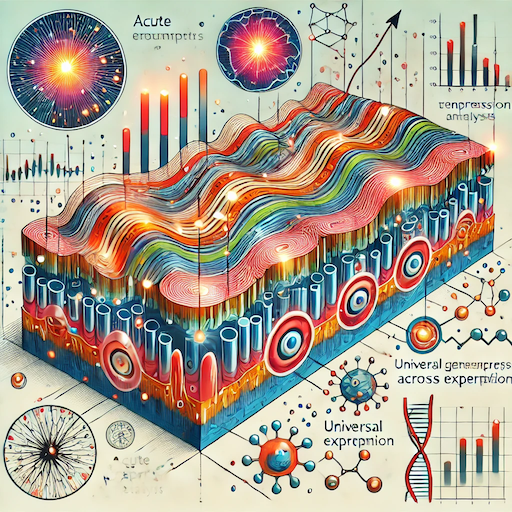

Wound healing is often described as a sequence of stages: inflammation, proliferation, and remodeling. However, this view does not fully capture its spatial and temporal complexity.
In our recent study, now published in PLOS ONE we analyzed a high-resolution porcine wound dataset covering 150 samples across 21 days, sampled from both wound centers and edges.
Rather than focusing on individual genes, we grouped genes into coordinated expression programs representing immune activity, extracellular matrix (ECM) remodeling, epithelial repair, and tissue-specific signals.
Key findings
We observed clear, coordinated dynamics across these biological programs:
Immune activity peaks early, especially in the wound center (days 1–6).
ECM remodeling follows, increasing after the immune response declines.
Epithelial repair remains active at the wound edge, while showing a temporary drop and recovery in the wound center.
Importantly, these processes are not independent or strictly sequential—they overlap in time and differ across wound regions.
A “round-trip” trajectory
When these coordinated patterns are summarized together, they form a simple but striking picture: wound healing follows a loop-like trajectory through functional states, starting and ending in approximately the same "normal" state.
Take-home message
Wound healing is not just a sequence of biological stages - it is a coordinated, spatially structured transition between functional states, resembling a dynamic cycle rather than a straight path.
This work provides a reference framework for understanding acute wound healing and highlights the importance of spatially resolved sampling in transcriptomic studies.
Please sign in or register for FREE
If you are a registered user on Research Communities by Springer Nature, please sign in