A statistically validated stacking ensemble of CNNs and vision transformer for robust maize disease classification







Inspiration
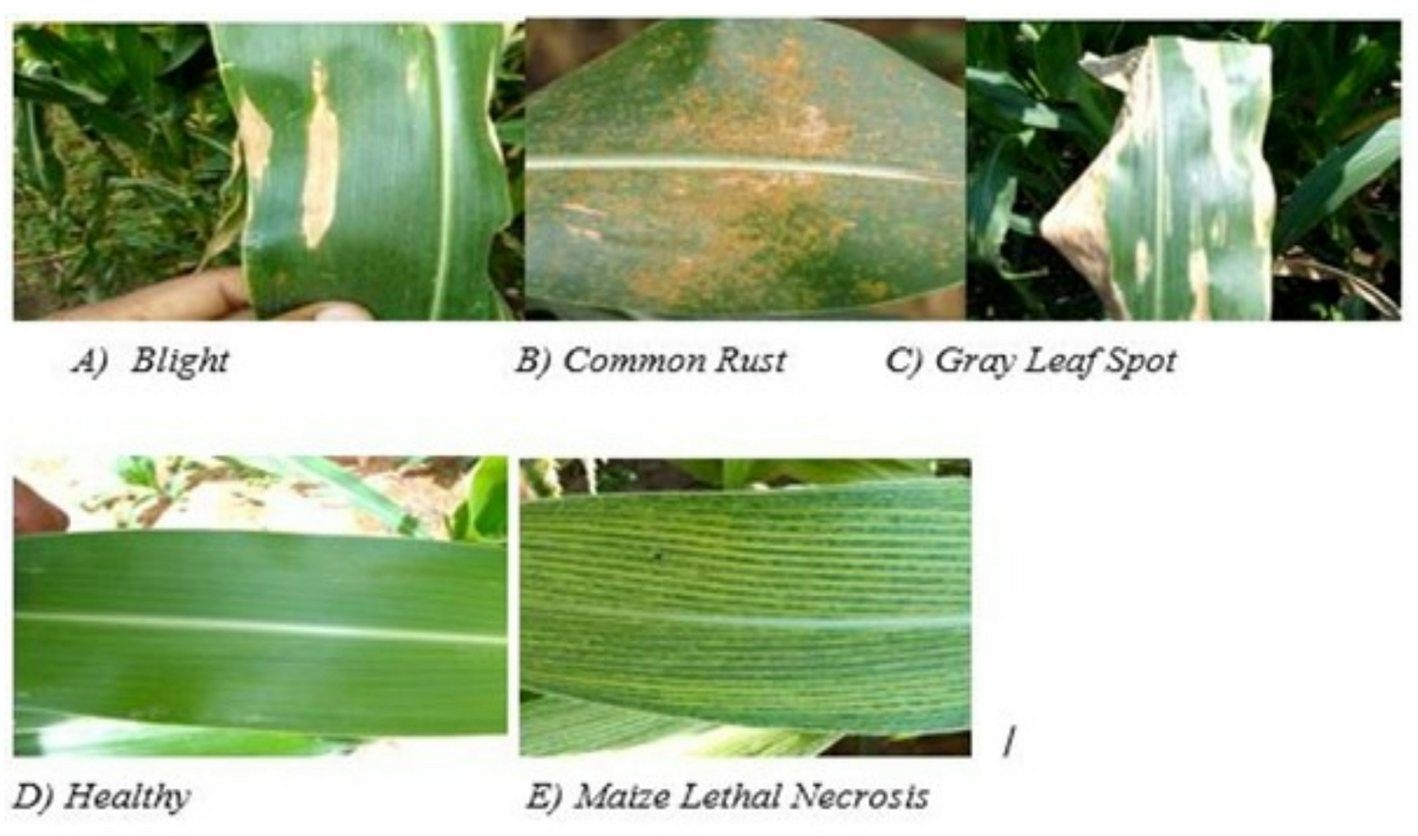
We note that global food security is under increasing pressure from crop diseases. In particular, maize is a staple crop in many countries including Ethiopia, where yield losses due to foliar diseases such as Turcicum Leaf Blight, Common Rust, Gray Leaf Spot and Maize Lethal Necrosis are a serious threat. Traditional visual inspection by farmers or extension agents is labor intensive, subjective and prone to misdiagnosis. Moreover, deep learning and transformer based models have shown promise in plant disease diagnosis via images, but there remain gaps. Thus, we tried to build a robust disease classification model for maize leaves that can:
(1) Apply multiple architectures (CNNs + Vision Transformer) in a heterogeneous stacking ensemble
(2) Provides statistical validation (K-fold, paired t-test) to ensure performance gains are real
(3) Takes into account real world field data (rather than only curated lab images)
(4) Assesses computational cost , so that the solution can be realistically applied (e.g., for Ethiopian farming conditions).
Actions
First, we collected a large dataset of maize‐leaf images: 15,995 images, combining in field smartphone photos from Ethiopia and a public Kaggle dataset. Then, we pre processed images (resizing to 224×224, normalization, median filtering, K-means segmentation to isolate leaf regions) to reduce noise and background variation. Next, we selected several pre trained CNN architectures (DenseNet201, InceptionV3, NASNetMobile, VGG19) and a Vision Transformer (ViT) to act as base learners. Additionally, we built a stacking ensemble: all base models extract features, then a meta learner (a fully connected network) concatenates the feature vectors and learns how to best combine them. We ran stratified five fold cross validation on the training/validation split, and held out an independent test set (~15% of data). We also applied a paired t-test comparing the ensemble vs the best single model to check statistical significance (p < 0.05). Finally, we analyzed computational cost (training time, inference speed) and deployment scenarios.
Outcomes
First, on the hold-out test set, the stacking ensemble achieved 99.15% accuracy. Second, in the five-fold cross‐validation, the mean validation accuracy was 99.13% with a very low standard deviation (~±0.14), indicating high stability. Third, the improvement over the best single model (DenseNet201) was statistically significant (paired t-test, p < 0.05). Fourth, although high-performance, the ensemble comes with the cost of higher inference time (~5× slower than a single DenseNet201) and heavier computational resources (training on a Tesla P100 GPU took ~6.5 h). Fifth, we emphasize that this makes the solution more suited for deployment .
As a result, the heterogeneous stacking ensemble combining multiple CNNs and a Vision Transformer is, according to the researchers, novel in the maize‐leaf disease domain. That means, the rigorous methodological approach: stratified K-fold, paired t-test, comparative benchmarking of heavy vs light models and the field collected data from Ethiopian farms adds real-world variation (lighting, backgrounds, smartphone camera), improving generalizability.
The research dataset is available at: https://doi.org/10.57760/sciencedb.28532
Influencer
For practitioners (agronomists, extension agents, farmers) this model offers a high‐accuracy tool for diagnosing maize leaf diseases in real‐world settings, potentially leading to earlier intervention, reducing misdiagnosis, saving yield and input costs.
Because the research was done in Ethiopia, it is particularly relevant for sub-Saharan Africa and smallholder farming contexts, where smartphone penetration is growing and crop disease diagnosis remains a challenge.
From a research perspective, the work sets a new baseline (99.15% accuracy) for maize-leaf disease classification with field images, and outlines a methodological standard that others can follow or build upon.
Insights
It’s very encouraging to see a research addressing a locally relevant, globally important problem (maize disease) with modern AI methods. The fact that we collected field images makes the work more meaningful and practicable for African agriculture.
The emphasis on statistical validation (paired t-tests) is a welcome step: many papers report high accuracy but don’t show that improvement is statistically significant nor that results are stable across folds. That builds trust.
One thing to watch is how well the model generalizes when the maize plant variety, disease presentation, background vary more widely than the dataset. We note this . For a farmer, tools that “fail” outside their training domain can still harm trust. What matters even more is real‐world usability. We deliver a prototype which is a good start.

A dedicated teaching and research professional with a strong focus on leveraging AI technologies for healthcare, agriculture and manufacturing solutions. His approach is methodical, guided by a well-structured project timeline that includes stages like planning, tool development, data collection, analysis and dissemination.
Follow the Topic
-
Discover Artificial Intelligence
This is a transdisciplinary, international journal that publishes papers on all aspects of the theory, the methodology and the applications of artificial intelligence (AI).

Related Collections
With Collections, you can get published faster and increase your visibility.
Transforming Education through Artificial Intelligence: Opportunities, Challenges, and Future Directions
Artificial Intelligence (AI) is rapidly changing the educational field by enabling personalized learning, intelligent tutoring systems, automated assessments, learning analytics, and administrative automation.
This collection invites original research, systematic reviews, and visionary perspectives on the transformative impact of AI in education. It aims to explore how AI technologies can enhance equity, inclusion, and efficiency in educational settings across different contexts, including higher education, K-12, vocational training, and lifelong learning. This collection will address technical, pedagogical, ethical, and policy aspects, fostering interdisciplinary perspectives and evidence-based insights.
This Collection supports and amplifies research related to SDG 4 and SDG 9.
Keywords: Artificial Intelligence, AI in Education, Educational Technology, Data Analytics, AI Ethics
Publishing Model: Open Access
Deadline: Nov 30, 2026
Advanced AI Methods for Personalized Healthcare
The advancement of Artificial Intelligence (AI) technologies, especially Reinforcement Learning (RL) and Deep Learning (DL), is transforming healthcare, enabling innovative solutions for patient monitoring, diagnostics, and personalized treatment. These technologies facilitate the effective use of healthcare data and intelligent analytics, enhancing clinical decision-making and improving patient outcomes. AI is revolutionizing how healthcare is delivered, making it more proactive, efficient, and accessible. This Collection explores new methods and applications of AI for healthcare such as personalized healthcare. Contributions in this Collection showcase novel frameworks, case studies, and interdisciplinary approaches that drive the future of personalized healthcare, fostering innovations that bridge technology and patient care.
In this context, we are inviting original research articles, reviews, and perspective papers addressing (but not limited to) the following themes:
- Personalized medicine
- IRL for dynamic treatment regimes
- Wireless sensor networks for patient monitoring
- Identification and prevention of critical condition
- Monitoring systems within the medical devices contest
- Methodologies and tools for the rapid integration of WSNs, IoT and AI in health monitoring
- Behavior analysis of patients
- Personalized health-promoting interventions
- Ambient assisted living and active assisted living
- AI security and privacy models for healthcare applications
- AI methods for rehabilitation
Publishing Model: Open Access
Deadline: Feb 27, 2027