Advances in microbial enzyme technology for food processing strategies and applications
Published in Chemistry and Cell & Molecular Biology




Why Microbial Enzymes?
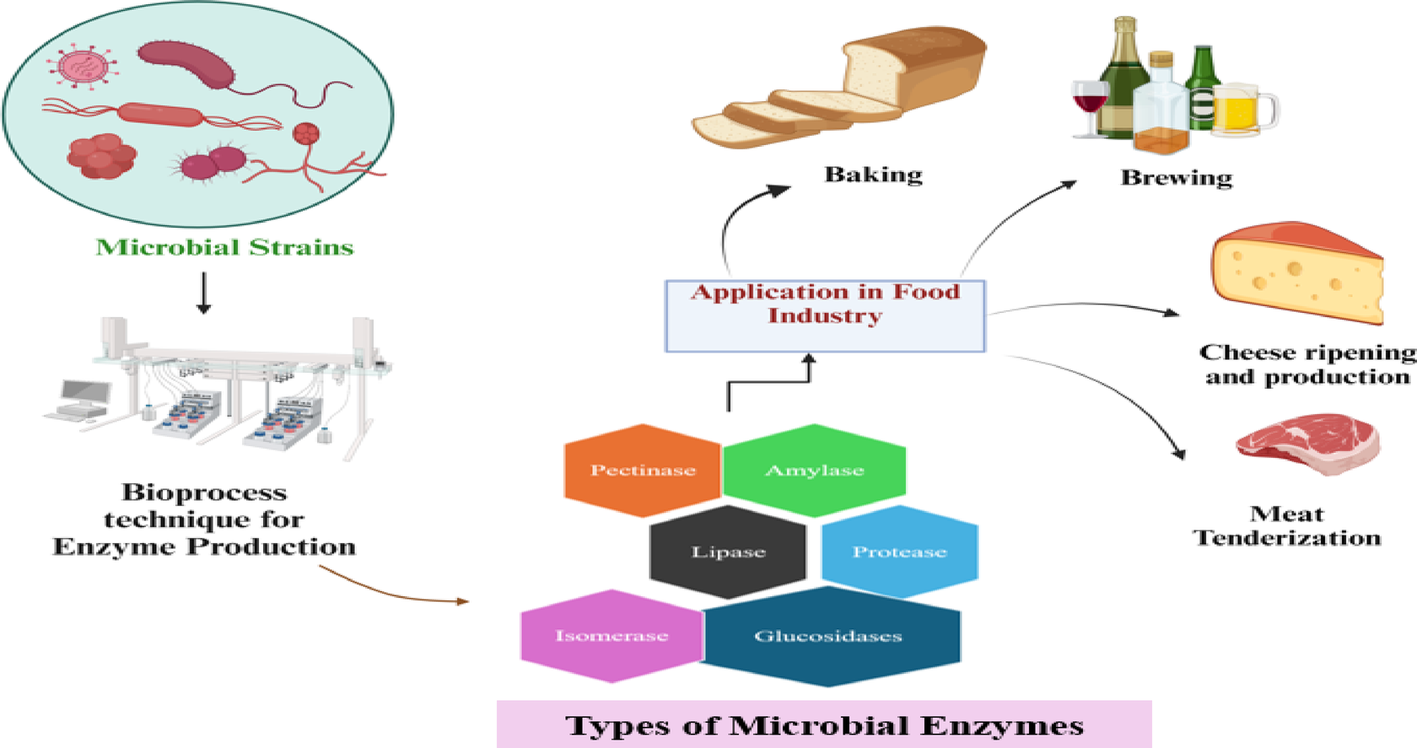
Enzymes are nature’s catalysts—they speed up chemical reactions without being consumed. In the context of food processing, enzymes help break down complex molecules into simpler forms that are easier to digest, taste better, and have longer shelf lives. While enzymes can be extracted from plants or animals, microbial enzymes—produced by bacteria, yeast, and fungi—have rapidly become the preferred choice for industrial applications.
Microbial enzymes offer several advantages:
-
Cost-effective production using fermentation
-
High stability under industrial conditions
-
Scalability for mass production
-
Customizability via genetic and metabolic engineering
These attributes make microbial enzymes invaluable tools for the food industry as it grapples with rising demand and sustainability challenges.
The Big Picture: Research Goals
Our goal was to synthesize the latest technological advances in microbial enzyme research and examine how these innovations are shaping food processing strategies and applications. Rather than narrow laboratory experiments, our article provides a broad, integrative review—highlighting trends in enzyme production, technological breakthroughs, industrial successes, and emerging opportunities for future research and commercialization.
Key areas covered include:
-
Different microbial sources of food enzymes
-
Advances in enzyme production and strain improvement
-
Integration of biotechnology and genetic engineering
-
Applications in food texture enhancement, flavor improvement, and nutritional optimization
By weaving these threads together, we aimed to present a comprehensive picture of the field’s rapid evolution.
Challenges We Encountered
Like most research projects that involve a broad review of an entire field, this work presented several challenges:
1. Scope and Focus
Microbial enzyme technology spans many industries—food, pharmaceuticals, biofuels, textiles, and more. To do justice to the food processing sector, we had to carefully refine our scope without oversimplifying or overlooking key technological aspects.
We balanced this by emphasizing enzymes most relevant to food processing—such as amylases, proteases, lipases, and cellulases—and highlighting their impact across different types of food products.
2. Rapidly Evolving Literature
This field is advancing quickly thanks to breakthroughs in systems biology, fermentation engineering, and computational design. Staying current with the latest enzyme engineering strategies and industrial case studies required careful curation and synthesis of recent publications, patents, and industry reports.
3. Bridging Science and Accessibility
Our audience at Discover Food includes researchers, industry professionals, students, and food enthusiasts. Writing in a way that is technically accurate yet accessible to non-experts was an intentional and rewarding challenge.
What We Found
Here are some of the most exciting insights from our work:
Microorganisms: Nature’s tiny factories
Microbes such as Bacillus, Aspergillus, Saccharomyces, and Trichoderma species remain cornerstone enzyme producers due to their rapid growth, robustness, and adaptability. These microbes are harnessed to produce enzymes like:
-
Amylases for breaking down starches
-
Proteases for protein modification
-
Lipases for fat transformation
These enzymes improve food texture, flavor, digestibility, and shelf life.
Enhanced Production through Biotechnology
Recent advances in genetic engineering allow scientists to modify microbial strains to:
-
produce higher enzyme yields
-
express enzymes under controlled conditions
-
tailor enzyme activity to specific food applications
Tools like CRISPR, metabolic pathway editing, and systems biology approaches are now central to enzyme strain development—opening new frontiers for custom-designed biocatalysts.
Sustainability and Circularity
Enzymatic processing reduces energy demands and chemical waste compared to traditional methods. For example:
-
enzymatic hydrolysis of starches uses less heat and water
-
enzyme-based clarification replaces harsh filtration chemicals
This aligns with global efforts to make food production more sustainable and resource-efficient.
Implications for the Future
The ripple effects of microbial enzyme innovation extend far beyond improving current food processes. We anticipate:
-
New food product categories with enhanced nutritional profiles
-
Improved plant-based food textures through targeted enzyme use
-
Waste valorization using enzymes to upcycle food byproducts
-
Precision fermentation platforms producing bespoke enzymes for personalized nutrition
There’s also enormous potential for integrating machine learning and bioinformatics to discover novel enzymes and predict their function before lab testing—dramatically accelerating innovation timelines.
Personal Reflections
Working on this review was a deeply enriching experience. It reminded me of how tiny organisms can have a gigantic impact on global food systems. Microbial enzymes might be invisible to consumers, but they are behind many of the foods that define modern diets, from tender bread to dairy alternatives and beyond.
I’m also grateful for the collaborative nature of this field—where microbiologists, food scientists, engineers, and industry partners work together toward shared goals of quality, sustainability, and innovation.
Final Thoughts
The future of food processing is intertwined with microbial enzyme technology. As global food demand rises and environmental pressures mount, these natural catalysts offer powerful solutions that are efficient, adaptable, and aligned with sustainable development goals.
We hope this paper and this Behind the Paper post inspire others—students, researchers, and industry innovators—to explore the potential of enzymes in transforming the way we make, enjoy, and think about food.
here is the link of the paper-https://link.springer.com/article/10.1007/s44187-025-00779-8

Follow the Topic
-
Discover Food
This is a transdisciplinary, open access journal that provides a leading platform for the rapid dissemination of knowledge and advances covering the research and innovation that is taking place across the food sector.

Related Collections
With Collections, you can get published faster and increase your visibility.
Food, Sustainability, and Public Health: Linking SDGs for Global Nutrition and Responsible Consumption
This Collection, which differs from other existing food security and sustainability Collections, emphasizes the existing links between sustainable and healthy food production and consumption, exemplified by the Mediterranean Diet, in its cultural, societal, and preventive health dimensions; and Public Health, considered beyond human health to also include animal, plant, and environmental health, in a One Health and Planetary Health approaches.
Thus, with this Collection we intend to publish high quality research, concerning strategies that allow achieving the goals set out in SDGs 2, 3 and 12, which are linked among each other by the theme “Food”, and their relationship with others SDGs, namely 13 and 15. However, other approaches included in the other SDGs, but which somehow have associated food/nutrition issues and optimization of natural resources are welcomed, accepting manuscript proposals, in the form of original research papers, review articles and systematic reviews, including but not limited to the following topics:
• Access for all people, particularly the ones at risk, to a quantity of food that meets the nutritional needs of each group, or growth phase/physiological state;
• Implementation of resilient agricultural practices that increase productivity and production, that help maintain ecosystems, that strengthen the capacity to adapt to climate change, extreme weather conditions, droughts, floods and other disasters, and that progressively improve quality of earth and soil;
• Maintenance of the genetic diversity of seeds, cultivated plants, farmed and domesticated animals and their respective wild species, managed appropriately at the national, regional and international levels, and ensuring access and fair and equitable benefit sharing the use of genetic resources and associated traditional knowledge;
• Premature mortality, non-communicable diseases, mental health and regular and nutritious food;
• Food/nutrition, One Health approach and sustainable food production;
• Nutritious and sustainable diets;
• Population growth and food production;
• Food production and the deterioration of natural resources and greater urbanization, water, farmland and rural labor;
• Methodological innovations, such as life cycle assessment, big data analytics, and digital health tools, which can provide modern frameworks for assessing food systems sustainability and their public health outcomes;
• Stress urban food environments, food deserts, and city-level interventions.
Keywords:
Climate changes and food systems; Climate-smart nutrition; Consumer behavior; Determinants of food choices; Eating behavior; Food security; Food systems transformation Food, health and society; Health and wellbeing; Health communication and literacy; Health promotion; Healthy diets for a healthier planet; Non-communicable diseases; Nutrition and food literacy; Nutrition and lifestyle; One Health; Planetary Health; Public health policy; Resilient diets; Responsible production and consumption patterns; Sustainable agriculture; Sustainable consumption and production; Sustainable Development Goals; Zero Hunger
This Collection supports and amplifies research related to the following SDG: Of the 17 Sustainable Development Goals (SDGs), 3 of them (2, 3 and 12) are directly linked to the theme of healthy and sustainable eating and production systems, and 2 others (13 and 15) are related:
• SDG 2: End hunger, achieve food security and improved nutrition and promote sustainable agriculture.
• SDG 3: Ensure healthy lives and promote well-being for all at all ages.
• SDG 12: Ensure sustainable consumption and production patterns.
• SDG 13: Climate Action.
• SDG 15: Life on Land.
Publishing Model: Open Access
Deadline: Sep 30, 2026
Emerging Trends in Fermented Dairy and Non-Dairy Products: Fermentation Technologies, Innovations, and Health Benefits
Fermented dairy and non-dairy products have garnered significant attention in recent years due to their perceived health benefits, diverse flavors, and nutritional profiles. This collection explores the latest trends and advancements in these fermented products, focusing on fermentation technologies, innovations, and their potential health benefits.
The collection delves into the evolving landscape of fermentation technologies applied to both dairy and non-dairy substrates. It examines innovative techniques and methodologies aimed at enhancing product quality, flavor development, and nutritional content. Topics include novel microbial cultures, fermentation conditions optimization, and the integration of advanced processing technologies.
Scientific insights into the health-promoting properties of fermented dairy and non-dairy products are a central theme. Contributors explore the role of probiotics, prebiotics, and bioactive compounds generated during fermentation in supporting digestive health, immune function, and overall well-being. Discussions encompass the impact of fermentation on nutrient bioavailability and the potential therapeutic applications of fermented products.
Drawing from diverse disciplines such as food science, microbiology, and nutrition, this collection bridges scientific research with practical applications. It fosters cross-disciplinary dialogue on fermentation technologies, innovations, and their implications for public health and sustainable food systems. This collection is designed for researchers, industry professionals, policymakers, and educators interested in the latest developments and future directions of fermented dairy and non-dairy products. It serves as a comprehensive resource for understanding the scientific underpinnings, technological advancements, and market dynamics shaping this rapidly evolving field.
Keywords: Fermentation technologies; dairy and non-dairy products; Probiotics; Prebiotics; Bioactive compounds; Microbial cultures; functional properties; health benefits
Publishing Model: Open Access
Deadline: Sep 30, 2026