Advancing Sustainable Road Infrastructure through Life Cycle Assessment (LCA)
Published in Sustainability and Civil Engineering
The transition toward sustainable transportation systems demands a critical evaluation of materials used in road construction. Life Cycle Assessment (LCA) has emerged as a robust framework to quantify environmental impacts across the entire lifespan of infrastructure—from raw material extraction to end-of-life disposal. 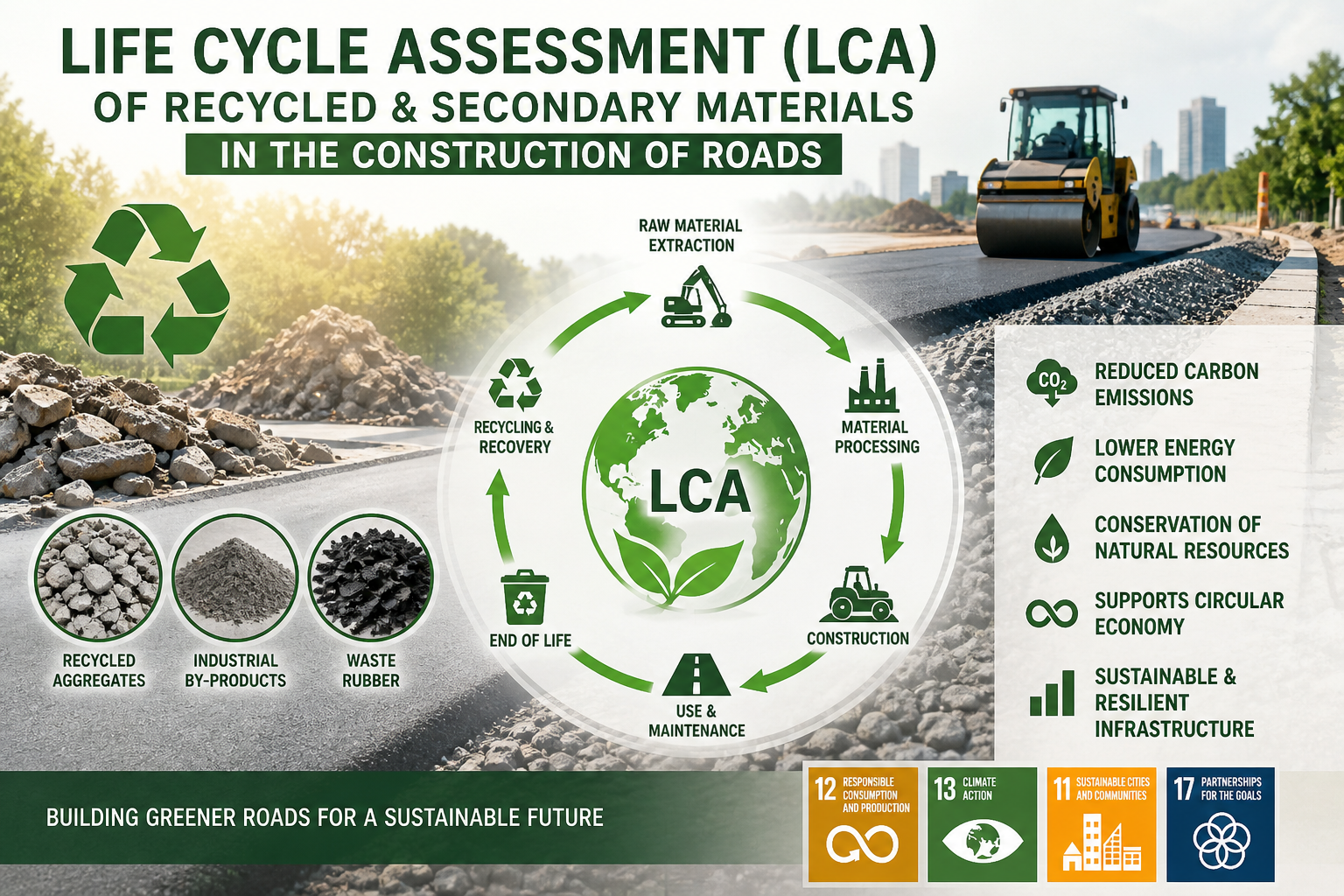
Our recent work highlights the transformative potential of recycled and secondary materials in reducing carbon footprints, energy consumption, and resource depletion in road construction:
Sharma, S. N., Lodhi, A. S., Dehalwar, K., & Jaiswal, A. (2024). Life cycle assessment of recycled and secondary materials in the construction of roads. IOP Conference Series: Earth and Environmental Science, 1326(1), 012102. https://doi.org/10.1088/1755-1315/1326/1/012102
Key Insights:
- Recycled aggregates, industrial by-products, and secondary binders significantly reduce embodied energy and emissions
- LCA enables evidence-based decision-making for sustainable material selection
- Integration of innovative materials aligns with circular economy principles and SDG 12 (Responsible Consumption and Production)
This research builds upon a broader body of work exploring advanced materials and sustainability in urban infrastructure, including:
- Permeable paving, biocrete, and piezoelectric materials for transit-oriented walkways (Sharma et al., 2026, De Gruyter)
- Urban water quality and environmental health management (Sharma et al., 2026)
- Waste management, AI integration, and sustainable construction practices (Springer Nature, Elsevier contributions)
Notably, our edited volumes with Springer Nature further expand this discourse:
- Deltas Resilience: Nature-Based Solutions for Sustainable Development in India (2026)
- Urbanisation and Waterscapes: Resilience and Sustainability in Urban Deltas (2026)
💡 Way Forward:
Embedding LCA into policy, design, and implementation processes can redefine how we approach infrastructure development—shifting from cost-centric to sustainability-driven planning.
Let’s continue to bridge engineering innovation, environmental stewardship, and policy integration for resilient and future-ready transport systems.
#SustainableInfrastructure #LifeCycleAssessment #CircularEconomy #RoadConstruction #SpringerNature #SDG12 #UrbanPlanning #GreenEngineering
References
Kumar, G., Vyas, S., Sharma, S. N., & Dehalwar, K. (2024). Challenges of environmental health in waste management for peri-urban areas. In M. Nasr & A. Negm (Eds.), Solid waste management (pp. 149–168). Springer Nature Switzerland. https://doi.org/10.1007/978-3-031-60684-7_9
Don Eliseo Lucero-Prisno III,Dauda Ayuba Sr.,Anna Yunana Akinga,Kolawole Emmanuel Olayinka,Fadele Kehinde Precious,Jerico Bautista Ogaya,Shashikant Nishant Sharma,Eda J. Opina,Abraham Fessehaye Sium,Carina Joane V. Barroso,Lin Xu,Ryan C. Guinaran,Jannet Bondad,M.B.N. Kouwenhoven (2025). Impact of climate disaster, migration and health risk on food security in Africa. In Advances in food security and sustainability. Elsevier. https://doi.org/10.1016/bs.af2s.2025.08.003
Ogbanga, M. M., Sharma, S. N., Pandey, A. K., & Singh, P. (2025). Artificial intelligence in social work to ensure environmental sustainability. In M. Nasr, A. Negm, & L. Peng (Eds.), Artificial intelligence applications for a sustainable environment (pp. 1–??). Springer. https://doi.org/10.1007/978-3-031-91199-6_16
Sharma, S. N., Dehalwar, K., & Singh, J. (2024). Emerging techniques in solid waste management for a sustainable and safe living environment. In M. Nasr & A. Negm (Eds.), Solid waste management (pp. 29–51). Springer Nature Switzerland. https://doi.org/10.1007/978-3-031-60684-7_3
Sharma, S. N., Dehalwar, K., Jain, S., & Pandey, A. K. (2025). An assessment of the applications and prospects of AI tools in solid waste management. In M. Nasr, A. Negm, & L. Peng (Eds.), Artificial intelligence applications for a sustainable environment. Springer. https://doi.org/10.1007/978-3-031-91199-6_4
Sharma, S. N., Lodhi, A. S., Dehalwar, K., & Jaiswal, A. (2024). Life cycle assessment of recycled and secondary materials in the construction of roads. IOP Conference Series: Earth and Environmental Science, 1326(1), 012102. https://doi.org/10.1088/1755-1315/1326/1/012102
Sharma, S. N., Prajapati, R., Jaiswal, A., & Dehalwar, K. (2024). A comparative study of the applications and prospects of self-healing concrete / biocrete and self-sensing concrete. IOP Conference Series: Earth and Environmental Science, 1326(1), 012090. https://doi.org/10.1088/1755-1315/1326/1/012090
Sharma, S. N., Singh, S., Kumar, G., Pandey, A. K., & Dehalwar, K. (2025). Role of green buildings in creating sustainable neighbourhoods. IOP Conference Series: Earth and Environmental Science, 1519(1), 012018. https://doi.org/10.1088/1755-1315/1519/1/012018
Sharma, S. N., Dehalwar, K., Singh, J., & Kumar, G. (2025). Prefabrication building construction: A thematic analysis approach. In S. B. Singh, M. Gopalarathnam, & N. Roy (Eds.), Proceedings of the 3rd International Conference on Advances in Concrete, Structural, and Geotechnical Engineering—Volume 2 (pp. 405–428). Springer Nature Singapore. https://doi.org/10.1007/978-981-96-0751-8_28

Shashikant Nishant Sharma is a distinguished scholar and practitioner in the field of development studies, widely recognised for his contributions to planning, management, and sustainable development. Having a B Plan from SPA Delhi, MURP from IIT Roorkee, PGDDM from IGNOU Delhi and a PhD from MANIT Bhopal, India, has wide educational exposure. He is the author of 20 books that critically engage with issues of urban planning, policy, sustainable development and governance. Currently, he serves as the Head of Research at Track2Training, an NGO he co-founded to advance training, capacity building, and skill development initiatives. He has also contributed to academia as an Assistant Professor at NIT Calicut and as a Guest Faculty at UPES Dehradun, where he taught and mentored future professionals. His work bridges the gap between academic research and practice, making him a prominent voice in contemporary development discourse.