Against single-day histories: Reading Palestine through South Africa's unfinished work
Published in Social Sciences, Sustainability, and Law, Politics & International Studies


The genocide unfolding in Gaza is too often framed through a single, cataclysmic date – October 7, 2023. South Africa's democratic transition is too often reduced to another – April 27,1994. Both framings are ethically disabling. They compress structures of domination into moments, occlude the long durations of dispossession, and blunt the obligations of institutions to prevent, remedy, and repair.
This is the central claim of my new paper in the Journal of Bioethical Inquiry, "Against Single-day Histories: Complexity and Care for Palestine Through a South African Lens." Building on the United Nations Independent International Commission of Inquiry's September 2025 legal analysis – which finds Israel responsible for genocidal acts and for failures to prevent and punish – I argue that ethics in the face of genocide must reacquire time and procedure. South Africa, with its own long durations of apartheid violence and its uneven reparative archive, offers a lens that is at once humbling and clarifying.
Two concepts, one orientation
The paper advances complexity and care as an integrated ethical orientation.
Complexity, in this usage, is not a hedge against judgment. It is a duty to read systems – to move beyond episodic facts toward the patterned relations among policies, institutions, and harms. The Commission's (2025) pattern-of-conduct method exemplifies this. It aggregates direct evidence (officials' statements) with circumstantial evidence (siege, starvation, attacks on healthcare, reproductive harm, the targeting of children) and asks whether genocidal intent is the only reasonable inference from the totality of conduct. Complexity, properly understood, commits ethics to method.
Care, in this usage, is not sentiment. It is operational obligation with timelines, agents, and verifiable effects. The Commission's (2025) recommendations make this crisp: cease genocidal conduct, restore unimpeded humanitarian access, enable medical evacuation, halt arms transfers, investigate complicity, cooperate with international justice. Genocide's prohibition is jus cogens; the duty to prevent and punish is erga omnes – owed to all. These are not optional gestures of compassion. They are the institutionalisation of care as law.
Why South Africa is the lens
South African intellectual resources help us see what otherwise gets obscured. Gobodo-Madikizela (2023), working with the Truth and Reconciliation Commission archive, theorises a triadic temporality of trauma — a crossing and re-crossing of past, present, and anticipated future. The afterlife of apartheid is not a haunting from somewhere else. It is lived in the present and projected forward, generating a predictive temporality that demands reparative intervention now.
This matters for Palestine because it makes legible what the Commission's (2025) legal frame already implies: events in Gaza since October 2023 "have not occurred in isolation." They are continuous with decades of unlawful occupation, racial segregation, and an ideology of removal. Single-day framings collapse this; triadic temporality keeps it in view.
It matters for South Africa too. From Marikana to service-delivery protest killings, the repetition of violence reveals the limits of a transition that celebrated a single date without transforming the structures that produced harm. The Truth and Reconciliation Commission opened a space for naming structural violence – including through embodied, non-verbal, and culturally specific testimony – but commemorative rituals and declarative reconciliations have not, by themselves, interrupted the matrix that reproduces injury.
Ethics as design, not exhortation
The paper translates this synthesis into institutional design rules: representation as a knowledge practice rather than an attendance list; testimonial parity so that those most harmed are treated as decision-relevant; auditable reason-giving that tracks the Commission's (2025) pattern domains; material and traceable remedies; and iterative public review. The aim is to relocate ethics from exhortation to enforceable procedure.
This is where the paper meets the rest of my work. My research on transformation and governance in South African higher education argues that governance cannot be reduced to compliance, that procedures must be capable of bearing ethical weight, that lived experience must count as knowledge. "Against single-day histories" extends those commitments to the question of what universities, municipal councils, multilateral bodies, and states must do – now – in the face of an ongoing genocide.
The unfinished work, here and there
In the paper I write that "the South African lesson is that such translation is possible and necessary but never finished." I cite the contrast between the University of Cape Town, which adopted a Gaza resolution and has since navigated the backlash that followed, and Stellenbosch University, where the Senate voted against its own Gaza motion. These are not abstract case studies. They are live institutional decisions in which the design of governance – who speaks, what counts as evidence, how reasons are recorded, how remedies are enacted – determines whether ethics becomes design or decorum.
For me, the comparison is also personal. My earlier work on transformation and governance in the South African public university system (link to publication), and my time inside Stellenbosch University's statutory governance bodies, was where I first watched ethical claims get reduced to symbolic gestures and procedural delay. To write about Palestine through a South African lens, then, is not to claim distance. It is to acknowledge that the same patterns of avoidance, the same retreats into proceduralism, the same compressions of history, recur. The work of complexity and care travels.
A practice of governance over time
The paper closes with a claim I want to underline here. The question of whether ethics can assist resolution and chart a path to just peace can only be answered in the affirmative if ethics reacquires time and procedure. The Commission's (2025) doctrine supplies the former;
South Africa's reparative archive supplies the latter. Together they suggest that the way out of colonial temporality is not through new slogans but through procedures of care that are historically grounded, pattern-attentive, and capable of preventing the repetition that triadic temporality forewarns.
Palestine and Gaza demand nothing less. So does the future we keep making in the present.
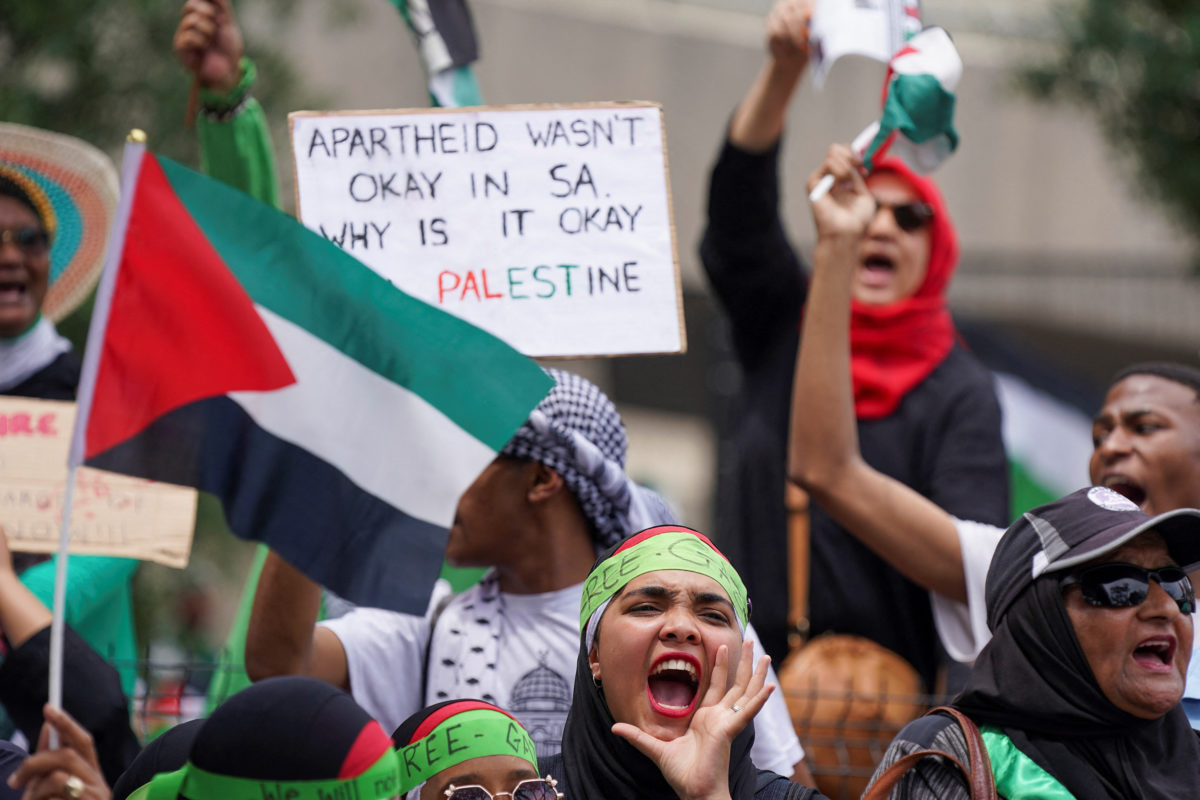
[Poster image, by Nic Bothma, is of demonstrators protesting in Cape Town, South Africa, in support of Palestinians, amid Isreal's ongoing war in Gaza, on November 01, 2023.]

Bryan Jason Bergsteedt is a doctoral candidate, studying a Doctor of Education (DEd) in Educational Leadership and Management, at the University of Pretoria. His research draws on Complexity Theory, ethical leadership, and socioemotional dynamics, to explore how systems of governance can advance equity, social cohesion, and nation-building. He holds a Postgraduate Diploma in Leadership Development (cum laude), from Stellenbosch Business School, graduating top of his cohort. He received undergraduate and postgraduate qualifications at faculties of Science, Medicine and Health Sciences, and Economic and Management sciences, at Stellenbosch University.
Bryan has held multiple executive governance roles, including Chairperson of the Institutional Forum, and Council Member, at Stellenbosch University, contributing to policy reform, transformation oversight, and strategy. His interdisciplinary background spans governance, education, and multilateralism, with over a decade of experience in teaching and academic leadership in the higher education sector.
He recently attended the 63rd United Nations Graduate Study Programme, in Geneva, as the sole South African representative, and represents South Africa on the Global Youth AI Advisory Body – a global network of emerging leaders examining the intersection of artificial intelligence and its impact on humanity. His lived experiences continue to shape his advocacy for inclusive, ethically grounded approaches to governance and policy.
Follow the Topic
-
Journal of Bioethical Inquiry
This is an international, multidisciplinary, peer-reviewed journal that publishes scholarly papers and commentary across the range of issues that arise within the field of bioethics.


Please sign in or register for FREE
If you are a registered user on Research Communities by Springer Nature, please sign in