Analog Memristive Generative Adversarial Networks for Edge AI Computing
Published in Electrical & Electronic Engineering

Explore the Research
 Nature
Memristive GAN in Analog - Scientific Reports
Scientific Reports - Memristive GAN in Analog
The Generative Adversarial Networks (GAN) [1] is a subclass of generative models that are able to produce or generate new content. The simplicity of implementing GAN algorithms makes it attractive and popular as a data-driven generative model. They are popular for generating fake multimedia and recently gaining interest in COVID19 research for discovery of molecular structures. However, GANs are notoriously difficult to train, with training being a time-consuming and computationally intensive process. The GANs today are implemented on systems requiring high computational capacity having high energy consumption. If we were to bring GANs on edge devices for near sensor computing, we would need energy-efficient solutions.
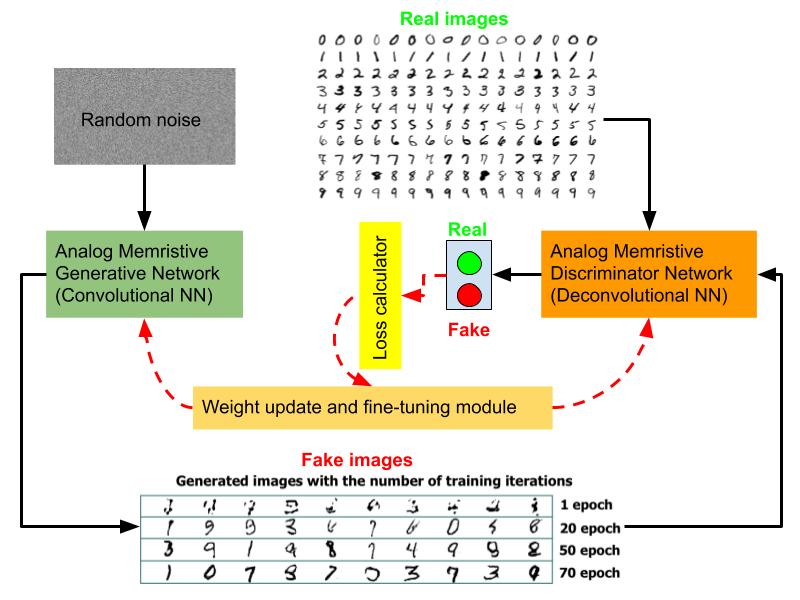
Fig 1. A simplified block diagram of analog memristive GAN
The memristive devices in crossbar are well-known today as a possible way to implement dot-product computations required for implementing analog neural networks. Crossbar [2] like memristor array configurations can be used to implement convolutional networks and multi-layer neural networks. Taking a step ahead from the conventional approaches, the analog GAN with memristors implements an area and energy-efficient approach to realise GAN operations in the analog domain, capable of being integrated near to image sensors as a low power near sensor AI computing solution. Fig 1 shows the overview of the analog GAN system that can be implemented on-chip.

Fig 2. Results of the fake images generated by analog GAN even with failures and variability of the memristor devices
While the non-idealities of memristors [3] and circuit parasitics are of primary concern in neuro-memristive analog circuits, the analog GAN shows a high level of tolerance to the variabilities (Fig 2). Although, learning the GAN under noisy conditions is known to be compensated with tuning and manipulation of objective criteria, it is a new finding that hardware noise can be tolerated in analog GAN implementations. The possibility to have an on-chip hardware-accelerated solution for inference and learning stages of GAN, close to natural sensing signals, would have a large impact on the way in which GAN applications are designed for edge AI computing devices.
Read the paper: Memristive GAN in Analog
1.Goodfellow, Ian, Jean Pouget-Abadie, Mehdi Mirza, Bing Xu, David Warde-Farley, Sherjil Ozair, Aaron Courville, and Yoshua Bengio. "Generative adversarial nets." In Advances in neural information processing systems, pp. 2672-2680. 2014.
2. Kim, Kuk-Hwan, Siddharth Gaba, Dana Wheeler, Jose M. Cruz-Albrecht, Tahir Hussain, Narayan Srinivasa, and Wei Lu. "A functional hybrid memristor crossbar-array/CMOS system for data storage and neuromorphic applications." Nano letters12, no. 1 (2012): 389-395.
3. Sangwan, Vinod K., and Mark C. Hersam. "Neuromorphic nanoelectronic materials." Nature Nanotechnology (2020): 1-12.

Follow the Topic
-
Scientific Reports
An open access journal publishing original research from across all areas of the natural sciences, psychology, medicine and engineering.

Related Collections
With Collections, you can get published faster and increase your visibility.
Cancer Prevention and Control
Publishing Model: Hybrid
Deadline: Feb 19, 2027
Healthy Aging
Publishing Model: Open Access
Deadline: Dec 31, 2026